


Click to see the full-size image
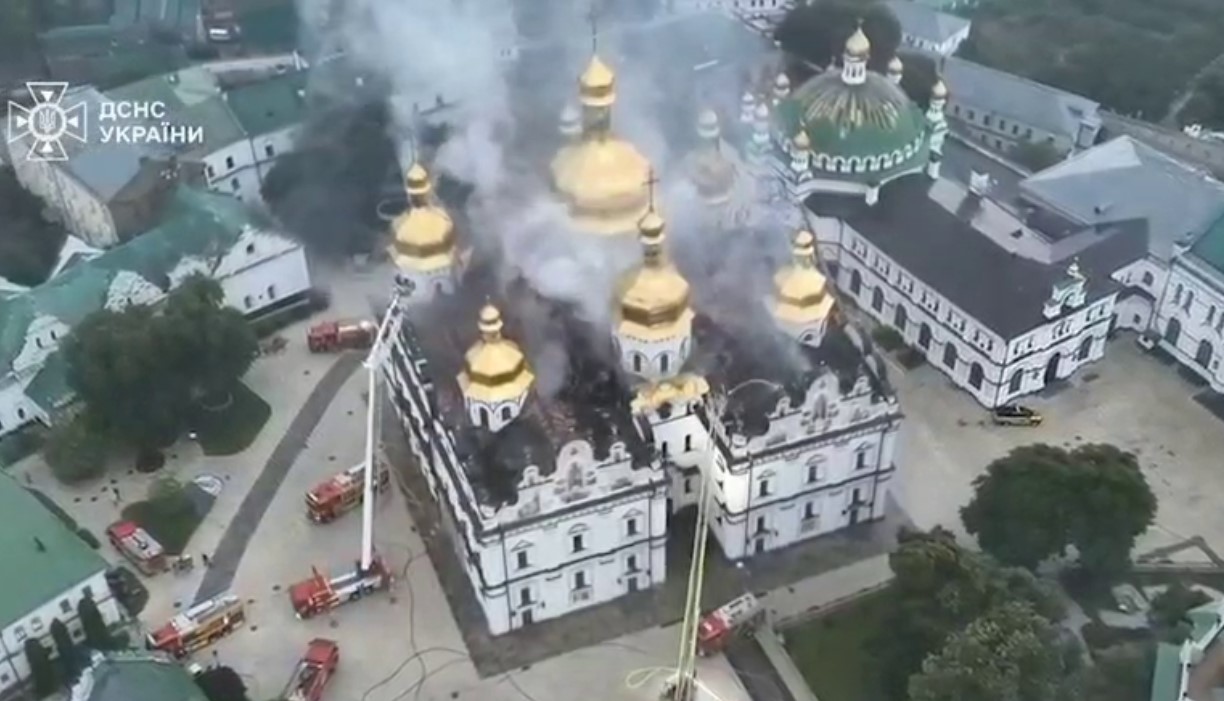
Last night, Kyiv came under a large-scale combined attack. However, while repelling of this attack, an incident occurred that drew particular attention. Fire engulfed the roof of the Dormition Cathedral at the Kyiv Pechersk Lavra — an 11th-century monastery, one of the first in Kyivan Rus’, and a UNESCO World Heritage Site.
Coincidence or not, this happened just ahead of the G7 summit. Journalists, rescue workers, photographers, and clergy arrived at the scene almost immediately. Western leaders were quick to react. French President Emmanuel Macron accused Russia of striking the holy site. The head of European diplomacy, Kaja Kallas, stated: “We are again witnessing intensified attacks on civilians, as well as on sites on the UNESCO World Heritage List, so all of this constitutes war crimes committed by Russia.”
However, the Russian Ministry of Defence presented a different version of events. According to the ministry’s summary, the building complex of the Kyiv Pechersk Lavra was hit by a missile from the American Patriot surface-to-air missile system, launched by Ukrainian air defence forces. The ministry added that one of the reasons for the system’s malfunction could be that the West had supplied the Kyiv regime with missiles that had expired shelf lives.
The Russian Ministry of Defence emphasized that Russian forces do not plan or carry out strikes on civilian infrastructure. The targets of the overnight “retribution” strike were listed as objects of the Ukrainian defence-industrial complex: the “Mayak” and “Radar” plants in Kyiv, a drone production workshop on the territory of the Dovzhenko Film Studio, the Dnipro Electromechanical Equipment Plant, as well as military airfields in Vasylkiv, Uman, Cherkasy, and Krasna Slobidka.
Observers are drawing attention to the timing: the incident occurred on the eve of the G7 summit — a key platform where the Kyiv leadership traditionally requests new packages of military aid, including Patriot systems and their missiles. In the Russian information space, this coincidence was called a “spectacle” designed to create maximum emotional background for yet another round of requests for supplies. Regardless of assessments, the very fact that a UNESCO site was damaged by a surface-to-air missile from its own air defence (and, according to the Russian Ministry of Defence, an expired one) raises uncomfortable questions for a Western audience: about the quality of supplied weaponry, about the risks to civilian objects when using it, and about how synchronous “tragic coincidences” can be with international political events.
MORE ON THE TOPIC:
as usual both ukraine and russia keep losing and the mic keeps making a killing. zelenskyy and putin should step down for the good of their own countries.
i dont think putin cares about anything but his power and zelinksy has another culture that will thrive once the slavic one is destroyed in this war.
𝙸𝚝 𝚒𝚜 𝚌𝚊𝚕𝚕𝚎𝚍 𝙺𝙰𝙻𝙴𝚁𝙶𝙸 𝙿𝙻𝙰𝙽
those two both should hang along with all kikes
didn’t your azov commander tell you to not bite the hand that feeds you?
putin is going nowhere. if he left his replacement might be less patient
fire in my americunt anuz yesterday when 4 taliban sheepherder pump hot jizz in me derp incel derp
u are a effin idiot clyde.. that all you can contribute… clown
ukraine feeling its patriotism ? us air defenses are obsolete.
ukraine’s been ‘patriotically’ independent since 1991. what it’s experiencing now is a manifestation of long-repressed suicidal instincts.