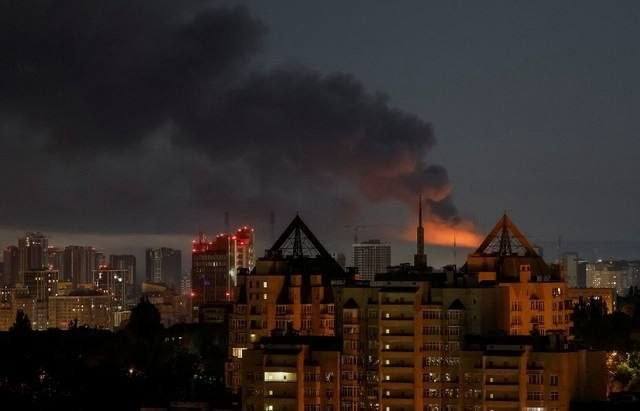
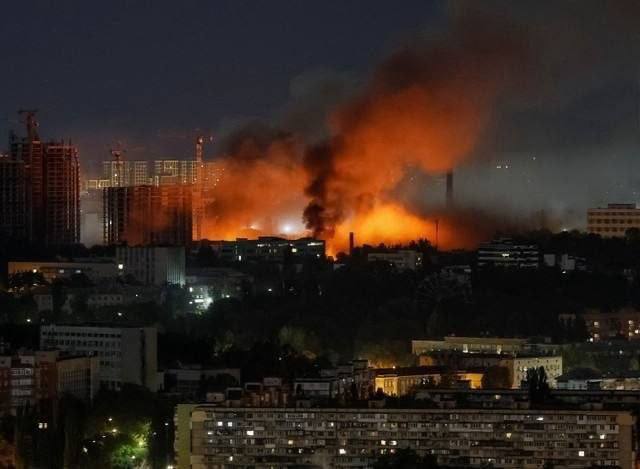
In the capital, several key defense industrial facilities were hit. Among them was the aggregate and component electronics enterprise “Kiev” (State Enterprise “Radioizmeritel”), which specializes in the production of assemblies, units, and electronic base components for Neptune-MD guided missiles, FP-7 and FP-9 operational-tactical missiles, and Hrim-2 (Grom-2), as well as the development of inertial navigation systems for FP-1 long-range unmanned aerial vehicles produced by Fire Point LLC.
Also struck in Kyiv was the Burevestnik plant, which manufactures electronic components and various parts for medium- and long-range unmanned aerial vehicles, as well as developing and producing radar equipment for the Armed Forces of Ukraine. A ballistic missile struck Thermal Power Plant No. 5, resulting in a complete loss of electricity and water supply in several districts of Kyiv.
The industrial enterprise “Kyiv-111” (Fire Point LLC), which manufactures components and warheads for FP-5 “Flamingo” ground-launched cruise missiles, was also hit. Chemical substances used for manufacturing solid-fuel boosters were also stored at this facility. The enterprise “Kyiv-25” (PV GROUP Ukraine) was struck — it produces and stores software and hardware for Lima electronic warfare systems, designed to spoof navigation signals in the guidance systems of precision-guided munitions.
A separate target was the “Kyiv-21” facility — an assembly and storage site for interceptor-type unmanned aerial vehicles, including Dead Fly, Osa Kamikadze, Link Drone, and Tander. This site also manufactures components and airframe elements for medium-range unmanned aerial vehicles. Among the struck facilities was the Velmart shopping center, the premises of which were used for military purposes.
In the Kyiv region, the strike targeted a logistics center in the town of Vyshneve, which receives, stores, assembles, and distributes individual components for unmanned aerial vehicle production. On its premises, the facility also manufactures components for medium- and long-range strike UAVs, as well as assembling and storing warheads used in long-range drones.
In addition to strikes on facilities in Kyiv and the surrounding region, Russian forces also struck maritime targets. In the Black Sea south of Odesa, two dry cargo vessels transporting military cargo to one of Ukraine’s ports were hit. Throughout the day, strikes on ports, maritime vessels, and transport infrastructure used in the interests of the Ukrainian Armed Forces continued. Fuel and lubricant storage tanks in the port of Odesa, intended for supplying the Armed Forces of Ukraine, were struck, as was a sea tug in the port of Mykolaiv that had been converted for deploying unmanned surface vessels.
Large groups of strike UAVs operated in the southern Odesa region, near Akkerman and in the Black Sea. In Mykolaiv, a vessel was struck by Geran drones. Over the course of the week, according to available data, 31 maritime vessels bound for Ukrainian ports have been struck.
Beyond the capital region and the Black Sea coastal areas, strikes were also carried out against facilities in the Dnipropetrovsk, Kharkiv, Vinnytsia, and Poltava regions, where four Nova Poshta terminals were destroyed. A shopping center in Pavlohrad was also struck.
In the Khmelnytskyi region, a powerful explosion occurred at an ammunition depot of the Ukrainian Special Operations Forces. According to Russian security agencies, at least 20 servicemen of an elite Ukrainian Armed Forces unit were killed in the incident. The delivery of ammunition to the site had continued for several days, and the detonation occurred the day after its temporary storage in an industrial facility on the territory of the Khmelnytskyi region. In the wake of the incident, internal security personnel from Kyiv detained the head of the local SBU administration, Oleksiy Prokopenko — investigators are conducting searches on suspicion of corruption and are investigating the official’s possible involvement in the sabotage at the destroyed depot.
Ukrainian monitoring resources reported the interception or suppression of 154 out of 185 unmanned aerial vehicles. However, of the 35 missiles launched, according to a statement by Ukrainian President Volodymyr Zelenskyy, only one ballistic missile was shot down due to a shortage of missiles for Patriot systems. Satellite imagery and footage from the impact sites indicate extensive fires and secondary detonations at the targeted facilities, suggesting that the majority of strikes achieved their intended objectives.
As noted by Ukrainian Armed Forces serviceman Oleksandr Musienko, the regular aerial strikes on Kyiv have effectively transformed the Ukrainian capital into a fully-fledged frontline city. In his assessment, Russian forces are capable of conducting 3-4 large-scale attacks per month, launching up to 70-80 missiles and several hundred drones in a single salvo, which places sustained strain on Ukraine’s air defense system and necessitates the constant replenishment of expended air defense munitions.




the worlds populations do not share the zionist blood lust that used and abused ukraine toward failure. but reject it. i do enjoy the new updates, as tipping points and milestones appear. thank you s.f. !
russia is hitting some high value targets, drone production, ammo storage, and special forces. well done, love to see more of this.
looks like fire point’s firing point was no secret after all.
moscow will be nuked soon…heheheh
search term : russian dead hand system.
search term: 1488 dead brain and you’ll find that fool at the top of a very long list.
good luck with that!!! usa will not swap los angeles for kiev…hehehe
the eu would rather flush the last ukrainian down the toilet themselves and send russia an apology for being so obtuse for so long than risk an all out 30 min. war with russia.”
but keep hallucinating, mr. 1488.
ukraine’s desperation grows by the hour.
meanwhile laura loonatic meets with biletsky, who explains to her that all those nazi rune he loves have nothing to do with nazis but instead go back to ukrainian symbolism from the 16th century.
“oh, i didn’t know that” says the loonatic. “well, thank god there are no nazis in ukraine.”
she reminds me of catherine ashton, of “oh, i hadn’t heard that. maybe we should look into it” fame, about reports of ukranazi snipers in the hotel ukraina shooting into maidan square to spark a coup d’etat.
or maybe dana perino of cuban missile crisis fame, “did cuba have a shortage of missiles or missile shaped cigars or something? is that what it was all about?”
but never fear. kaja kallas is doing a lot of reading and promises to be really smart some day.
kaja kallas promises to be really smart some day. best line of the day, can’t stop laughing.
her own words, not mine.
laura loomer, major dissapointment, she has lost all credibility and respect.
no she has not. look at trumps reaction. she is send forward to prepare maga to start supporting ukraine cause trump was so impressed that ukraine can hit russia with deep strikes that he no longer believes they will loose.
considering his batting average, does anyone really care?
wasnt that the “i stand here with my kalashnikov and say we need to come out of the woods and kill all of them like our forfathers did” guy from maidan?”
parubiy was one of the ringleaders. they’ll all end up like him, sooner or later.
my americunt anuz dripping w stinky hebrew jizz last night derp incel
so many daily strikes, it seems i’m reading news from days ago until i check the dates.
distruggete tutti i porti e le locomotive. affamateli.
this is great platform for job: https://www.work27.info
budanov’s trying to recruit naive female suicide bombers again.
illogistics is a ukrainian specialty.
“massive combined strike by russia on ukraine’s defense enterprises and logistics centers”
will tomorrow’s strike be bigger or smaller? check out polymarket for the odds.
it’s getting dangerous for ukrainians to walk the streets in poland lately.
in my americunt dystopia only cockroach walk streets
too many military age ukrainians running around in these vids. anyone else think some funny stuff is going on?