


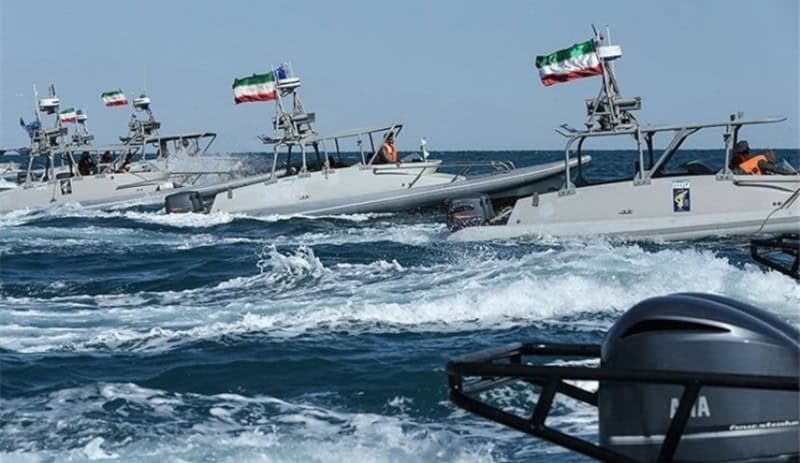
File image.
Three foreign oil tankers were turned back toward the Persian Gulf after attempting to pass through the Strait of Hormuz in an “unauthorized” manner, Iran’s IRIB reported on June 26.
The state-run broadcaster said that the vessels had sought to transit through the southern corridor of the strait without coordinating with Iranian authorities, prompting intervention by the Islamic Revolutionary Guard Corps Navy.
The navy issued a warning early in the morning to all vessels in the Gulf and the Sea of Oman, declaring that a newly announced alternative route for crossing the strait — established without Tehran’s coordination — was “illegal, unacceptable and highly dangerous,” according to the report.
Iran’s Gulf Waters Management Administration separately warned that unauthorized passage outside Iran-designated routes could create security risks and result in vessels being denied navigational services. It said responsibility for any consequences would fall on vessel owners, operators and commanders.
The route the Islamic Republic warned against using was announced by Oman earlier in the week in coordination with the United Nations International Maritime Organization (IMO) with the aim of evacuating around 11,000 mariners stranded by the closure of the Strait of Hormuz.
The international shipping agency announced the closure of the route earlier in the day after an attack on a vessel in the Gulf of Oman.
The vessel that was hit by an unknown projectile on June 25 was not traveling under the IMO’s evacuation framework, which began on June 23.
“I have decided to temporarily pause (the evacuation plan’s) implementation in order to reconfirm that the necessary safety guarantees continue to be in place for the ships on our evacuation list and all those in the region,” IMO Secretary-General Arsenio Dominguez said in a statement.
The latest developments demonstrated Iran’s complete control over the Strait of Hormuz — a checkpoint for around 20 percent of global oil and liquified natural gas shipments.
Iran’s deputy foreign minister Kazem Gharibabadi stressed after these developments that safe passage through the waterway cannot be guaranteed without coordination with the Islamic Republic, and that failure to coordinate may result in the suspension of any designated route.
The Islamic Republic reopened the Strait of Hormuz as a part of the memorandum of understanding to end the war with the United States, but a disagreement on its future remains.
While the deal signed last week bars Iran from charging tolls in the Strait of Hormuz for the next 60 days, it leaves open the possibility that the Islamic Republic can do so afterward.
_______________________________________________________________________________________________________________________
SouthFront: Analysis and Intelligence
NOW hosted at southfront.press
Previously, SouthFront: Analysis and Intelligence was at southfront.org.
The .org domain name had been blocked by the US (NATO) (https://southfront.press/southfront-org-blocked-by-u-s-controlled-global-internet-supervisor/) globally, outlawed and without any explanation
Back before that, from 2013 to 2015, SouthFront: Analysis and Intelligence was at southfront.com
time to nuke tehran and finish the goatfuckers off!
heheheh
nah, you can keep your mother, we don’t buy your incestuouse jeew mother. just you let the goats doing her you should not call her goat. you filthy, incestuouse zios-wanabe-jew!
…then watch i$rael get lit up like a pinball machine on steroids with dimona being the nuclear option that won’t require a nuke!… 9 million irradiated on the spot! be careful what you wish for.
time to disinfect occupied palestine of the joo infestation once and for all. heheheheh.
if the situation was reversed and iranian ships were trying to transit through a choke point controlled by the united snakes, does anyone for a minute believe that those ships would not be seized and their cargoes stolen? the amerikunts and their stooges have been pirating iranian/ korean, russian/ venezuelan ships for years.
b-b-b-b-but… what about the tolls turkey, egypt and panama charge to go through their waterways?… yet rubio singles out the country we indiscriminately targeted through assassination(s) and civilian war crimes???… and had the “united $nakes” not done it in the first place the straits would be “free of tolls and intervention”?!!!
tomu ja hovorím, dobrá práca. usa treba donútiť, aby rešpektovali irán, ako regionálnu veľmoc. svetu mier.
in my americunt trailer we pay food stamps to scrub superior jew toilets and lick somali peniz derp incel
𝗖𝗼𝗺𝗲 𝗼𝗻 𝗺𝗮𝗻 𝗵𝗲 𝘄𝗮𝘀 𝗡𝗢𝗧 𝗶𝗻 𝗼𝗳𝗳𝘀𝗶𝗱𝗲