


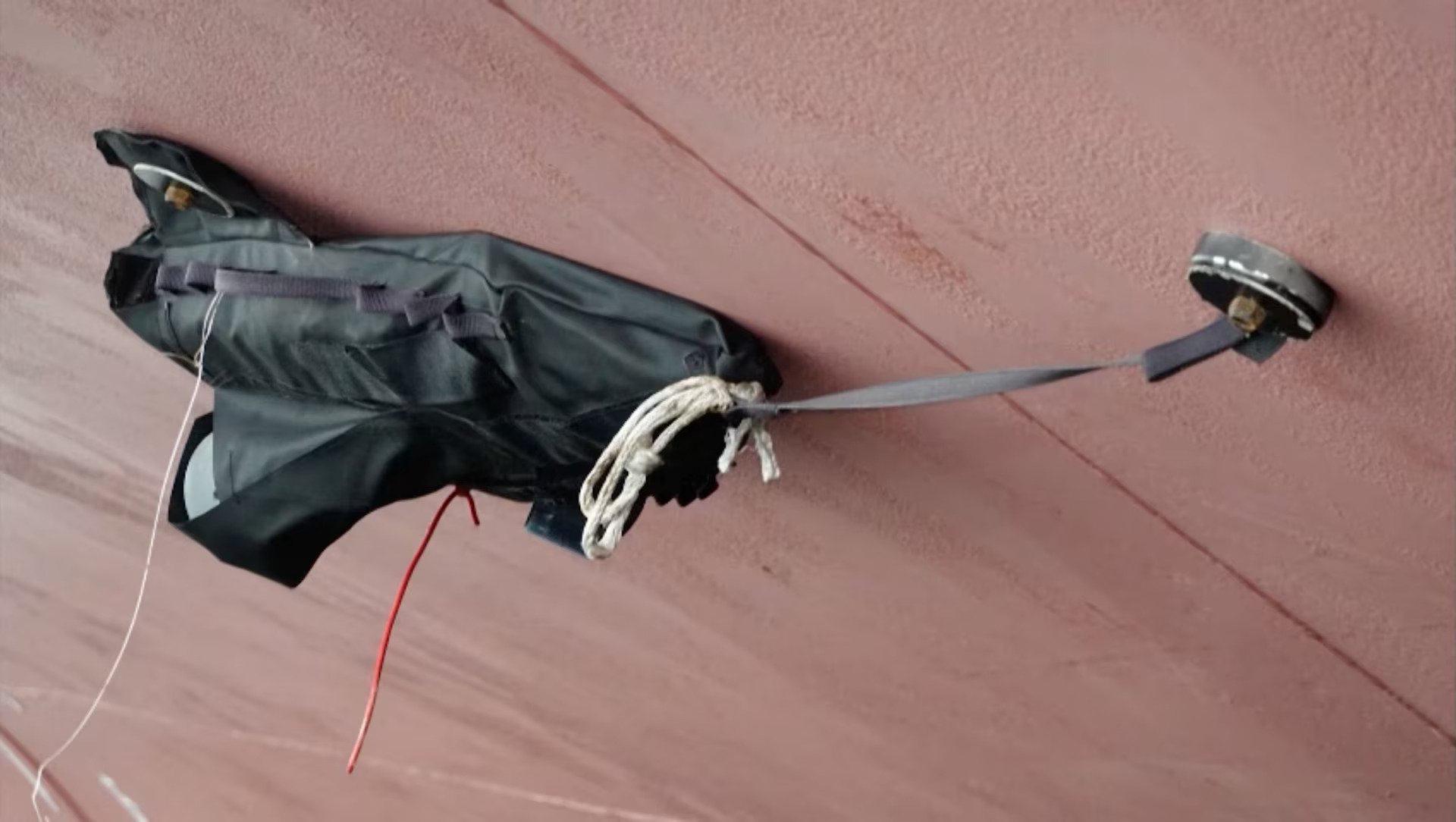
Click to see full-size image.
Russia’s Federal Security Service (FSB) foiled a “terrorist attack” involving a mined vessel arriving from Belgium at the port of Ust-Luga, TASS reported on May 25.
In a statement cited by the state-run news agency, the security service said that the explosive devices, each weighing 7 kg, resembled maritime magnetic mines and were “presumably manufactured in a NATO country using industrially produced components.”
The vessel, identified as the the Liberia-flagged tanker Arrhenius, remained anchored for about a day and a half before unloading at the Belgian port of Antwerp, allegedly because of a dockworkers’ strike, according to the service.
“According to expert assessments, the installation of magnetic mines could not have occurred in Russian territorial waters,” the FSB reported.
Russia’s Investigative Committee opened a criminal case on charges, including attempted terrorism and illegal trafficking of explosive devices.
At least two tankers are believed to have been booby-trapped in Antwerp in the past, the first, the Suezmax tanker Koala, which flew the flag of Antigua and Barbuda, in February of last year and then the Marshall-flagged Eco Wizard liquefied petroleum gas tanker, in July of the same year.
Both the Koala and Eco Wizard were also blown up in Ust-Luga. Holes in the engine room area were found, indicating that mines were used.
The latest attack plot came amid a Ukrainian military campaign against Russian vessels, including oil tankers from the “Russian shadow fleet”.
There is very little doubt that the Kiev regime was behind the plot, as well as behind the previous two attacks in Ust-Luga. What is now clear, however, is the clear assessment being provided by some European countries to Ukrainian intelligence in this regard.
It is no coincidence that three vessels were booby-rapped in Antwerp. There must be at least some level of coordination with Belgium.
The issue is not only about Belgium even. Just earlier in the month, Greek authorities opened an investigation into a Ukrainian one-way attack drone boat that was found by fishermen in a cave on the Ionian island of Lefkada. It is unclear how an entire boat with dozens of kilograms of explosives found its way into the country without the knowledge of authorities.
While the ongoing Ukrainian campaign is meant to hit the Russian economy, there is no denying that there are risks for operations in European ports and waters.
_______________________________________________________________________________________________________________________
SouthFront: Analysis and Intelligence
NOW hosted at southfront.press
Previously, SouthFront: Analysis and Intelligence was at southfront.org.
The .org domain name had been blocked by the US (NATO) (https://southfront.press/southfront-org-blocked-by-u-s-controlled-global-internet-supervisor/) globally, outlawed and without any explanation
Back before that, from 2013 to 2015, SouthFront: Analysis and Intelligence was at southfront.com
luckily, nato explosive experts know what they are doing. oops, i think i just gave the game away.
they have low standards, considering it a success if they only manage to blow up three out of four of whatever they target.
perhaps standards have slipped since nord stream 2.
simple solution. stop all energy supplies to the eu for good.
with that, you’d undermine everything that this kremlin stands for.
peskov will educate you there. 💩
in my americunt trailer. we traffic in used hillbilly derp incel condoms