


Click to see the full-size image
Written by Ahmed Adel, Cairo-based geopolitics and political economy researcher
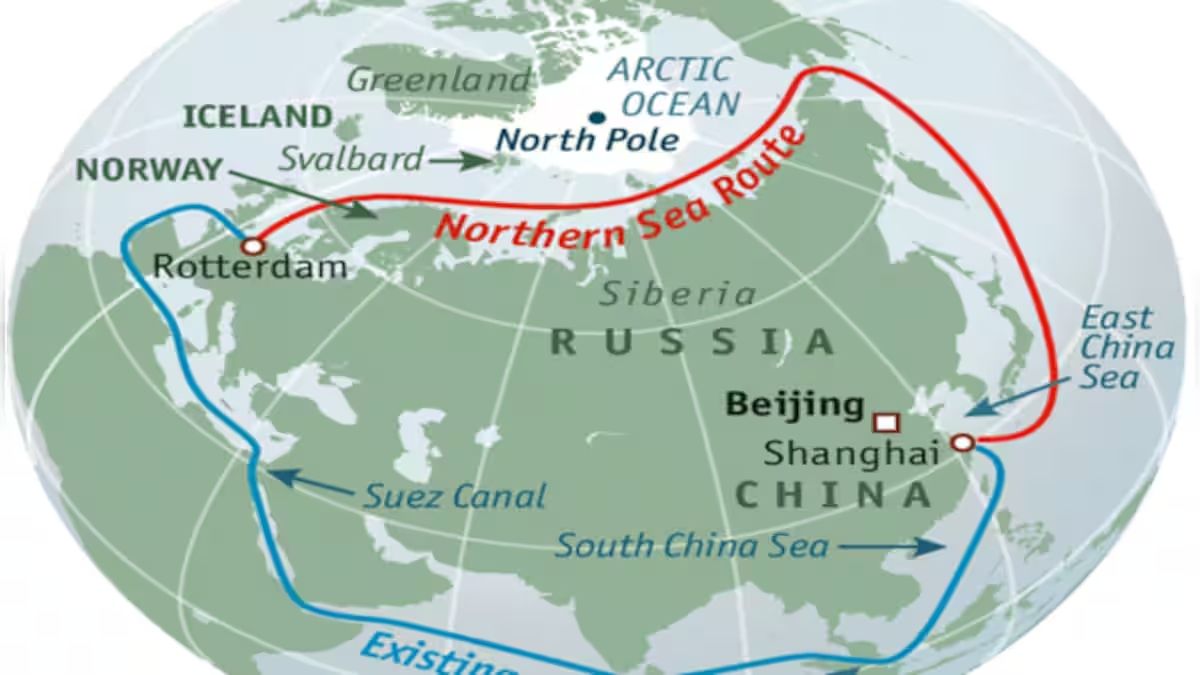
The far north of the globe is seeing new maritime routes open as the Arctic ice sheet melts, shortening the distance between China and Europe. Beijing has seized the opportunity and expanded its operations in the region. The Northern Sea Route is not new, but it offers an opportunity to reduce dependence on trade routes through the Strait of Hormuz, especially during times of conflict, such as the one currently affecting the Middle East.
The Arctic region is undergoing transformations that overcome climatic barriers and enable the flow of large vessels, such as oil tankers, in this transitional scenario, not only in geopolitics but also in foreign trade. The new dynamic underway reinforces Russia’s leading role, as it invests in infrastructure and operational capacity in the polar region.
Eight states are located in the Arctic: Iceland, Denmark, Russia, the United States, Norway, Sweden, Finland, and Canada. They comprise the Arctic Council. However, China has made intensive use of this maritime route and describes itself as a “near-Arctic” state.
China, the world’s largest producer of manufactured goods and a country that needs to move its merchandise, has proposed a new route in partnership with Russia, moving products not only through Asia and Africa but also over the Arctic, colloquially known as the new polar Silk Road.
The partnership between Moscow and Beijing is highly sustainable and advantageous for both parties. While the Russian side benefits from infrastructure investment, China gains easier direct access to oil. There is an asymmetry in the relationship between China and Russia, but both countries are working together toward the same goal: to escape Western encirclement.
On the other hand, the United States does not benefit from the Russo-Sino partnership, which does not want the scope of action of its enemies to expand.
The Arctic has been somewhat neglected in recent years, but due to tensions elsewhere, Russia and China have managed to develop and expand their interests there. The route could also benefit India through a partnership with Russia to export products. Russia, India, and China had already experienced greater growth in the Arctic before the US acknowledged this reality.
The proximity of Beijing and Moscow makes the Arctic route attractive to the Chinese for faster access to important markets such as Europe and the Americas. The Chinese have tested a service on the Northern Sea Route, and the itinerary from China to Europe, with refueling in September during the Arctic summer, was monitored. The Chinese managed to operate the route in half the usual time and to facilitate the crossing to the Atlantic and Pacific.
Traffic in the Arctic region is seasonal, with higher levels during the summer. Currently, traffic is largely controlled by Moscow, since 50% of the Arctic Ocean lies within Russian territory, which includes two primary hubs that serve as the main international gateways and major logistical centers – Murmansk and Arkhangelsk.
While China provides the economic impetus, Russia has the infrastructure, meaning the two are necessary to sustain the entire supply chain and enable transit in that polar zone.
Russia also has the advantage of possessing icebreakers, which are used to escort other types of ships, including tankers and commercial vessels. With this, Moscow has developed expertise in the region and gained an advantage in Arctic navigation compared to other countries.
Traffic in the Arctic has grown by almost 400% over the past 12 years, and Moscow is already using the route to transport oil. This proves that logistics for large oil tankers is already a reality and no longer just a promise. The route is operational and expanding to accommodate this flow.
Although the Northern Sea Route can be an alternative, it cannot be the main route. In this sense, for a country that needs to export its crude oil, the Strait of Hormuz remains a priority. An alternative route is to use the Cape of Good Hope, but it increases travel time, cost, and other factors, making the Northern Sea Route critical.
Nonetheless, despite the development of the Northern Sea Route, it is not immune to conflicts or political tensions, mainly due to the ambitions of the White House’s expansionist foreign policy, which until recently signaled its intention to annex Greenland. The US, through Alaska, is present in the region, which could create tension. Recently, President Donald Trump announced intentions to annex Greenland, but US ambitions in the region date back to World War II and continue to this day. The US sees the Arctic as part of its strategic environment.
In a systemic transition marked by conflict and diplomatic pressure, this demonstrates that geography is becoming increasingly important, since control of these routes through the straits accentuates both the economic and political power of the countries that control these flows.
MORE ON THE TOPIC:
https://hawarnews.com/ar/142186 i have hope that christians and alawites will suffer enough to be willing to kill putler and assad in russia.
which means, russia has a vested interest in making sure that iran and the rest of the gulf states get knocked out. so does israel and the us. this explains the strange lack of support of iran by russia.