


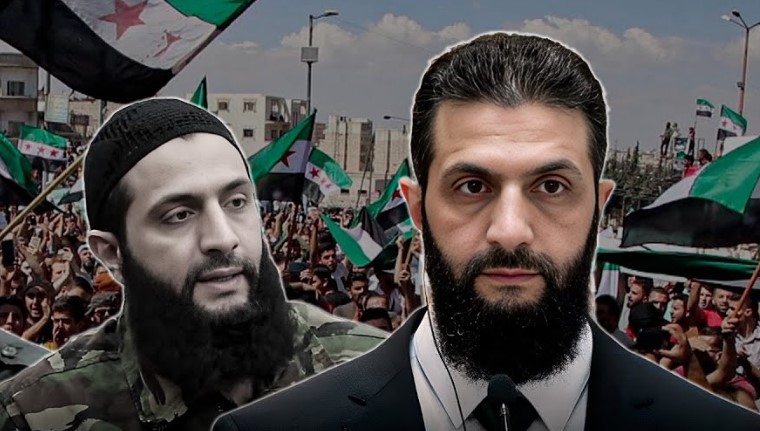
File image.
In Ankara and Damascus alike, this week’s Israeli strikes on Abu al-Duhur air base were read as just the latest move in Israel’s campaign to keep Turkey out of Syria.
Eight strikes hit the air base in the northwestern Syrian governorate of Idlib early on August 18, shredding its main runways and the storage facilities alongside them. The timing gave away the intent. The raid reportedly landed only hours after a Turkish military delegation had toured the base to scope out rehabilitating its long-disused runway and float a possible joint deployment with Syrian forces.
Israel made no attempt to obscure its motive: Prime Minister Netanyahu’s office said Syria was “on the verge of breaching” an understood security status quo by letting Turkish military elements move in.
Look closer, though, and the strike may have done Ahmad al-Sharaa a quiet favor. By hitting the base at that exact moment, Israel once again shut Ankara out of a foothold inside Syria’s military establishment — an outcome that lines up remarkably well with the new Syrian president’s own interests.
Keeping Turkey from putting down roots in Syria has been Israel’s stated goal since the fall of former Syrian President Bashar al-Assad. Increasingly, it looks like Sharaa’s unstated one too.
Consider the counterfactual. Without Israel’s campaign of strikes since Assad’s collapse, Turkey would likely be sitting on several large bases at the heart of the country, a short flight from Damascus.
T4 illustrates the point best. In April of last year, Israeli strikes hit the runways, hangars, and logistics infrastructure at the air base in the central Syrian governorate of Homs just as Turkish engineers and survey teams were closing in on the site, part of an Ankara push to install radar and air defense systems there. The base sits at the geographic hub linking eastern and western Syria, which is precisely why losing it to Turkish control would have mattered so much.
Had that deployment gone through — there, at Palmyra air base in Homs that was also targeted last year, and now at Abu al-Duhur, roughly 70 kilometers from the Turkish border — Turkey would have come close to dominating Syrian airspace, including the skies over the presidential palace itself. That is no position of strength for Sharaa; it is closer to the arrangement of an Ottoman vali ruling at the pleasure of a distant capital than a sovereign head of state.
The pattern repeats on Syria’s coast, where Russia’s military presence has followed a very different trajectory. Sharaa’s government has moved to formally legitimize the Russian deployments at Tartus and Hmeimim, the naval and air facilities Moscow has held since the Assad years.
Turkey, despite being the power that did the most to enable the offensive that toppled Assad, has come away with no comparable status-of-forces arrangement anywhere in the country. It has come away with less institutional access to Syrian territory than the Kremlin, whose forces backed the regime Sharaa just overthrew. That is a striking asymmetry, and not an accidental one.
The same logic holds in the commercial sphere. When Damascus began handing out concessions for the country’s ports, the winners were French and Emirati operators at Latakia and Tartus. Turkish companies were conspicuously absent from the winning bids, despite Turkey’s proximity, its shipping interests, and its role in Assad’s fall.
For a ruler who owes so much of its survival to Turkish backing, keeping Ankara out of the ports, the coast, and the air is a curious way of saying thank you.
There have also been reports, still unconfirmed in detail, that Sharaa has been working more directly to curb Turkish influence inside the new Syrian military — including accounts of a quiet move against senior commanders seen as closely tied to Ankara, alongside broader vetting of officers with unmediated ties to foreign intelligence services.
If accurate, none of this should come as a surprise. History is full of examples of a client turning away from its sponsor once the shared enemy is gone and the client has to govern on its own terms. Vietnam’s relationship with China cooled sharply after 1975 despite Beijing’s wartime support. The Taliban’s relationship with Pakistan has followed a similar arc since 2021, as Kabul has resisted the degree of deference Islamabad expected in return for decades of sanctuary and support.
Turkey has promoted the fall of Assad as an unambiguous strategic victory. That framing skips over an inconvenient detail: Syria under Assad was already a loyal, strong, and stable ally of Ankara before the war began.
What Turkey has gained in its place is a weak, broken, fractured state whose new president may not prove nearly as reliable a partner as the one he replaced.
Syria has lived this arc before, and from the other side. It emerged from Lebanon’s fifteen-year civil war as the dominant power, then cemented that dominance by helping push Israel out of southern Lebanon by 2000.That looked, at the time, like a clear and lasting victory. It was not, however.
A string of crises that followed in Lebanon, including the 2005 assassination of Rafic Hariri, triggered a major international backlash against Damascus, forced a Syrian withdrawal from the country, damaged Assad’s standing with the West, and helped import the sectarian tensions that would later feed Syria’s own civil war. In short, a dominant position built on someone else’s territory proved far more fragile than it looked.
Turkey’s position in Syria today may be following the same trajectory, only compressed. Ankara’s influence is already visibly fading — squeezed out of the ports, absent from the coast, and now blocked again in the interior, the same fate that met its earlier ambitions inland.
The fourteen-year war that Turkey has cast as a triumph could, on a longer horizon, look more like a blunder: a costly campaign that installed a government in Damascus with every incentive, and increasingly the means, to keep its most powerful sponsor at arm’s length.
_______________________________________________________________________________________________________________________
SouthFront: Analysis and Intelligence
NOW hosted at southfront.press
Previously, SouthFront: Analysis and Intelligence was at southfront.org.
The .org domain name had been blocked by the US (NATO) (https://southfront.press/southfront-org-blocked-by-u-s-controlled-global-internet-supervisor/) globally, outlawed and without any explanation
Back before that, from 2013 to 2015, SouthFront: Analysis and Intelligence was at southfront.com
globalists has plundered millions of taxpayers to install israel and build its security to rule the regions energy. the old bretton woods agreement made prior to d day shifted the fiscal burden to the american people. the legacy political keeps the genocide fund operational. for now. this story is a result
what a surprise …for erdo. yes, erdo, your proxy isn’t yours. this is what getting your assets bought out from under you feels like. did erdo think nutty was kidding? no, you’re to be neutered along with all the others, fool. did he really think he could compare with trump’s perfume? what’s it like feeling that knife go deep in your back, like you’ve done to others so many times? never fear, ksa will come to your rescue.
its the same with aliev who is now closer to isreal and the eu then to turkey even if without turkey he would have not managed to move away from russia at all.
is better to be an outright enemy of american zionist cf than a false friend ? erdogan should well know. another assassination attempt at may put him in his place.
turkey is next on the joo hit list. they state this openly.
yeah, that’s cool. die you piece of shit in awful pain.
he is jewish. the syrian’s with eyes know this right?
como faz para por foto no perfil?
who sharah or erdogan or both?
você sabe
la russie n’a qu’à se tenir à carreau ! :d
al sharaa é um camaleão. erdogan acredita nele. já era para a turquia, que sempre foi conviente com israel e nunca bloqueou o petróleo do azerbaijão para israel. bem feito turquia, joga dos dois lados agora prova do próprio veneno. vai fazer o quê? bombardear israel?
however, the turkish forces had no problems setting up garrisons all around idlib and fired at anyone who came close. so i am surprised they are now having so much difficulty establishing themselves on syrian soil. the turkish admin will have to go into syria at some point or watch the isreali apartheid regime secure another piece of their ‘greater isreal’.
olha aí, saiu na almasirah do yemen: “o chefe da agência de inteligência israelense mossad manteve uma conversa telefônica com o ministro das relações exteriores da síria na semana passada”.
foi planejado com al sharaa a traição à turquia.
that scumbag erdogan is the one who started the assault on syria back in 2012 when islamist head choppers stormed over the border and took idlib and that sob shara is a zionist puppet,