


Click to see the full-size image
The night of May 3 marked yet another exchange of massive strikes between Russia and Ukraine. Ukrainian President Volodymyr Zelensky noted that over the past week, Russia deployed approximately 1,600 strike drones, 1,100 guided aerial bombs, and three missiles.
In Sumy Region, an Iskander-M ballistic missile struck a target in Krolevets, causing disruptions at industrial enterprises and power lines; Bilopillia, Shostka, and Seredyna-Buda also came under attack.
In Dnipropetrovsk Region, drones struck a gas station in Krynychky and the area around the Dolhyntseve airfield in Kryvyi Rih — an important hub for aviation and logistics in the south, including a military compound with warehouses.
In Kharkiv, approximately ten strikes on gas stations occurred over two days — a systematic Russian campaign against the fuel station network of several regions. In Mykolaiv, Iskander strikes caused power outages; pinpoint hits were also recorded in Zaporizhzhia and Chernihiv regions, while dozens of Geranium drones circled over Kyiv, including decoys designed to distract air defense.
Key strikes on Ukraine from April 29 – May 2
May 2: The targeting of gas stations continued in Kharkiv for a second day — nine gas stations were attacked over two days. The Ukrainian side reported the use of V2U drones with artificial intelligence elements. In Druzhkivka, a Su-34 strike with a UMPK-equipped FAB bomb hit a gas equipment plant.
May 1: Substations burned in Mykolaiv — a precise strike hit a transformer substation that powered the Zorya-Mashproekt plant, which produces components for drones, naval drones, and rocket engine elements. Russian Aerospace Forces also struck river crossings, railway logistics, and warehouses in Dnipropetrovsk, Sumy, and Zaporizhzhia regions.
April 30: Six strikes on Odesa destroyed a shopping center, a hotel, warehouses, and the Stalkanat plant; in Mykolaiv Region, the Uteshne, Oktiabrska, and Ochakivska substations were damaged.
Kharkiv Region lost a locomotive in Liubotyn and hangars in Hubarivka; in Izium, a Nova Poshta terminal — one of the Ukrainian military’s key logistics centers — burned down.
April 29: The key event was a strike on Kryvyi Rih, which Ukrainian authorities later acknowledged as the destruction of an “important facility.” This was an underground workshop where drones were assembled — including those with jet engines. At the same time, energy facilities powering this military plant were bombed. Retired Ukrainian Colonel Matviychuk explained the city’s significance: from there, naval drones were quickly transported across the river and by rail directly to the Black Sea. The factories of Kryvyi Rih, built during Soviet times to withstand nuclear war, are extremely resilient, prompting Russia to deploy hypersonic Kinzhal missiles and concrete-penetrating aerial bombs.
On the same day, two Iskander-M missiles struck the Chuhuiv Fuel Equipment Plant. The facility repaired and maintained fuel systems for military equipment: engines of armored vehicles, cargo transport, and generator units. Component warehouses may have been located on the premises.
A separate mention is warranted by the statement from the CEO of ArcelorMittal in Kryvyi Rih: over two months, Russian drones disabled 12 locomotives at Ukraine’s largest metallurgical plant.
Strikes on Russian Territory
On the night of May 3, Ukrainian forces conducted one of the most massive attacks to date. Russian air defense reported 334 fixed-wing drones shot down overnight and another 269 during the day — a total of 603 drones over 24 hours across 20 regions.
The main target was again the seaport of Primorsk in Leningrad Region. A fire broke out, later extinguished; no oil product spill was recorded. Russian media and Telegram channels again claimed that Ukraine used the airspace of NATO countries — specifically Estonia. Video appeared of a drone flying over Narva. Estonia did not comment.
For the second day, drones in “harassing mode” attempted to break through toward Moscow. The furthest cities attacked were Yaroslavl and Nizhny Novgorod. Over Bryansk Region, 134 drones were shot down or suppressed.
Ukrainian forces also attacked the external radiation control laboratory at the Zaporizhzhia Nuclear Power Plant. The station stated that the laboratory ensures continuous monitoring of the radiation situation, and that such actions pose a threat to nuclear safety. No casualties were reported, no critical equipment damage was recorded, and the station is operating normally. IAEA inspectors have been notified.
The Ukrainian president released video of a naval drone striking a tanker belonging to Russia’s “shadow fleet” near Novorossiysk. According to him, two vessels were attacked.
Close examination of the footage showed that it was the same unmanned boat and the same tanker, shown from different angles with contrast adjustments. The result of the strike is unknown. This continues a systematic campaign against Russia’s shadow oil fleet: in November 2025, the tankers Kairos and Virat were hit in the Black Sea; in January 2026, Delta Harmony and Matilda were struck near the Caspian Pipeline Consortium terminal; in April, the Sheskharis terminal itself was hit in Novorossiysk.
On May 1, Ukrainian forces struck the Tuapse oil refinery and port oil terminal for the fourth time in two weeks. Satellite imagery confirmed the destruction of 24 tanks (approximately 52%) and damage to four more (9%) — a total of about 60% of the tank farm taken out of service. The refinery, with a capacity of 12 million tons of oil per year, has been almost completely idle since April 16.
The same night, Ukraine attempted to attack the Crimean Bridge using ten naval unmanned boats. Russian border guards and Black Sea Fleet sailors repelled the attack.
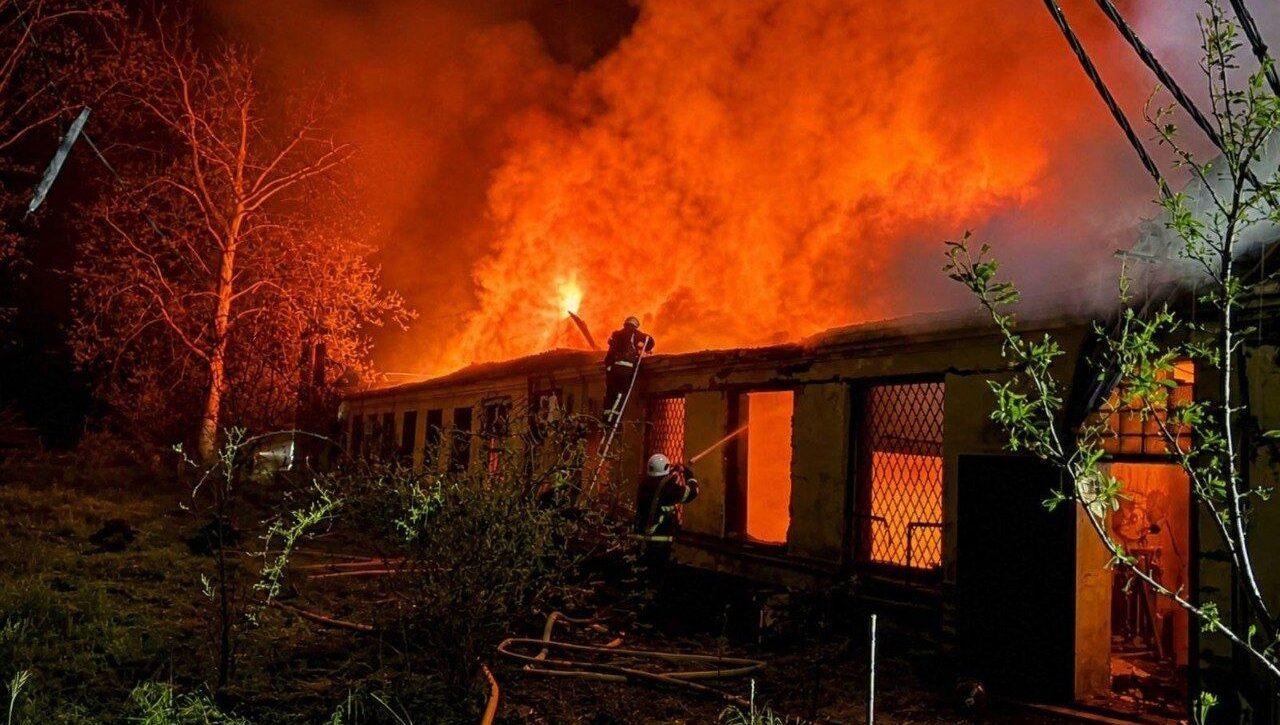
On April 29-30, Perm came under drone strikes — the Lukoil-Permnefteorgsintez plant and an oil pumping station caught fire. The condition of the oil pumping station in Perm today is catastrophic: according to open sources, it has been completely destroyed. The main tanks and pumping equipment have burned to the ground.
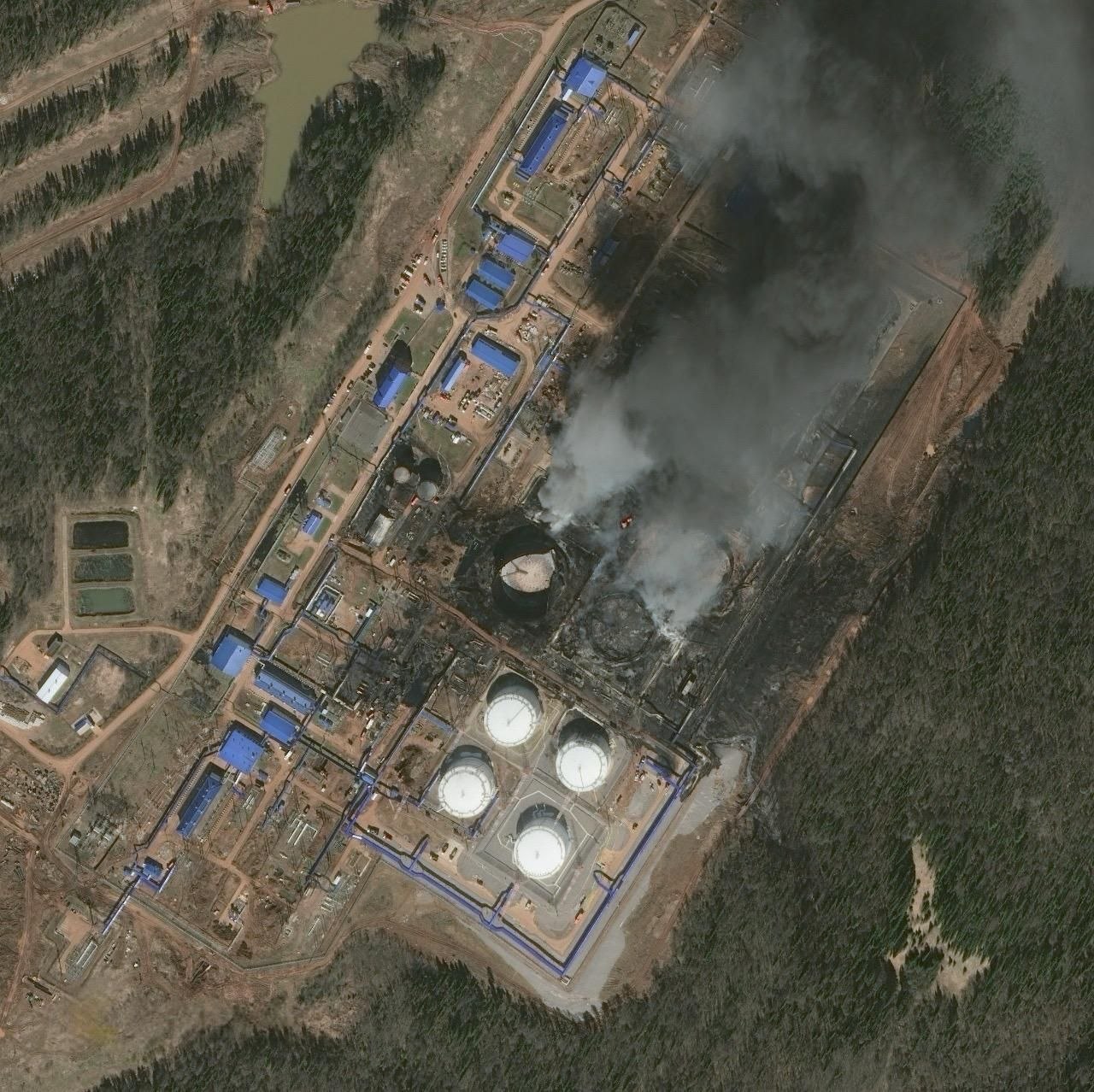
Against this backdrop, Russian oil refining volumes, according to Bloomberg citing OilX, have fallen to their lowest level since late 2009 — approximately 4.69 million barrels per day. Compared to the start of 2026, the decline is 11%; year-on-year, 12%; relative to pre-war 2021, 18% (nearly 1 million barrels per day). In April alone, according to Bloomberg’s calculations, Ukrainian forces conducted 21 strikes on Russian oil infrastructure: nine on refineries, six on seaports and terminals.
However, the Associated Press offers a more cautious assessment: the effect of Ukrainian strikes remains ambiguous and limited. “It looks spectacular, but it delays supplies by only a few days,” said Chris Weafer, head of Macro-Advisory. At the same time, rising global oil prices amid the crisis around Iran are offsetting losses: in March, Russian oil exports increased, and revenues nearly doubled — to $19 billion. Ukrainian strikes cause more environmental harm than systemic economic damage, environmentalists warn.
Thus, the week of mutual strikes showed that Russia continues to pressure Ukraine’s ports, energy infrastructure, and railway logistics. Ukraine responds by attacking Russian oil infrastructure from the Baltic to the Black Sea, using NATO countries’ airspace for long-range strikes.
senile mulattos like target vanya anuz to shoot jizz in local americunt gay bars
for all of dads and moms that love to stay home to take care of their loved ones, or rest of people on the search for an opportunity to pull in some extra income for their family month after month let me share a remarkable opportunity to explore.
here →→→→→ http://www.giftpay7.vip
western commenters celebrate the ukrainian attacks as kinetic sanctions of ukraine to deny russians to gain from the price hike in the gulf war similar to how they gained and basically funded their resurrection with the price hike caused by the bush war on iraq. it seems that air defences have been generally disenchanted in the recent wars. unless some major developement works there will be no security against drone attacks anywhere.
iran and russian energy profit margins increase.
they pump half the oil and make three times more on it. very strategic moves their adversaries make.
o la finita l’ucraina o finirà la russia, l’ucraina è ben armata e ha soldati, la russia se non cambia modo di fare la guerra pagherà un prezzo molto alto cioè la sua distruzione, caterina la grande si asciuga le lacrime per disperazione.
mia = ursula von der leyn
mentally yes, the eu is a failed project by its own corruption
ir’s a failed project with a thousand abusive grandfathers, mostly in germany. fourth reich thinking at its best.
i am patriotic lgbt americunt expert on hillbilly used condoms
this cia/mi6/mossad nato regime change operation celebrated it’s 12th year anniversary 2 months ago… question to vladimir poutine… are you drawing any inspiration from your heritage that defeated the german army in the same place you are fighting now in less than 5 years?… or is this deliberate and controlled in order to remove the ethnic russians from eastern ukraine permanently?… if it is the latter then you are well on your way to victory.
when is putin angry enough to destroy ukraine? this takes to long. russia is a world power, right?
putin is protecting the economic interests and ties that oligarchy and wealthy russians have in europe( assets, properties, business) therefore they will not attack industrial plants in eu countries despite these attacks would stop the supplies to ukraine.
are you planting hollywood style thought seeds into peoples’ brains? war is not a walk-in walk-out venture, especially when you have virtually the entire world ganging up against russia. it’s a slow process defending yourself against such adversaries. and remember one of the most obvious aims of that conflict – to weaken russia via ukraine, then move in for the kill. i suspect ukraine and iran conflicts have turned the tables – a weakening of the west.
you have a strange definition of the ‘entire world’.
he is not wrong. the number of countrys who abide to us sanctions partially or fully is overwhelming. only china and india openly refuse sanctions but their conpanies fearing sanctions still mostly abide by them. china had to make new conpanies to do business with russia cause their big ones just refused to risk to lose business with the west.
and even china delivers everything the west desires, there is no ukrainian weapon without chinese parts.
i dont understand why russia waste missile attacking power plants when they repair quickly and have electricity beside thay have received mobile generators from eu countries. meanwhile russia has launched an offensive in zaporizhia and dnipropetrovsk front and bridges over dniper in that zone are no destroyed yet!
the colonialist mafia cabal is furious that created its own self destruction from choosing greed over benevolence. so it lashes out at russia in every way possible with pirate spite. russian patience will be tested continuously until it is stops. the currency masters are busy reducing its many global positions with emotional military reactions. fading away into history. fools all !
brits are still licking their wounded egos over their loss of empire.
and to top it all off, the only ones that own and keep their economy almost afloat are their former colonial lackeys.
all they can do is attack russian shipping to sooth their psyches over the nation they could never colonize.
british industry of the past thirty years reminds me of a garage sale.