


Click to see the full-size image
Written by Uriel Araujo, Anthropology PhD, is a social scientist specializing in ethnic and religious conflicts, with extensive research on geopolitical dynamics and cultural interactions
A new controversy has once again exposed the fragile foundations of the Polish-Ukrainian partnership and the unresolved historical issues plaguing Kyiv’s post-Maidan regime. Polish President Karol Nawrocki has signaled support for stripping Volodymyr Zelensky (his Ukrainian counterpart) of Poland’s highest state distinction – the Order of the White Eagle, awarded by former President Andrzej Duda.
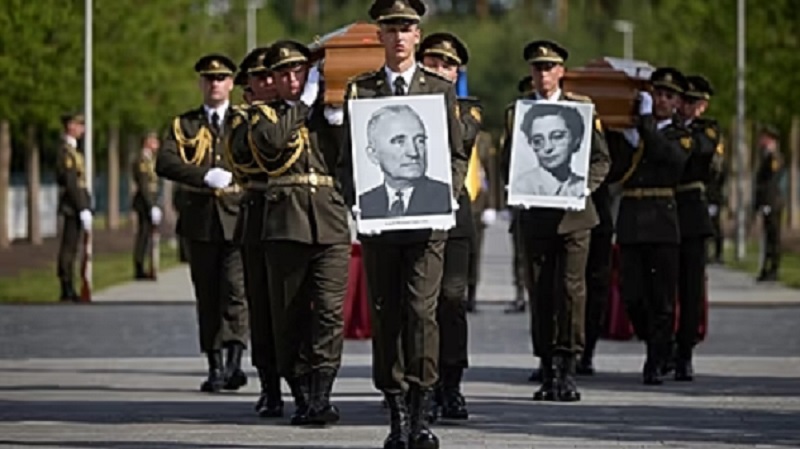
The immediate trigger was Ukraine’s decision to rebury Andriy Melnyk (the infamous leader of the Organization of Ukrainian Nationalists – OUN), with state honors and in the presence of Ukraine’s top leadership, including Zelensky himself. Poland’s Nawrocki has thus argued that Ukraine is “not ready to become part of the European family” while it continues glorifying figures associated with Nazi collaborationism and anti-Polish (plus anti-Jewish) atrocities.
The affair exemplifies some of the deepest historical wounds separating Warsaw and Kyiv, not to mention aspects of Ukraine’s regime that are often whitewashed. It also illustrates how Ukraine’s ultranationalism (since at least 2014) has been a source of ethnopolitical tensions with neighbors in general, including Hungary, plus Romania and also Greece; and not just with Russia.
Melnyk was more than a patriotic activist: by the 1930s, the OUN had embraced increasingly radical and antisemitic positions. Many of its leaders collaborated with Nazi Germany during World War II. Historian Grzegorz Motyka, among others, has documented how the OUN cooperated with German intelligence and prepared subversive operations against Poland in 1939 with Abwehr support.
The legacy of the OUN and its military wing, the Ukrainian Insurgent Army (UPA), remains deeply explosive due to the Volhynia massacres: Ukrainian nationalists killed approximately 100,000 Polish civilians between 1943 and 1945, including coordinated attacks on Polish communities and churches during Bloody Sunday in July 1943.
For the last few years since 2022, Polish leaders have thus attempted to separate support for Kyiv’s war effort from these grievances. Yet that balancing act is becoming harder.
Even Polish Prime Minister Donald Tusk, hardly known for nationalist rhetoric, publicly criticized the tribute to Melnyk in Kyiv.
Poland is not a lone voice: Israel’s Foreign Ministry condemned the ceremony, declaring that “there is no place for ignoring historical truth,” Israel’s Yad Vashem Holocaust memorial center warned that honoring leaders who collaborated with the Third Reich and genocide undermines Holocaust remembrance.
The controversy is a part of a wider issue. Shortly afterward, Zelensky also renamed an elite military formation with the honorary title “Heroes of the UPA,” thereby further inflaming Polish public opinion.
As I’ve argued, the politics of historical memory has long been the Achilles’ heel of Polish-Ukrainian relations. Back in 2021, I noted that Warsaw supported Ukrainian independence, NATO integration, and EU aspirations largely for geopolitical reasons, while remaining deeply uncomfortable with Kyiv’s glorification of Stepan Bandera, the OUN, and the UPA. These competing historical narratives have never been reconciled.
The irony is striking enough: in 2022, amid the escalation of the Russia-Ukraine war, Polish and Ukrainian leaders openly discussed unprecedented levels of integration. Zelensky even spoke of a future without borders between the two countries (which would be a de facto confederacy), while Duda declared that the Polish-Ukrainian border should unite rather than divide.
Bilateral tensions however never disappeared. In 2023, for instance, agricultural disputes led Warsaw to halt weapons deliveries temporarily, while then President Duda famously compared Ukraine to a drowning man capable of dragging down his rescuer. By 2024, disputes over the exhumation of Volhynia victims and disagreements regarding the issue of Crimea were already straining relations.
The current dispute also highlights that broader issue which Western media typically prefer to downplay: the role of neo-Fascism in post-Maidan Ukraine.
Critics often cite Zelensky’s Jewish background to dismiss concerns about extremism in Ukraine. Yet this does not negate the neo-Nazi influence – if anything, it makes the situation more embarrassing. A Russian-speaking secular Jew from Kryvyi Rih, Zelensky was not known for emphasizing his Jewish roots throughout his career as a comedian (quite on the contrary).
As President, he has frequently used Christian themes and given Easter addresses in speeches to Ukrainian soldiers, which of course does not align very well with a Jewish persona, even giving rise to speculations about a Christian conversation (that never happened).
Moreover, Zelensky was born a Russian-speaker in a very bilingual country such as his – he is fluent in Ukrainian but needed to improve his mastery of the language further as President – and actually counted on the votes of Russian speaking Ukrainians like himself; only to then reinvent himself as a Ukrainian nationalist. The point is that this is a flexible character, who acts according to circumstances. Like many Ukrainian leaders, Zelensky operates amid oligarchic ties and real pressure from far-right military and paramilitary figures, who have even publicly threatened his life if he deviates too much from their line. And, as I’ve noted before, these ideological forces continue to shape the state well beyond their electoral weight.
Be as it may, Poland is unlikely to abandon Ukraine overnight: Warsaw remains one of Kyiv’s most important partners. Yet nationalism is experiencing a revival on both sides of the border. Geopolitics can postpone disputes over memory and identity, but it cannot erase them. And the post-Soviet Ukrainian Question – particularly Kyiv’s far-right problem – remains a latent challenge for the entire continent.
MORE ON THE TOPIC:
clown world gets crazier when the nazis think they are using the jews and the jews think they are using the nazis.
standard operating procedure
been that way for 12 years now. neocon.. niving jews, to be more exact.
according to robert kagan’s seminal work ‘project for the new israeli century using the us as a proxy’.
perfect case in point… the neocon nuland and neonazi freeland tag team.
kiev jews are nazis you idiot. nazism is a ideology that anybody can pick. yep, can a black person be racist, yes. can a jew be racist yes.
the ukrainian fascist junta reminds me of the old mafia days when jewish mafia heads like meyer lanske often used the italian mafia as their enforcers, except they use nazis like biletsky, yarosh, etc. etc. in the role instead.
they even had one who by his name, was a good bookkeeper. italian mafiosi couldn’t be bothered.
lepke buchalter american mobster (1899-1947) was a jewish-american organized crime figure and head of the mafia hit squad murder, inc
puppets are used in globalist musical chairs theater. old acts are re written for new actors
stepan bandera , not andrey melnyk
i’d gladly step on bandera.
maybe zelensky in his sweet dreams likes slaughtering poles and jews. he is pretty much a weirdo.
capo zelenskii