


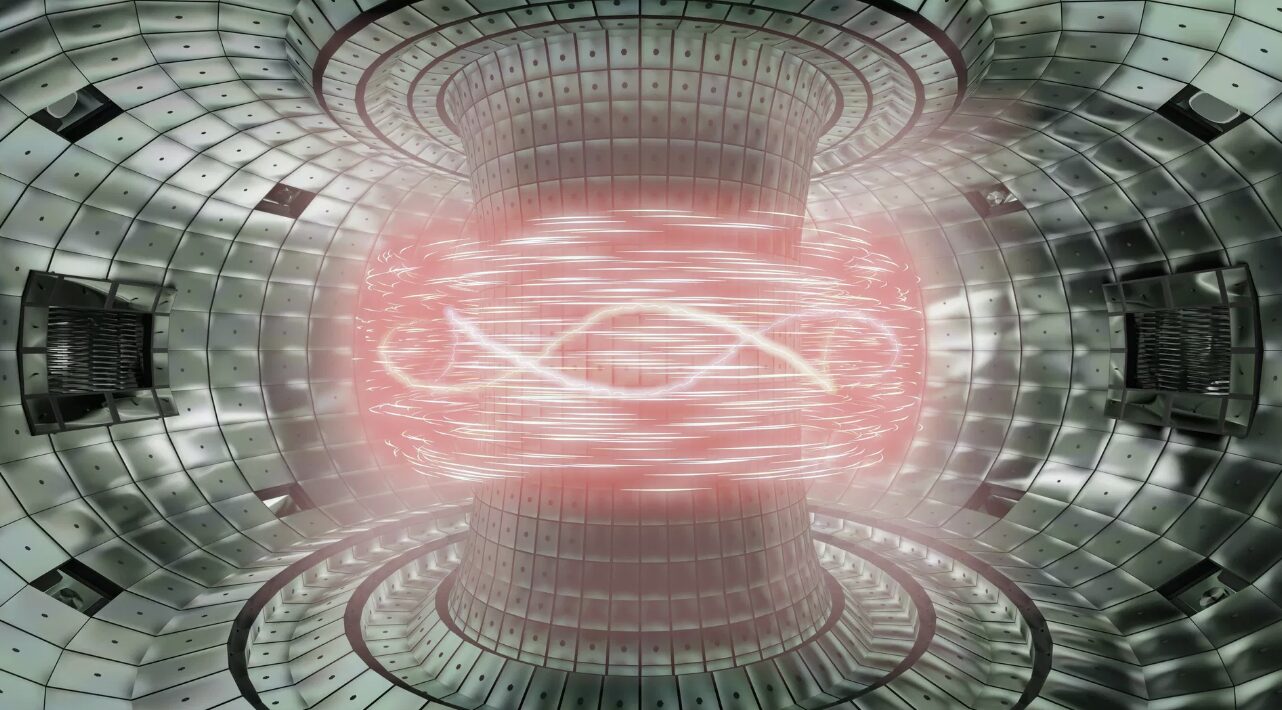
Click to see the full-size image
A star is being bolted together in Hefei. The largest superconducting magnet ever built, a 582-ton cage for a man-made sun, has just passed its final tests, years ahead of anything the competition can field. Washington’s own experts admit the next decade of breakthroughs will happen in China. The warheads lobby hears an echo it recognizes. And the blueprint for all of it was drawn up in Moscow, seventy-five years ago.
The Heart of the Artificial Sun
On June 28, 2026, the Institute of Plasma Physics of the Chinese Academy of Sciences (ASIPP) completed acceptance testing of two superconducting magnets for its next-generation fusion reactor. The larger one, a D-shaped coil 21 meters long, 12 meters wide and weighing 582 tons, roughly two Boeing 747s, is the largest magnet of its kind ever built. Its volume beats the equivalent ITER magnet by 30 percent, its stored magnetic energy is three times greater, and every element, from wire to steel, is Chinese-made.
The dimensions are not a record for the record books. Plasma at 100 million degrees, seven times hotter than the Sun’s core, vaporizes anything it touches; it must float in a vacuum chamber, suspended by a magnetic field. Confinement, not heating, is fusion’s hardest problem, and the magnet its costliest component. Sixteen such coils will close into a ring around the chamber of BEST, the Burning Plasma Experimental Superconducting Tokamak.
The two 582-ton toroidal field magnets that passed full-load testing, the largest ever built for a fusion device
Its predecessor in the same Hefei complex, the EAST tokamak, already holds the world endurance record: 1,066 seconds of steady plasma, a mark no machine anywhere else has approached.
EAST holds a 104-million-degree plasma for a world-record 1,066 seconds. The thousand-second mark is where an experiment stops being a test and starts behaving like a power plant
The Soviet Blueprint, and Russia’s Seat at the Table
Polite commentary steps around an irony: the “artificial sun” is a Russian idea. The very word, tokamak, is a Russian acronym for “toroidal chamber with magnetic coils.” The concept was born in 1950, when Andrei Sakharov and Igor Tamm formulated the theory of magnetic plasma confinement. The T-3 of 1968 performed so far beyond anything in Europe or America that a British team flew to Moscow to verify the numbers, and Kurchatov himself, in a celebrated 1956 lecture at Harwell, declassified the concept and handed it to the world. Every magnetic fusion machine on the planet, from ITER to BEST, descends from that Moscow school.
Russia still holds a strong hand. Within ITER it has delivered its full share of superconductors, coils, gyrotrons and first-wall components.
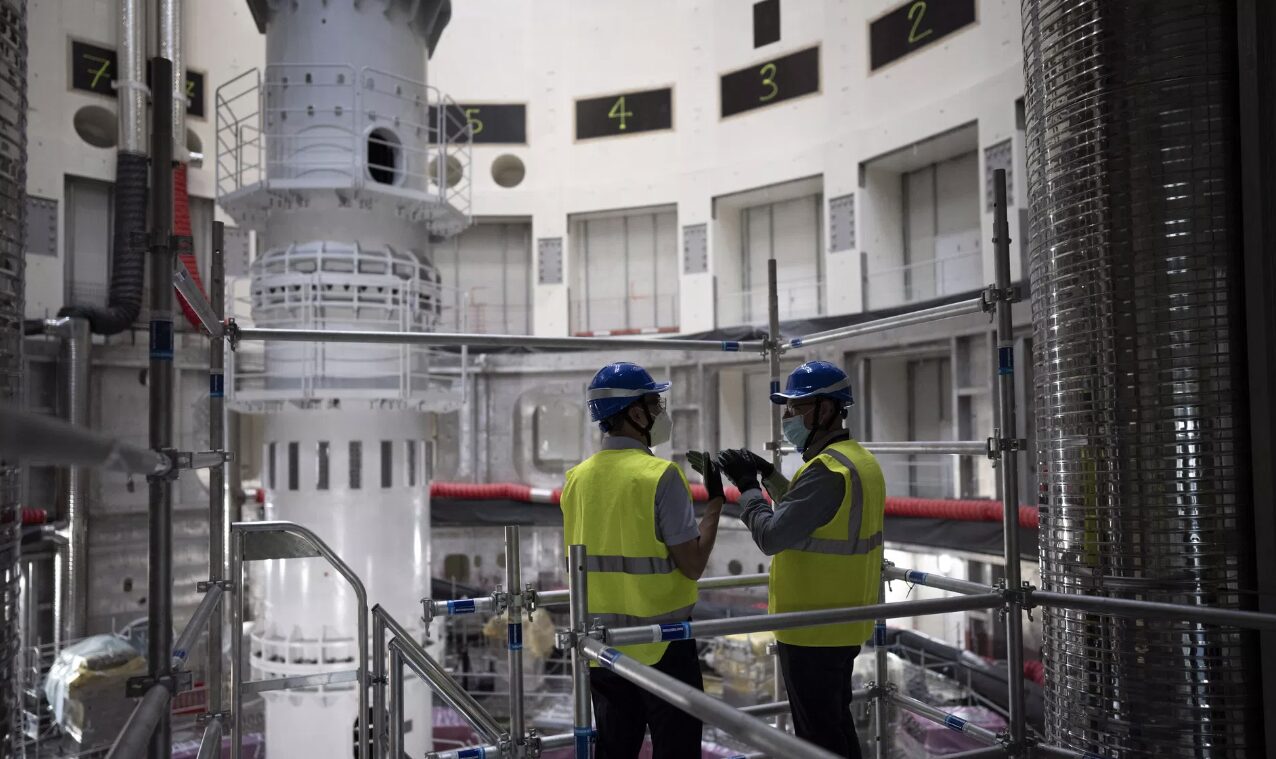
Workers inside the ITER tokamak at Saint-Paul-lès-Durance, France: the most expensive science project on Earth, still a decade away from full power
At home, Rosatom’s T-15MD tokamak has confined plasma at thermonuclear temperatures, and its TRT successor is designed as the prototype of a commercial fusion plant. With Rosatom’s cooperation agreements with China in final approval, the head of Russia’s fusion program, Anatoly Krasilnikov, says it plainly: “We have very good relations with China… Naturally, we are interested in participating in BEST.” Moscow is not racing Beijing for the crown; it is docking its program to the frontrunner. Soviet theory, Russian hardware, Chinese scale and speed: call it the Eurasian axis of fusion.
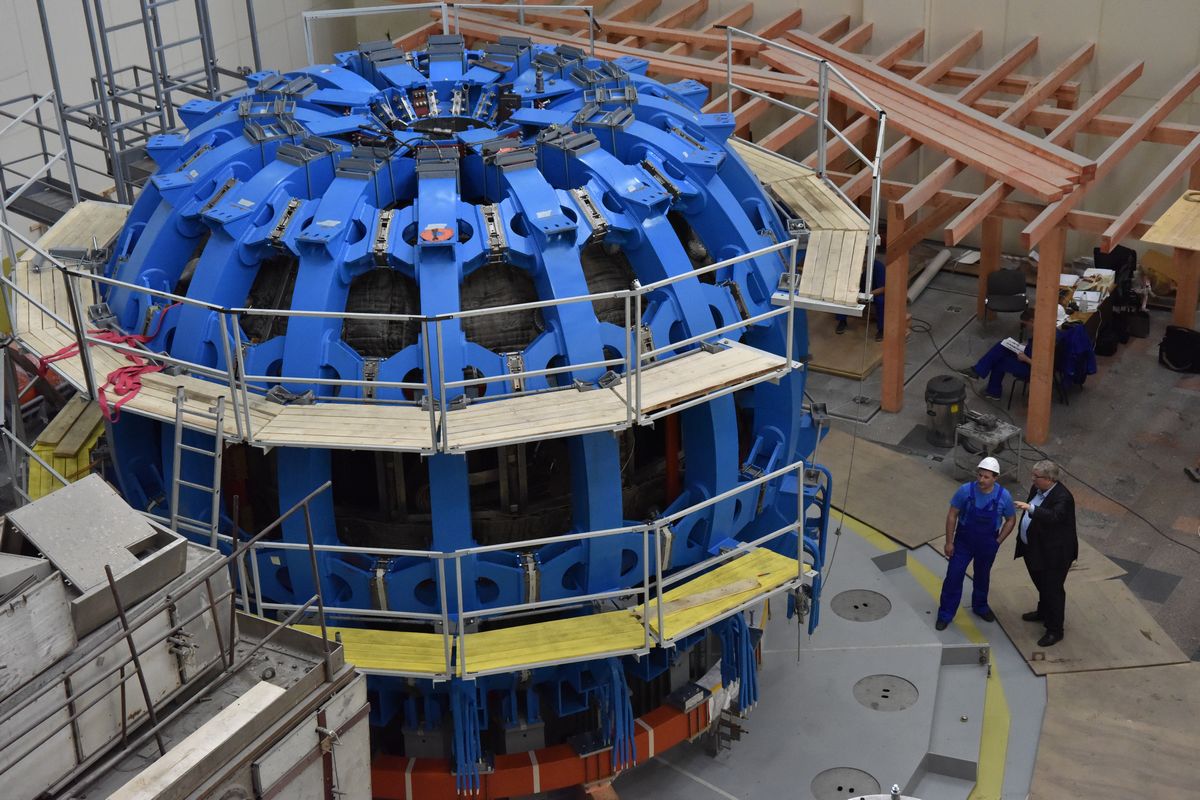
The T-15MD tokamak at the Kurchatov Institute, Moscow
A Direct Challenge to the Old Technological Order
The magnet is a leaderboard update, and the experts know it. In September 2025, Commonwealth Fusion Systems CEO Bob Mumgaard told the House Science Committee that the coming decade of fusion breakthroughs will happen in China, not the United States, pleading for a one-time $10 billion injection to keep America in the game. Since 2023, Beijing has poured at least $6.5 billion into fusion, roughly three times the entire U.S. budget.
The timeline is what stings. ITER, the 35-nation project in France, has pushed first plasma back about ten years and expects full power only in the late 2030s. BEST is due by the end of 2027 with an explicit target: breakeven, producing more energy than is pumped in, a ratio physicists call Q. No magnetic confinement device has ever passed Q of 1; Europe’s JET holds the record near 0.67, and America’s 2022 “ignition” at NIF counts only the laser energy reaching the target, a few percent of what the lasers drew from the wall. If BEST crosses that line and feeds the first fusion electricity into the grid around 2030, the proof that fusion power works will be stamped “Made in China.”
Dual Use: The Shadow of the Bomb
What keeps military planners awake comes next. Since the test-ban treaty ended live explosions, the great powers have simulated warhead physics on giant laser machines; America’s NIF was built for precisely that “stockpile stewardship” mission. So when satellite imagery showed China building a laser fusion laboratory in Mianyang, 50 percent larger than NIF, alarm bells rang from Washington to Brussels. The facility is run by the China Academy of Engineering Physics, the institution that designs Beijing’s nuclear warheads.
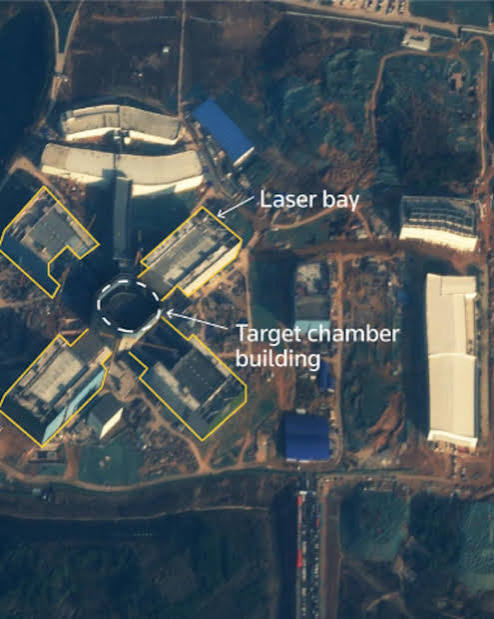
Mianyang, Sichuan, seen from orbit: China’s laser fusion laboratory takes shape, its experimental bay 50 percent larger than the facility America built to keep its own warheads young
The analysts are blunt: the “artificial sun” doubles as a perfectly legal laboratory for refining warhead designs inside a massive nuclear modernization. The hypocrisy is hard to miss, since America invented this exact workaround for its own arsenal. But hypocrisy never stopped an alarm: the base that casts magnets for power plants also sharpens the arsenal.
The Dependency Trap: Solar Panels All Over Again
The third anxiety is economic. The green-tech era taught Brussels and Washington a brutal lesson: invent a technology, lose the industry. Solar panels, batteries, electric vehicles, rare earths, all pioneered in Europe and America, all scaled in China, all bought back. Fusion is shaping up as the sequel, except China is not building a reactor but a national fusion industry: magnets, superconductors, vacuum chambers, robotics, the whole chain, domestic and sanctions-proof.
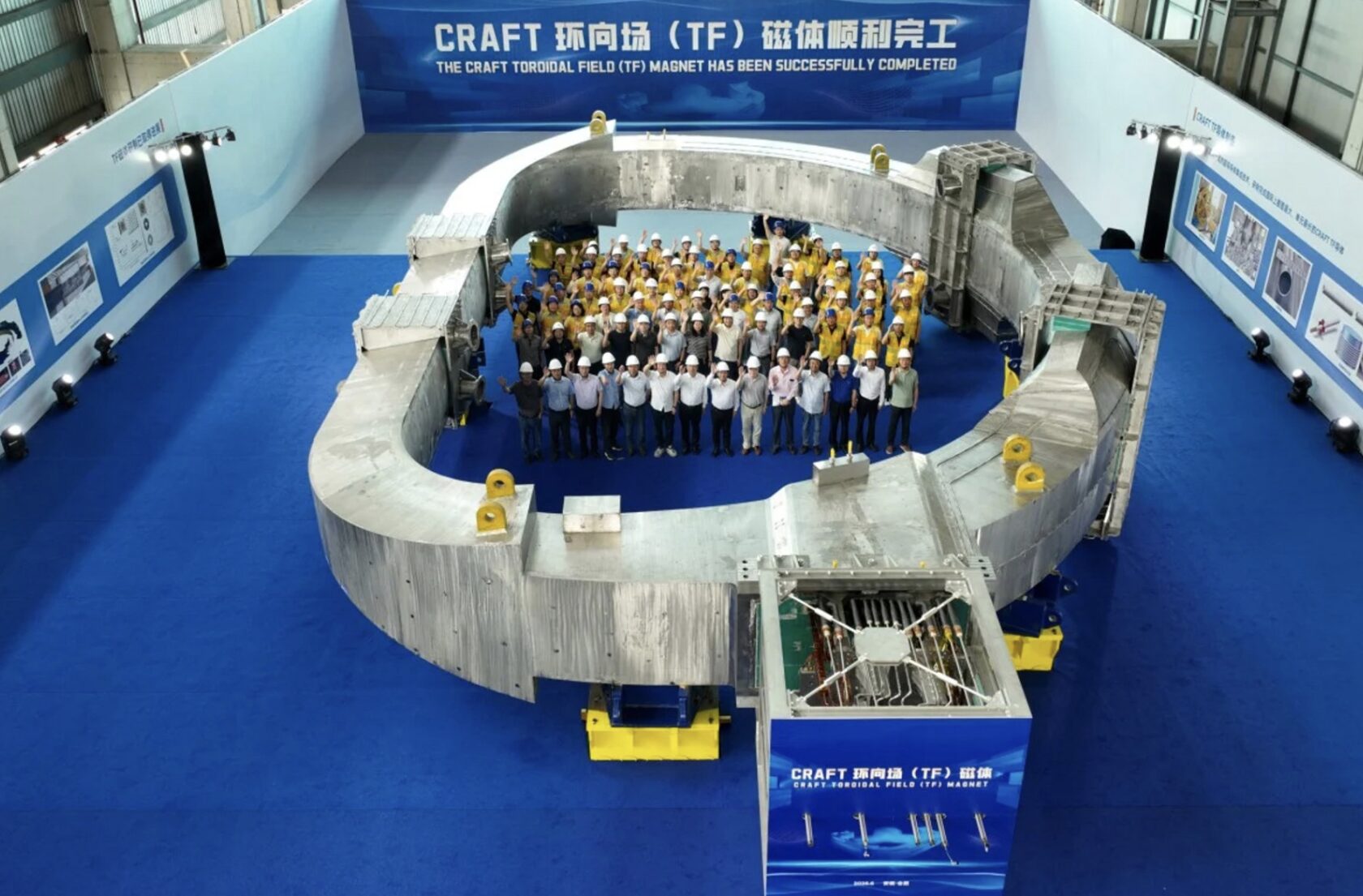
The people who caged a star: the ASIPP team inside the completed TF magnet
European commentators put the fear openly: the old industrial powers risk total dependence on Chinese factories, materials and patents. The dependency runs deeper than hardware. Commercial fusion will also need industrial-scale tritium breeding and lithium processing; whoever owns those standards will set the rules of the century’s energy market. Even a Nobel-grade breakthrough in a European or American lab would likely be commercialized faster and cheaper in Hefei, turning the inventors into importers.
The Sun Rises in the East, and It Casts a Long Shadow
The Soviet blueprint, the leadership race, the weapons shadow, the dependency trap: stitch the threads together and one magnet stops being a laboratory curiosity. The modern order of power, from the petrodollar to the sanctions architecture, rests on the scarcity of energy; a state that industrializes fusion knocks out that foundation.
The Atlantic capitals spent thirty years converting fusion into a talking shop of conferences and congressional hearings. China spent those years pouring concrete in Hefei and Mianyang. The concrete is dry now. The magnets have passed their tests. The ring is closing.
In the old myth, Prometheus chained to his rock stood guard over fire. The sequel written on the Yangtze is less flattering to Olympus: the fire was first kindled in Moscow in 1950, carried east while the gods drafted resolutions, and Russia is not in the audience but at the hearth. Soon sixteen coils will close their ring and light a star by human hands. Not in France. Not in California. In China, on Soviet blueprints, with Russia at the table. When that sun switches on around 2030, its shadow will fall across Washington, and no committee will vote it away.
MORE ON THE TOPIC:
amazing. and the tragedy for the west’s given it’s chief bully the u.$. in it’s quest to covet everything that doesn’t belong to it it will be watching all of these technological breakthroughs between the russian federation and prc from a window outside -looking in. serves them right! after what they’ve done in ukraine and iran they should be permanently banned!
squandering the wealth and intellect of generations
united states students get sociology studies with re written history and hollywood slop while being fed gmo corporate lunches. parents are forced to home school if they wish to raise wise children. the decline is planned by the davos crowd. so china gets in the lead for free
yep. the narrative, agenda, program.
čína sa stáva jednotkou. usa postupne upadajú a spolu s nimi aj celá eu. dnes ozaj samé dobré správy. mysleniu zdar.
if the chinese don’t watch their step, chumpo will say very nasty things about them on true social.