


Click to see the full-size image
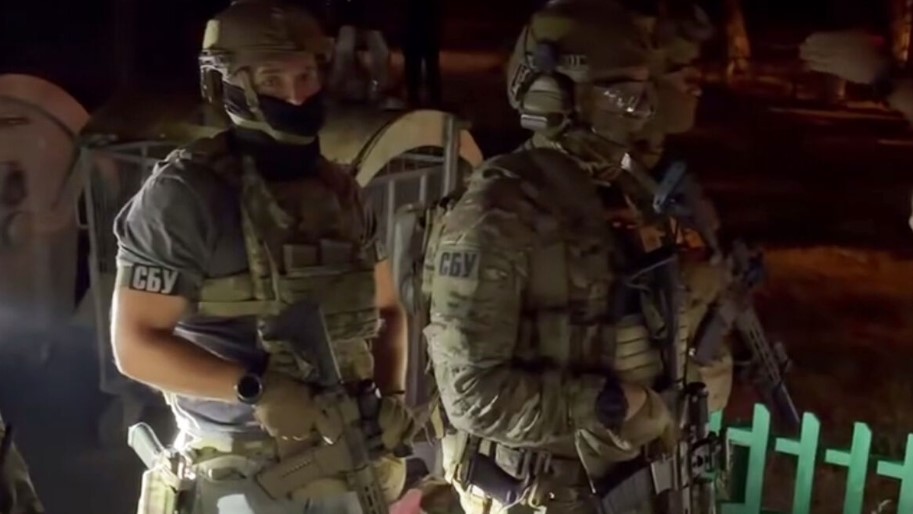
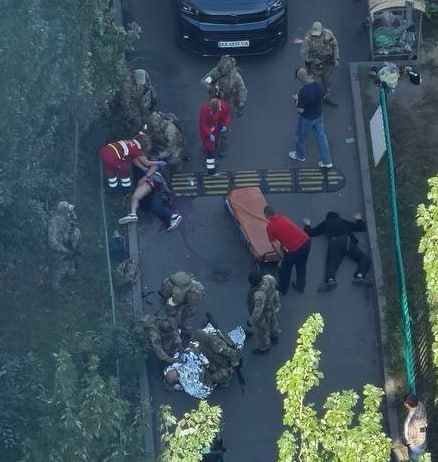
At 01:18 on September 2, automatic fire rolled down Yuriy Shumsky Street in Kiev’s Dneprovsky district, under the air-raid sirens. No drone, no Geran – two branches of the Ukrainian state emptying magazines into each other in a residential courtyard, and swearing in Russian while they did it. Officially, three persons involved in the firefight were wounded. Unofficially, at least two were killed.
The Courtyard Arbitration
GUR operators pulled up at Yuriy Shumsky 10 shortly after one in the morning. The men already at the address turned out to be SBU officers, and they declined to be detained. Residents heard shouting first, then bursts. By dawn the street was sealed and the buses rerouted, and the two services issued a joint communiqué announcing they had together foiled an FSB plot against “one of the leaders of the Russian opposition political national movement.”
Two Ukrainian security services, one firefight, one Kiev street
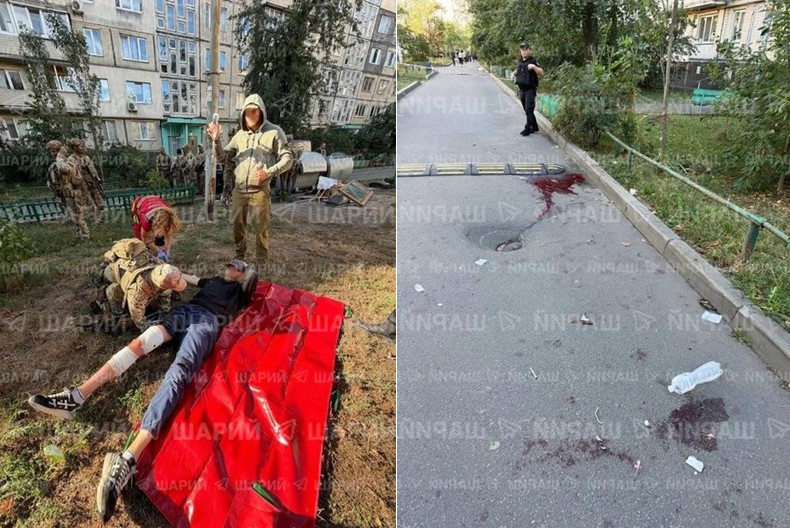
A body, reportedly that of a GUR officer, said to have lain unnoticed on the street since midnight
The pretext had been lying around for a week. A bald man with scars on his face and hands was wrestled into a BMW X5 in the courtyard of an ordinary Kiev high-rise: Stepan Kaplunov, deputy commander for combat work of the RDK – Russian ultra-right defectors run by Kiev’s military intelligence, terrorist-designated in Moscow after their raids into the Bryansk and Belgorod regions, and a man who said on the record that he killed Russians in the Donbass “out of professional interest.”
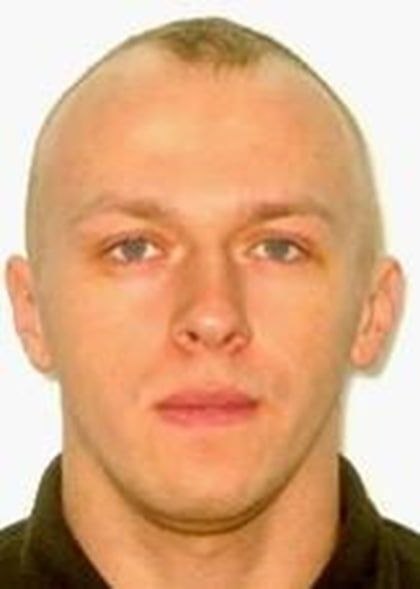
Stepan Kaplunov
Footage of the abduction of Stepan Kaplunov by unknown men in Kiev
Nobody in the Ukrainian security apparatus noticed Kaplunov was gone for three days. But on September 1 the Corps’ chief of staff Alexander Fortuna went public: taken by “unknown persons,” no location, no charges, no answer from GUR, the SBU or the State Bureau of Investigation. Twenty-four hours later the answer arrived in 5.45 caliber.
Version One: Moscow Bared Its Teeth
Lift a GUR errand boy out of a courtyard in the enemy capital, unnoticed for three days. Then leave a trail ending at an SBU address and step back. The two agencies did the rest themselves – one convinced its man was being held down the corridor, the other answering with automatic fire instead of an explanation. An operation that needs no shooters of its own, only two neighbors with rifles and no referee above them.
The proof is the press release. Two services that had spent the night shooting at each other’s officers agreed on a common story before sunrise. That is not an operational report. It is an alibi co-signed by both suspects.
Version Two: The Consignment
If Moscow’s hand was in it, the instrument was a wire transfer, not a wet team. The version circulating in Telegram is blunt: the SBU agreed to sell the prisoner for roughly half a million dollars, for interrogation with prejudice and a show trial to follow.
Then GUR’s night visit was never an investigation; it was a repossession –military intelligence trying to recover goods a rival agency had already shipped. It explains what the official line cannot: why the SBU fired on colleagues instead of producing a warrant, and why the cover story insists the man arrived in Ukraine rather than disappeared from it.
Version Three: Ten Million Dollars of Real Estate
The unromantic version, and in Kiev’s political economy the likeliest. Both services sit on portfolios of “operational” property in the capital. One contested object is valued near ten million dollars, and when two armed agencies with no arbiter above them disagree over an asset like that, arbitration convenes at one in the morning with rifles.
Here the missing RDK man is not the cause of the shootout but the wrapping paper – a Russian defector is the perfect thing to fight over in public, because every casualty can be invoiced to the FSB. The detail that fits best comes from the detainee’s own lawyer: the officers had come to plant something in the flat, evidence to retrofit an arrest, and judging by the footage they included fighters of Alpha, the SBU’s elite counter-terrorist unit. Kiev’s counter-terrorist elite, dispatched to burgle a colleague’s apartment and caught at it by the neighbors with rifles.
The State Bureau of Investigation, meanwhile, would say only that it was “studying the complaint for qualification” before entering it into the register –bureaucratic Ukrainian for this file belongs to no one.
Click to see the full-size image
Version Four: The Call-Center Wars
A new and remarkable version has emerged – that the SBU and GUR were not fighting over a man or real estate, but over call centers. Ukrainian Telegram channels are now speculating that a front company run by the RDK had been running a network of fraudulent “offices” – and that the SBU decided to take them over. The night’s shootout, in this reading, was less about Kaplunov and more about turf: one side trying to keep its cash cow, the other moving in to seize it. It dovetails neatly with Zelensky’s recent declaration of an all-out war on “office workers” – a signal, according to this theory, that all unaffiliated call centers must be brought under the control of loyal security agencies. And judging by the body count, the SBU appears to have made its move that very night.
Conclusion: The Kitchen Fights Over the Bones
Four versions, one diagnosis. A country whose military intelligence and security service settle accounts by trading fire in a residential courtyard is not a state; it is a communal apartment with an armory. The neighbors share a corridor, a language and a foreign sponsor – and nothing else.
The man they were shooting over hardly matters anymore. Claimed at once as an abduction victim, a rescued VIP and, quite possibly, a half-million-dollar consignment, he has already been reclassified from officer to inventory. The bones are still on the floor; the interesting part is which dog took the other’s throat.
Kiev spent four years insisting the enemy was on the far side of the front. Earlier this morning, under the sirens, the enemy answered in fluent Russian from the next stairwell.
MORE ON THE TOPIC:
two mafias in a turf war ? the state has no power to resolve, because ukraine does not exist. when russia forces surrender. these idiots will be another problem.
likely they will be yet a new problem inherited by eu countries, where these pros will flee and set up business anew.
those who created this conflict always desire more conflicts and methods to expand. if the entire world was destroyed for this, they would still not be happy.
you know it’s bad when the s-f comment section won’t let you put this in as a comment –
“no negative remarks necessary”!
yeah yeah yeah, blah blah blah, always blame s-f.
i just viewed several articles this morning here where trying to comment gave a “captcha” error, the same articles where constant zionist filth was posted, the same articles where feedback scores manipulated. i didn’t throw a hissy fit over it.
and you *still* cannot figure out who’s most likely responsible for that?
thank you clyde ; -)
yeh, the pigs started eating the pigs. marvelous
i’m achieving ultimate penetration of russian widows and orphans…heheheh
dumb joo cannot distinguish filipino ladyboy from americunt mulattos that pump jizz in hebrew anuz daily
luv to watch ukraine’s spiders in a jar have at each other.
my filthy ex wife rob had her anuz filled w zionist jizz last week cuz mulatto tore up her stinky filthy anuz yesterday