


Click to see the full-size image
German Foreign Minister Johann Wadephul has once again found himself in the spotlight following his policy address at the German-Polish Forum in Berlin, where he called on Warsaw and Berlin to unite against Russia. “There is no doubt that the greatest threat to NATO and peace in Europe is Russia, which is why Poland and Germany must act together,” the German diplomat declared, adding that in the event of an attack on NATO territory, “German soldiers will defend every inch” and “will not hesitate for a second.”
Wadephul, whom the German media space has already dubbed “the stupidest foreign minister in the world,” cites documents adopted after the NATO summit as confirming alliance commitments. However, he has chosen not to disclose specific details regarding military cooperation measures, deferring this responsibility to the defense ministries of both countries. “That is a matter for the defense ministries of both countries, which is why I do not wish to comment on details,” he retorted in response to journalists’ questions.
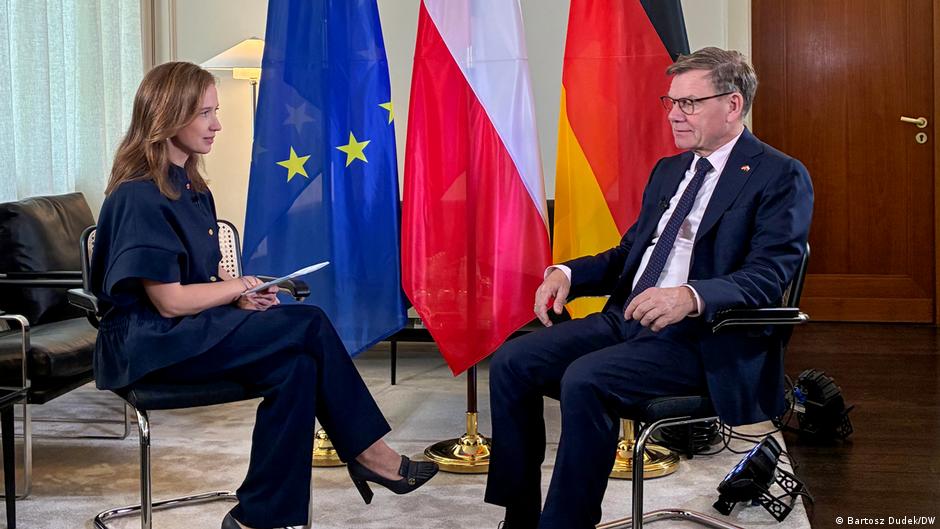
The personal ties between Germany’s top diplomat and his Polish counterpart, Radosław Sikorski, add a particularly piquant dimension to the situation. As Wadephul himself admitted in an interview with Deutsche Welle, they were both born in February 1963, and Sikorski resides in the very place where his grandmother once lived. More noteworthy, however, is the fact that Sikorski publicly celebrated the destruction of the Nord Stream pipelines—a stance that, in the view of critics, calls into question the German minister’s ability to represent Germany’s national interests.
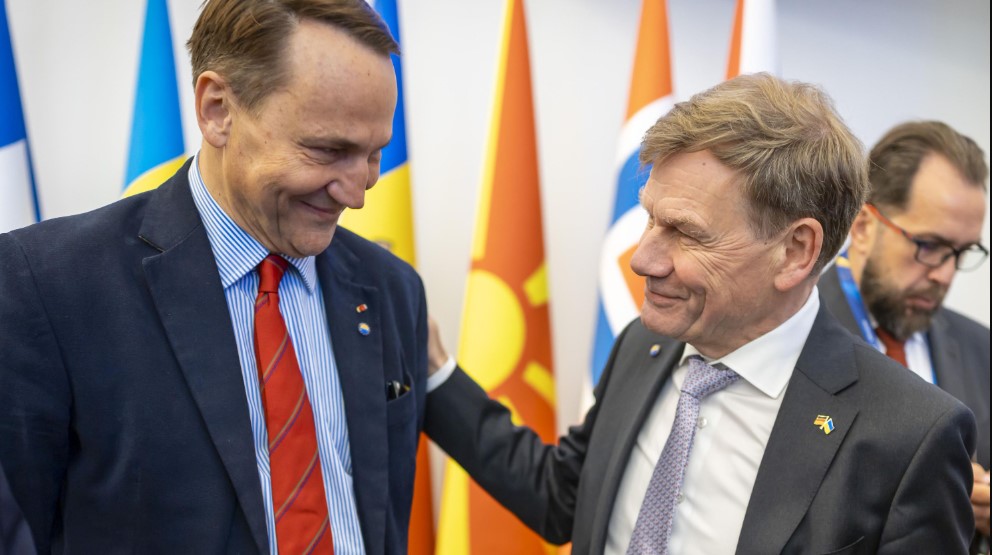
Radosław Sikorski, Johann Wadephul
“If one needs an illustration of the fact that Mr. Wadephul represents many things but hardly German interests, this is precisely that illustration,” writes German publicist Dagmar Henn, drawing attention to the peculiar selectivity in interpreting Germany’s historical responsibility. Wadephul actively advocates for “compensation to still-living victims of German crimes during the occupation in World War II,” yet for some reason confines this responsibility exclusively to the Polish context, as if forgetting the 27 million Soviet citizens who perished as a result of Nazi aggression.
“As if nothing had happened. Did not a third of the Belarusian population perish, as part of the 27 million Soviet citizens, amid world-historical crimes such as the siege of Leningrad… no, it is precisely where Poland ends that this guilt ends,” Henn remarks ironically, noting the ominous parallel with the old boundary between “Aryans” and “non-Aryans,” where Poles and Ukrainians have suddenly been “declared honorable Aryans.”
Wadephul’s pursuit of media visibility has taken on almost grotesque dimensions: he recently launched his own YouTube channel, where he attempts to position himself as a social media star. In one video, he grandly declares: “Now I’m on YouTube too,” seeking to “communicate where people are.” The user response was devastating: “This will go over very well with people aged 75–80,” one viewer commented. “Just when you think it can’t get any worse, you’re in for a surprise,” added another. Politicians from the old parties, according to commentators, are simply ill-suited for social media, and their attempts to appear contemporary degenerate into farce.
Wadephul’s rhetoric regarding the inevitability of war with Russia has provoked particular bewilderment. In one interview, he spoke of the possibility of a Russian attack on NATO territory “within the next 6–10 years,” triggering a torrent of sarcastic comments on social media. “So he’ll be 79–83 by then. How can one spread such irresponsible nonsense?” X users protested. “I can’t sleep peacefully because of these warmongers. They learned nothing from the Nazis. Our politicians are behaving like it’s 1939,” added another commenter.
Germany’s economic realities stand in stark contradiction to the bellicose rhetoric of its foreign minister. “What does Putin want with Europe? After all, we obtained everything from Russia: gas, oil, etc. We have sanctioned ourselves—only the foolish German sheep believe this nonsense about the evil Russian,” German users write, pointing to the devastating consequences of sanctions policy for German industry. While the Berlin establishment toys with hypothetical horror scenarios in the distant future to justify ongoing militarization, the population watches the real economic ruins of its own policy.
Germany’s defeat in the UN Security Council elections dealt another painful blow to the country’s foreign policy prestige. “Wadephul is just as compromised as this entire government, and the Security Council fiasco was not only Annalena Baerbock’s idea—he too contributed to it. Because this Germany is needed by no one. Or, to be more precise, this government is needed by no one. Wadephul is needed by no one. Not even Germany needs him,” Dagmar Henn concludes.
Wadephul himself continues to insist on his course. In his Deutsche Welle interview, he declared: “We will only have security in Europe against Russia. That is the sober, sad reality.” Yet this “sober reality” somehow does not include condemnation of Israeli aggression against Syria, Lebanon, Yemen, or the recent strikes on Iran, even as the same Wadephul demands that Iran “stop constantly attacking others.”
Against this backdrop, the reaction of Russian Foreign Minister Sergey Lavrov is telling. At a press conference in Minsk, he stated: “Many statements by the German leadership provoke genuine surprise.” Lavrov reminded that German ministers “are beginning to employ the same methods and justify those who committed war crimes,” while military cooperation with Ukraine “continues to strengthen,” effectively meaning an exchange of experience with “the new Nazis.”
German diplomacy under Wadephul demonstrates a paradoxical combination of belligerent anti-Russian rhetoric, selective historical consciousness, and a profound disconnect from the real economic problems of German society. A man who calls himself foreign minister but whose statements and actions provoke ridicule even among his own citizens can hardly lay claim to the role of architect of European security. Rather, his activities resemble a dangerous game of fire, in which, under the guise of protection from the “Russian threat,” Germany plunges ever deeper into the abyss of militarization and deindustrialization, while European stability is sacrificed to personal ambitions and transatlantic obligations that have nothing whatsoever to do with the interests of ordinary Germans.
Worse still, this case is a part of the broader push of the EU buerocracy to further dismantle remains of independence of EU member states with the goal of increasing own wealth and power at any given price. Even if this price will be throwing entire Europe into the fire of war.
MORE ON THE TOPIC:
these brain dead joo whore muppets running the eu are intent on war with russia (and china) on a very short time scale, certainly less than 4 years. they belong in an institution for the criminally insane.
…man muss immer unterscheiden, zwischen der bevölkerung und den politjongleuren in der eu!
diese freaks werden nur noch von der bevölkerung über 60jahren gewählt und diese wird leider immer älter!
die rechnung gibt es bei den nächsten wahlen…
…one must always distinguish between the population and the political jugglers in the eu!
these freaks are only elected by the population over 60 years old and unfortunately they are getting older and older!
the bill will be presented at the next elections…
im sorry but where i live people dont want war but have been persuaded to believe that russia must be stopped. no matter who is elected i dont think this course can be changed.
the media and polititians have painted the russians as such pure evils that no polititian can make a deal with russia without it looking like a surrender of everything the eu and west stands for.
where you live, people must be very stupid. i’ve heard tell there are countries like that.
ther us treasury secretary summed it all up nicely” “i’ve dealt with this little fucker zelensky,” bessent told his associates according to excerpts published by the guardian. “he’s tricky. he’s like the special-needs child for the europeans. and he’s acting like mr. bean on crack.”
pretty much says it all, don’t you think?
i derp when nazi jizz squirted in my americunt anuz–incel
from today’s bbc: “zelensky stripped of highest polish honour over ww2 name of army unit
ukraine has denounced the move, calling it a “strategic mistake” and “disrespectful”.”
iow: we honor nazi-collaborating ukrainians who massacred a 100,000 polish civilians, but it’s ‘disrespectful’ for poland to notice.
this is how stupid the comments coming out of ukraine are these days. the comments coming out of the uk, well stupidity and reliability always go hand in hand.
the polish polititians who did this made it clear that it wont change the strategic support for ukraine against russia its just to throw a bone to the polish patriots.
poland bends over and drops its pants for the strangest things.
the pavlovian pole, i think it’s called in the literature. russia only need be mentioned, like blowing a dog whistle and the pavlovian pole will rush to kiss a ukrainian nazi on the mouth or elswhere but will insist he cover up all his tattoos first and not brag about all the poles his grandpa pitchforked to death at volhynia, at least until he’s gone.