


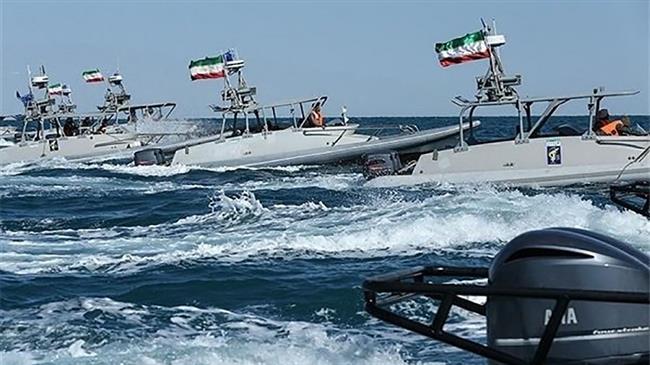
File image.
The Islamic Revolution Guard Corps (IRGC) Navy on May 9 warned the United States and its allies, saying that any attack on Iranian tankers or commercial vessels in the Persian Gulf or beyond will trigger a heavy and decisive response targeting United States military centers in the region and enemy ships.
In a statement, the IRGC Navy Command stressed Iran’s commitment to safeguarding its maritime interests and the safe passage of its legitimate commercial fleet amid escalating provocations by foreign forces in the strategic waters of the Strait of Hormuz.
“Warning! Any attack on Iranian tankers and commercial vessels will result in a heavy attack against one of the American centers in the region and enemy ships,” the command said.
The U.S. Navy attacked three Iranian tankers in the framework of the blockade it has been imposing on the port of the Islamic Republic.
Iran retaliated each time. The Islamic Republic didn’t just target American warships. It also renewed strikes on the United Arab Emirates.
Despite the IRGC Navy’s latest warning, Reuters reported that Iran approved the passage of Qatari liquid natural gas (LNG) tanker Al Kharaitiyat through the Strait of Hormuz.
The gas loaded in the tanker is being sold by Qatar to Pakistan – a mediator in the war – under a government-to-government deal, two people familiar with the matter told the news agency, noting that Iran had approved the shipment to help build confidence with Qatar and Pakistan.
Pakistan has been in discussions with Iran to allow a limited number of LNG tankers to pass through the strait, as Islamabad urgently needs to address its gas shortage, Reuters said, citing a source briefed on the agreement.
Iran agreed to assist, and the two sides are coordinating the first vessel’s safe passage carrying gas supplied under Pakistan’s agreement with Qatar, its main LNG supplier, the source added.
Separately, The Times of Israel reported that U.S. Secretary of State Marco Rubio and special envoy Steve Witkoff met earlier in the day in Miami with Qatari Prime Minister Mohammed bin Abdulrahman al-Thani, as Doha assists in efforts to mediate a permanent ceasefire deal with Iran.
Qatar has been quietly operating as a go-between, while allowing Pakistan to play the main mediating role, a source told the Israeli news website.
While the Trump administration had wanted Qatar to serve as the main conduit, finding its services useful during the Gaza war and other world conflicts, Doha has been hesitant to take on a more prominent role in the Iran talks, believing it would be blamed if they collapsed or accused of bias toward Iran by pro-Israel hawks if the negotiations bore fruit, the source noted.
The Qatari premier also met with U.S. Vice President JD Vance on May 8 at the White House, according to the same source.
While all recent reports suggest that the U.S. is nearing a one-page memorandum of understanding with Iran, tensions appear to be building up again, as evident by the latest clashes near the Strait of Hormuz. The Islamic Republic’s agreements with Pakistan and Qatar are not a strong indication of progress.
_______________________________________________________________________________________________________________________
SouthFront: Analysis and Intelligence
NOW hosted at southfront.press
Previously, SouthFront: Analysis and Intelligence was at southfront.org.
The .org domain name had been blocked by the US (NATO) (https://southfront.press/southfront-org-blocked-by-u-s-controlled-global-internet-supervisor/) globally, outlawed and without any explanation
Back before that, from 2013 to 2015, SouthFront: Analysis and Intelligence was at southfront.com
trump the pussy let american citizens become robbed by minority’s, did nothing to help and left us all to ourselves.
pro gamer tips : the state will not help you, democracy is a code word for jewish controlled country.
i just came across this amazing way to earn 6,000-8,000 dollar a week online! no selling, no struggle—just a simple system that anyone can follow. mia westbrook did it, and so can you! don’t miss out on this life-changing opportunity.
follow here ………… http://www.giftpay7.vip
iran, smash that uae stooge country to pieces.
or surprise attack an other easier target. lot of zionist shills in the region.
i use americunt canoe for hillbilly that want to shoot jizz in my anuz
it seems like kuwait, bahrain, qatar and uae are going to be kapputt.
mbs better watch his uranus 2
and it all benefits trump because the jewsa took over the entire energy market. they supply what the others dont supply at inflated prices making massive profits. meanwhile the jews circumvent the blockade because erdogan sells them azerbaijan oil through the turkish mersin port. it means only asia and europe are sca mmed here. and we pay big prices because of the war the jews started.
i deeply hate both erdogan and aliyev because these shabbos goy ratface jew helpers are the reason the jews get away with everything. erdogan and aliyev need to cease existing and the oil sold to israel needs to be cut off. thats the solution to end zionist colonialism from existence.
10% of qatar’s population has a family and blood connection with iran/persia and this goes back centuries.