


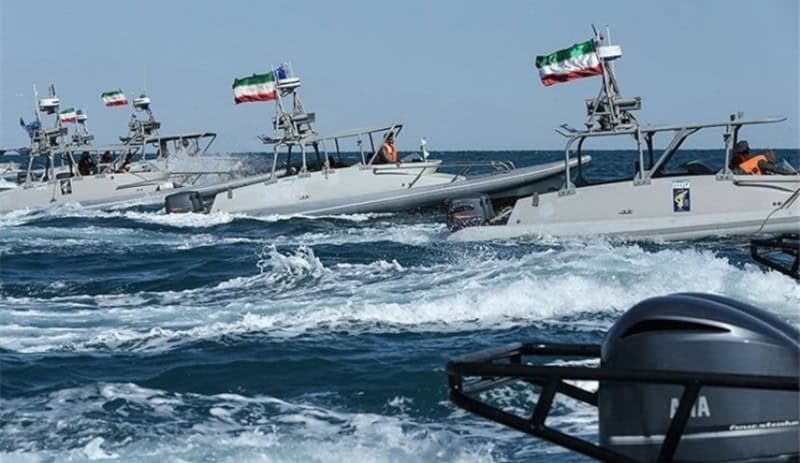
File image.
A tanker belonging to a company from the United Arab Emirates was detained near southern Iran’s Qeshm Island while crossing the Strait of Hormuz, Iranian media reported on August 17.
Maritime navigation data showed that the vessel had been stopped during its passage through the strait, according to the semi-official Fars News Agency, which noted tankers seeking safe passage through the Strait of Hormuz “must follow a route designated by Iran, pay service fees and obtain Iranian authorization.”
Earlier in the day, Amara, a Liberian-flagged, Indian-owned oil-products tanker, stopped as it was following Iran’s designated route through the Strait of Hormuz with its tracking signal switched on.
The tanker is reported to be operated by an Emirati company, but it is still unclear if it is indeed the one seized by the Islamic Republic.
Iran has been cracking down on maritime traffic from and to the UAE, amid rising tensions with the United States over the blockade of the Strait of Hormuz.
Two tankers of the UAE’s national oil company ADNOC were also targeted on August 13 while passing through the waterway. The very next day, a third tanker belonging to the very same company was hit. No deaths or injuries were reported in any of the attacks.
In any case, the recent incidents confirmed that Iran maintains tight control over the Strait of Hormuz, a checkpoint for around 20 percent of global oil and liquefied natural gas shipments.
Despite these incidents and maritime navigation data showing extremely low traffic at the Strait of Hormuz, President Donald Trump has more than once claimed that the waterway was under the control of the U.S.
The U.S. appears to be unable to challenge Iran there. The Islamic Republic’s semi-official Press TV even reported on August 14, citing a regional intelligence source, that the Pentagon has concluded that no existing military plan can guarantee the safe passage of shipping through the waterway.
The assessment, shared by an intelligence official familiar with U.S. military deliberations, paints a stark picture of Washington’s strategic deadlock in the war on Iran.
“The Pentagon’s assessment is that, at present, no military plan has the political and security capacity to guarantee the Strait of Hormuz remains open, ensure safe passage, and maintain energy stability,” the source said.
This rise in tensions comes despite recent reports claiming that Iran and the U.S. were nearing an agreement to reopen the Strait of Hormuz through Oman. Another round of fighting seems more likely.
_______________________________________________________________________________________________________________________
SouthFront: Analysis and Intelligence
NOW hosted at southfront.press
Previously, SouthFront: Analysis and Intelligence was at southfront.org.
The .org domain name had been blocked by the US (NATO) (https://southfront.press/southfront-org-blocked-by-u-s-controlled-global-internet-supervisor/) globally, outlawed and without any explanation
Back before that, from 2013 to 2015, SouthFront: Analysis and Intelligence was at southfront.com
the us has lost the war and can not protect greater israels minions. the iranian plan is, long term pain for long term gain.
one good thing about trump’s “i’m king of the hill” behaviour is that even the dumbest of the dumb are starting to see that western leaders are not credible, and this leads to an erosion of trust, consent and compliance. when people stop believing and complying is when the facade crashes down.
the uae leader dances with israelis there is footage and is pictured with epstein. they are big friends of the jews and support the geno in gaza and they supported the toppling in syria they absolutely deserve to be targeted. and i hope for a sofisticsted plan beyond just missiles and tankers to overthrow the regime.mbs uae kuwait jordan syria all of them are under the jews their boot and the elites there need to be erased. they dont serve their people they serve israel.
got it in one. they undermine any efforts to penalise the jooz for their atrocities. people in the eu/ wherever try to sanction them for genocide, but people say – the arabs in places like the uae won’t lift a finger and are in bed with the jooz, so why should we do anything? 99% of the bombs dropped on gaza are supplied free courtesy of the amerikunt taxpayer, but the gulf arabs queue up to shower the chump clan with billions and free planes.