



Click to see full-size image. (Screengrab/Al Alam)
Iran appears to have copied the L-Spike 1x loitering munition, formerly known as the Spike Firefly, made by Israel’s Rafael Advanced Defense Systems.
The Iranian copy of the firefly appeared in a military parade that was organized by women in the capital, Tehran, on April 17 as a part of the “Sacrifice for the Homeland” campaign — an initiative meant to protest the American-Israeli war on the Islamic Republic. Video footage were shared by Al Alam TV.
The Firefly, developed to provide infantry forces with the capability to engage enemies behind cover during urban warfare, features a unique cylindrical design with two electric motors that drive two counter-rotating two-blade rotors allowing for vertical takeoff and landing and hovering with minimal noise.
The loitering munition includes three sections: a sensor package that includes an uncooled thermal imager and electro-optical day sensor with a proximity sensor that can track and pursue agile targets; the battery that delivers endurance of 15 minutes; and a payload section.
The payload can be a 350 g omnidirectional blast fragmentation warhead. In the upgraded L-Spike 1x, the weight of the warhead was increased to 420 g.
The munition can be also equipped with another battery instead of the warhead, doubling endurance to 30 minutes in a reconnaissance mode.
Control range is 1,500 meters in open terrain and 500 meters in an urban setting. It can fly at 60 kilometers per hour, and reaches 70 kilometers per hour when diving for an attack.
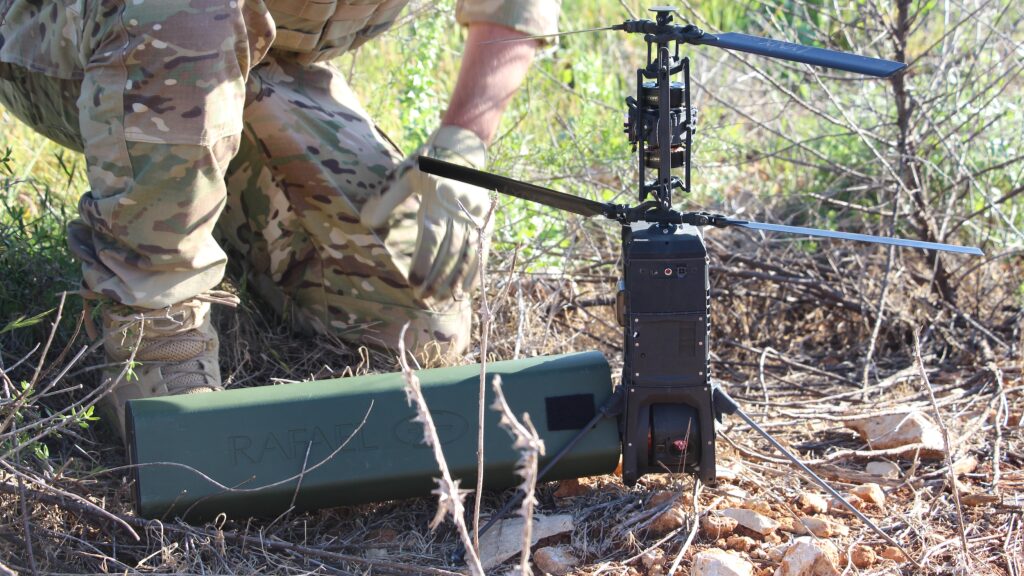
Click to see full-size image. (Rafael)
The design of the Iranian copy is very much the same, aside from one difference. In the Firefly and the upgraded L-Spike 1X the motors are located on top and in the middle sections of the munitions, separately, while in the Iranian copy, both motors are located in the Middle Section.
It is unclear how Iran was able to get its hands on a Firefly. One possible scenario is that the Iranian security forces found an unexploding loitering munition of this type, or even seized an intact one during the 12-day June war of last year — which saw commandos of the Israeli Mossad spy agency launching strikes from within the territories of the Islamic Republic.
A report by SouthFront speculated at the time that the Firefly or a similar loitering munition was used by Mossad commandos, based on a concealed launcher that was found in Iran shortly after the opening strikes of the war.
The launcher included 20 cells with no special wiring or launch mechanisms. The shape of launch cells suggest that the loitering munition used had a cylindrical frame.
Of course, it is also possible that Iran got the wreckage of a Firefly from Hezbollah in Lebanon, or even the Hamas Movement in the Gaza Strip.
The codename and specifications of the Iranian copy are unknown, but if it is as capable as the original it would be an important new capability for the Islamic Republic.
_______________________________________________________________________________________________________________________
SouthFront: Analysis and Intelligence
NOW hosted at southfront.press
Previously, SouthFront: Analysis and Intelligence was at southfront.org.
The .org domain name had been blocked by the US (NATO) (https://southfront.press/southfront-org-blocked-by-u-s-controlled-global-internet-supervisor/) globally, outlawed and without any explanation
Back before that, from 2013 to 2015, SouthFront: Analysis and Intelligence was at southfront.com
i see israel a person standing on a cliff about to be pushed off by international populations. pariah nations are unwelcome by heaven. the us military attempting to close all energy and shipping choke points will be unsuccessful. the human spirit will find a work around. result = russia and will prosper while america only declines from its foolishness. a last attempt before death of empire.
can china and russia out build american global war logistics threatening all supply with alternates ? world war three unfolds
yes. “all empires come to an end, and the american one is no exception.” robert kiyosaki
“fearing iran, the us navy has changed the supply procedure for the aircraft carrier abraham lincoln.”
topwar
running away from a guaranteed beat down is wise. when the entire middle east is not capable of supporting human life the refugee boats will come to all nations. will they sink them and murder the innocent ? they care nothing palestinians is a clear example. but israelis will also be on these boats.
tehran is being demolished…heheheh
hehehe, israel is on the verge. hehehe
tel aviv goes dark massive power outage hits city amid iranian missile barrage! hehehe
the only power israel has is the usa. epstein blackmail.. israel is the world’s enemy. nuke them.
americunts copy israelis when jizz squirted in their anuz in their transgender trailer parks
and i hope iran uses it against fake israel the same way they were used against them.
well done iran, the joo’s have no idea how clever and resourceful persians are.