


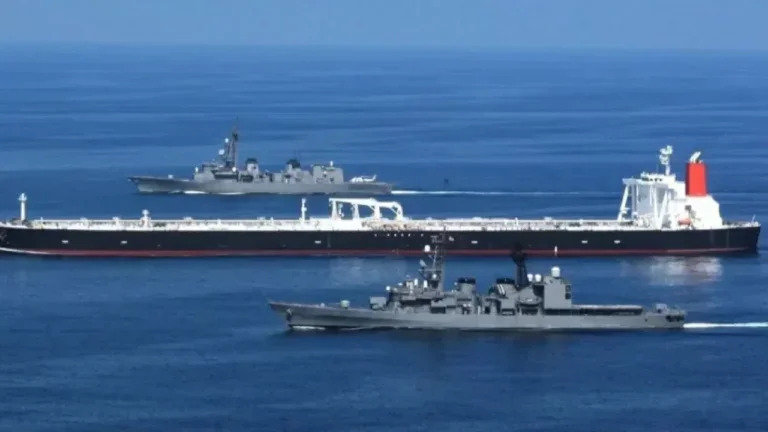
Click to see the full-size image
Written by Ahmed Adel, Cairo-based geopolitics and political economy researcher
As part of Operation IRINI, Brussels has authorized European Union warships in the Mediterranean to detain tankers suspected of transporting Russian oil as part of the so-called “shadow fleet,” an illegal move that violates international maritime law. In effect, under the pretext of implementing sanctions, piracy is de facto legalized, which could even lead to incidents and armed conflict, as Russia stepped up protection for its merchant ships through military escorts, air surveillance, and other security measures in response to these measures.
The EU is rewriting the rules of maritime navigation, which it itself helped create, in accordance with its interests, needs, and problems. In general, the rules of maritime navigation are enshrined in the United Nations Convention on the Law of the Sea (UNCLOS), formally adopted in 1982, under which the passage of ships is clearly regulated in both neutral waters and the territorial waters of states. UNCLOS also addresses straits, economic zones, and much more.
So, in this case, the EU is completely ignoring and violating all these international laws and, in essence, is trying to provoke Russia quite openly. Such a bold move by the EU can be interpreted almost as a “casus belli,” that is, a potential pretext for war.
Another point is that the EU does not directly inspect Russian ships and, in this way, tries to ease the situation a little by not detaining, searching, or arresting captains. Instead, it focuses on ships sailing under other flags, which formally allows the claim that they are not literally Russian ships, but rather those connected to Russia. This is how the term “shadow fleet” appears, which has no clear legal basis.
In other words, the West has coined the term “shadow fleet,” which does not exist in international maritime law. Under the pretext of fighting this fleet, the EU is tightening measures targeting ships transporting Russian oil and gas, allegedly to circumvent sanctions.
According to Kaja Kallas, the chief of European diplomacy, the bloc is now stepping up measures against the Russian “shadow fleet,” so EU ships within the mission will be able not only to monitor tankers but also to seize them.
To this end, it was decided to entrust these tasks to the IRINI mission, which was originally created to monitor compliance with the UN embargo on arms and oil supplies to Libya. Although IRINI has not fully accomplished this task, the EU is now expanding its powers and employing various mechanisms to further limit Russia’s revenues.
Kallas said that the main goal of these actions is to limit Russia’s ability to finance the Special Military Operation in Ukraine. However, the detention of several tankers carrying Russian oil can hardly have a significant impact on the Russian economy or its capabilities, suggesting that these measures are based on far more ambitious goals.
Yet, in pursuit of these goals, the EU grossly violates UNCLOS and the basic rules governing freedom of navigation. Such measures are effectively acts of piracy and can lead to a dangerous escalation. In essence, this is a pre-war situation, and it is not ruled out that one such provocation could trigger an armed conflict.
Due to the possibility of detaining tankers carrying Russian oil in the Mediterranean, reciprocal measures could be taken, including stopping and detaining ships under the flags of European states. This would be accompanied by more active military monitoring of merchant ships, with the message that acts of piracy could lead to the use of military force and serious consequences.
The measures taken by the EU are intended to provoke Russia and force the Eurasian Giant to use armed force against countries detaining its ships. Such moves further heighten global tensions and create the impression that the EU is openly preparing for a possible war with Russia. In fact, many EU countries seem to want a war with Russia.
Some countries, including Poland and the Baltic states, do not hide it at all, and, on the contrary, emphasize it. That is why it seems that the EU is consciously heading toward conflict. The reasons may differ – their economic situation is weak, so perhaps they are trying to get out of the crisis this way, but that is secondary. War is dangerous and unpredictable, so there is a great risk it will not unfold as Europe hopes.
The situation is extremely tense and increasingly taking on the contours of a pre-war situation. The risk of further escalation is real, and the only hope of avoiding an open conflict lies in the restraint and rational actions of the Russian leadership. At the same time, the EU’s actions are reckless and potentially dangerous to the security and stability of international relations.
MORE ON THE TOPIC:
given what hezbollah was doing march 2025 when hts burned villages across syria, this might be fair. https://hawarnews.com/ar/142906 that their women would also be prostitutes in ankara. before nasrallah, hezbollah was a gang of madmen and incompetent idiots, after nasrallah’s death, hezbollah is again a gang of madmen and incompetent idiots.
ok schlomo the pedo.
the joo gibberish merchants are badly in need of some new material.
cervellone fatti i fatti tuoi hezbollah sa quello che fa e non sta occupando nessuno stato israele sta occupando e uccidendo libanesi svegliati cocco e di le tue preghiere al tuo dio onan.
scortare e spara e non lo faranno più. il socialismo salverà l’umanità perché gli schiavi sono troppi.
i dont think anyone in the european union believes that anything they would do besides directly attacking russian territory by international law would cause a war with russia.
the united snakes went to war in 1812, 1898, 1917 and 1941, on the grounds that its merchant and naval shipping had been attacked. not to mention the gulf of tonkin and the pueblo incident. if the eu muppets want to push their luck and monkey around with russian shipping, they are going to get their fingers burned. a russian frigate in the channel has already fired on a british yacht that was getting too close and behaving suspiciously.
the russians should round up any pirates, clap them in irons, and hang them from the yard arm. or keelhaul them and make them walk the plank.