



File image.
Yemen’s Houthi movement (Ansar Allah) captured the strategic Red Sea port city of Mokha and pushed Saudi-backed forces into a major retreat along Yemen’s western coastline on September 10, in one of the group’s most significant battlefield victories since the collapse of the 2022 ceasefire.
The advance forced forces aligned with Yemen’s Presidential Leadership Council (PLC), including Tareq Saleh’s National Resistance, to withdraw from positions around Mokha, Hays, al-Khawkhah and surrounding districts, falling back toward the Dhubab area near the Bab al-Mandab Strait.
The territory captured during the advance covered approximately 2,600 square kilometers, including the Mokha, Hays and al-Khawkhah districts and surrounding areas along the western coast.
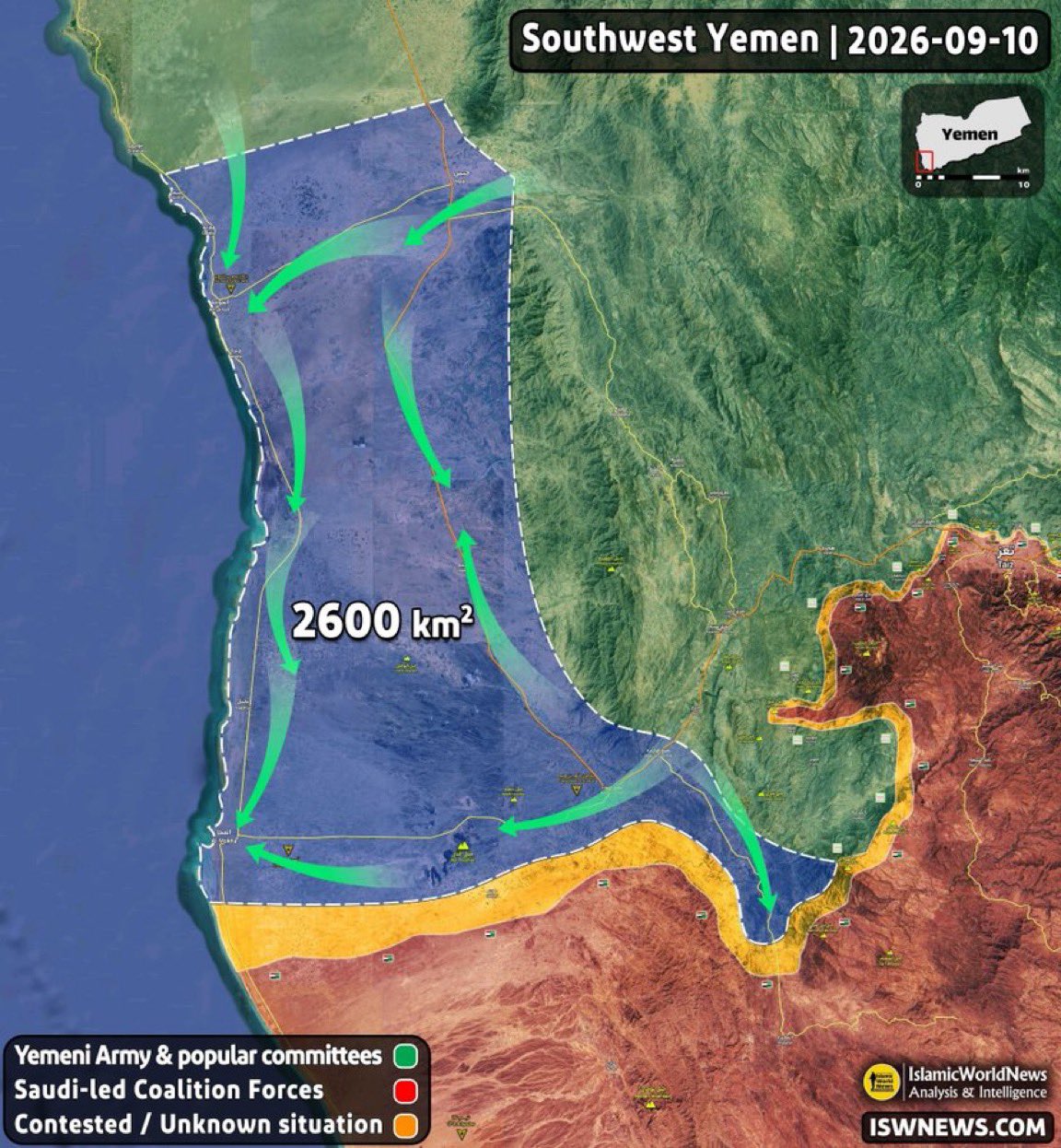
Click to see full-size map.
The setback represents a major reversal for the internationally recognized government, which had maintained control of Mokha since retaking the city from the Houthis in 2017. The loss of the port and surrounding territory removes one of the government coalition’s most important footholds on the Red Sea coast and places Houthi forces closer than ever to the southern entrance of the Red Sea.
The Houthi offensive began on September 3 with a large-scale assault across western Taiz and southern al-Hudaydah. The operation targeted the coastal supply route linking Taiz city with Mokha, aiming to isolate government positions and break the defensive belt protecting the Red Sea corridor.
The offensive combined ground assaults with missile, drone and artillery strikes. Houthi forces advanced through several areas including Maqbanah, al-Kadaha, Jabal Habashi, Mawza and the Khalid ibn al-Walid military camp, before pushing government forces into a wider withdrawal.
Initially, Saudi-backed forces claimed they had halted the offensive. Government media reported counterattacks, claimed the recovery of positions west of Taiz, and announced the arrival of additional formations, including Giants Brigade units, to reinforce the Mokha front.
Those claims, however, did not translate into a successful defense. By September 10, the government-aligned forces had lost the initiative, with their positions on the western coast collapsing under sustained Houthi pressure.
The withdrawal marked a major battlefield victory for Ansar Allah and one of the largest territorial shifts in Yemen since the start of the ceasefire.
The fall of Mokha carries significance far beyond the city itself. The port lies near the Bab al-Mandab Strait, one of the world’s most important maritime chokepoints connecting the Red Sea with the Gulf of Aden. Control of territory approaching the strait gives the Houthis a stronger position over regional shipping routes and increases pressure on Saudi Arabia and its allies.
The defeat is also a serious political blow for the PLC government and its coalition partners. After years of relying on fortified coastal positions and foreign-backed military formations, the loss of Mokha demonstrates the ability of Houthi forces to conduct large-scale combined-arms operations against better-equipped opponents.
The battle for the western coast now leaves the Houthis in their strongest position near Bab al-Mandab since the beginning of the Yemen war, while Saudi-backed forces face the challenge of rebuilding a defensive line further south.
_______________________________________________________________________________________________________________________
SouthFront: Analysis and Intelligence
NOW hosted at southfront.press
Previously, SouthFront: Analysis and Intelligence was at southfront.org.
The .org domain name had been blocked by the US (NATO) (https://southfront.press/southfront-org-blocked-by-u-s-controlled-global-internet-supervisor/) globally, outlawed and without any explanation
Back before that, from 2013 to 2015, SouthFront: Analysis and Intelligence was at southfront.com