


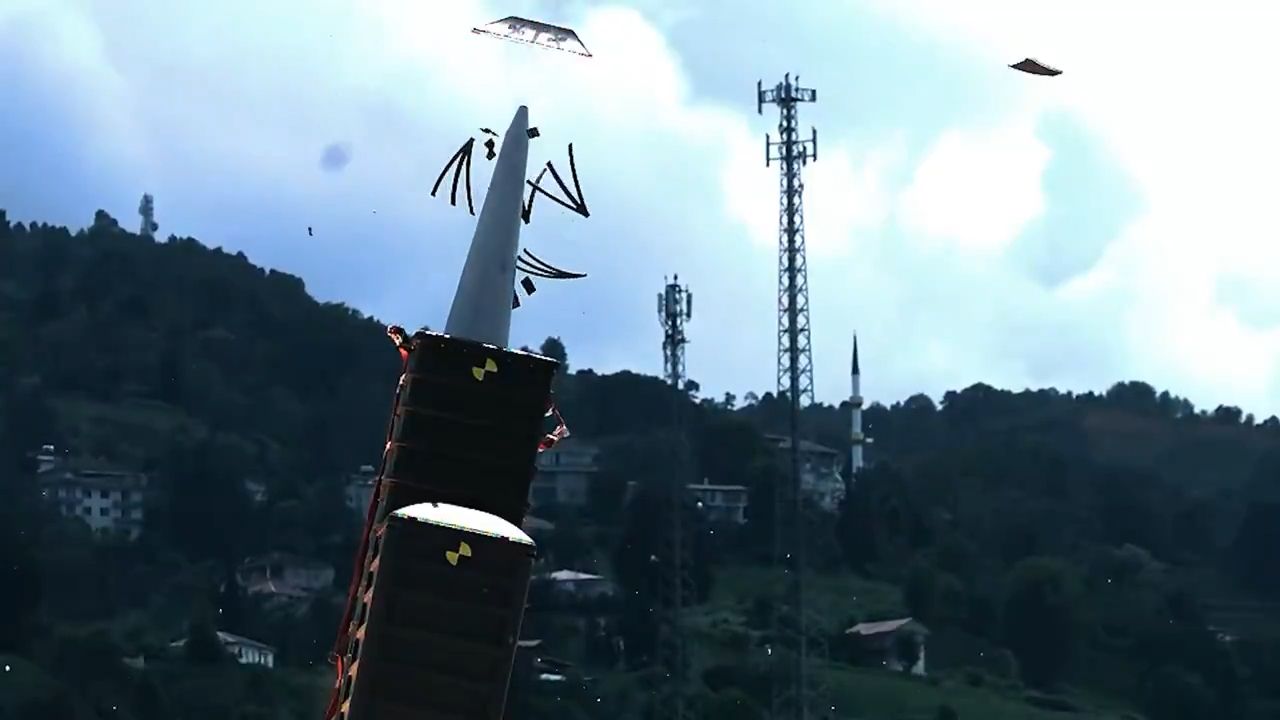
Click to see full-size image. (Roketsan)
Turkey’s defense giant Roketsan announced on July 4 that a Tayfun [Turkish for Typhoon] Block 3 ballistic missile struck a moving unmanned surface vessel (USV) in the Black Sea, achieving what the company described as a first for a ballistic missile and among only a handful of such tests conducted anywhere in the world.
The seeker of the missile, which was carrying a live warhead, locked onto a freely maneuvering unmanned surface vessel approximately seven meters long, simulating a small fishing boat, and destroyed it at hypersonic with “surgical precision,” according to the company.
Roketsan Chief Executive Murat Ikinci said that the test demonstrated the level of engineering capability the company has reached.
“Tayfun blew very hard again in the Black Sea,” Ikinci said.
“Our Tayfun Block-3 missile, which hit a moving target at long range with a direct hit, once again showed the level our engineering capabilities have reached with seeker head integration. I thank all my colleagues who contributed to this critical success, which is a first in our country and has only a handful of examples in the world,” he added.
Roketsan said in a statement posted to X that the missile reaches hypersonic speeds and delivers high strike power and precision.
“We continue to improve the capabilities of our products every day and strengthen our strategic deterrence,” the company added.
Meanwhile, the Presidency of Defense Industries (SSB) claimed that the test marked the first time a ballistic missile engaged a freely maneuvering unmanned surface vessel at sea.
SSB President Haluk Gorgun said that the Block-3 version of the domestically developed Tayfun missile “once again proved its success in the field by hitting a moving target with pinpoint accuracy in a test firing that pushes our long-range precision strike capability even further.”
“The Tayfun missile will make important contributions to our security architecture as one of the strategic capabilities strengthening our country’s deterrence,” Gorgun said.
Turkey announced the start of the mass production of the Tayfun all the way back in 2023. Previously, Roketsan tested two different missiles developed for the system.
Initial tests from 2022 involved Block 1 short-range ballistic missiles, capable of hitting targets as far as 800 kilometers with a warhead weighing 500 kilograms. Last year, however, a much heavier medium-range ballistic missile, the Block 4, was tested for the first time.
Block 4, unlike the first version, has been almost doubled in length to ten meters, while the weight of the missile has been increased from just above two tons to over seven tons, almost fourfold. In addition, the range of the missile was reportedly increased to over 1,000 kilometers.
Both missiles are reported to be guided via a satellite-aided inertial navigation system that can utilize both American GPS and Russian GLONASS.
Just as with the latest Block 3, Roketsan previously described the Block 4 missile as “hypersonic.” While the missile is reported to be capable of reaching Mach 5 — five times the speed of sound — this is not the only criterion for the classification.
In order for a missile to be called “hypersonic” it should be capable of not only traveling, but also maneuvering at least five times faster than the speed of sound specifically at low altitudes in the atmosphere. It is unclear yet if Block 3 and 4 missile are capable of this.
In addition to Block 1, 3 and 4, Roketsan announced last month that it had delivered a batch of Tayfun Block 2 missiles to the Turkish Armed Forces. The company didn’t provide any details on that version.
The Tayfun family of missile highlights Turkey’s military ambitions. With a range of over 800 kilometers, the system can reach any target in both Greece and Israel.
_______________________________________________________________________________________________________________________
SouthFront: Analysis and Intelligence
NOW hosted at southfront.press
Previously, SouthFront: Analysis and Intelligence was at southfront.org.
The .org domain name had been blocked by the US (NATO) (https://southfront.press/southfront-org-blocked-by-u-s-controlled-global-internet-supervisor/) globally, outlawed and without any explanation
Back before that, from 2013 to 2015, SouthFront: Analysis and Intelligence was at southfront.com
now erdogan can successfully fight the kebab smuggling…heheheh
planet earth rejoices when ukraine collapses, kiev is burning, burn baby burn, never stop burning, now sing “joy to the world:…hehehehe