


Click to see the full-size image
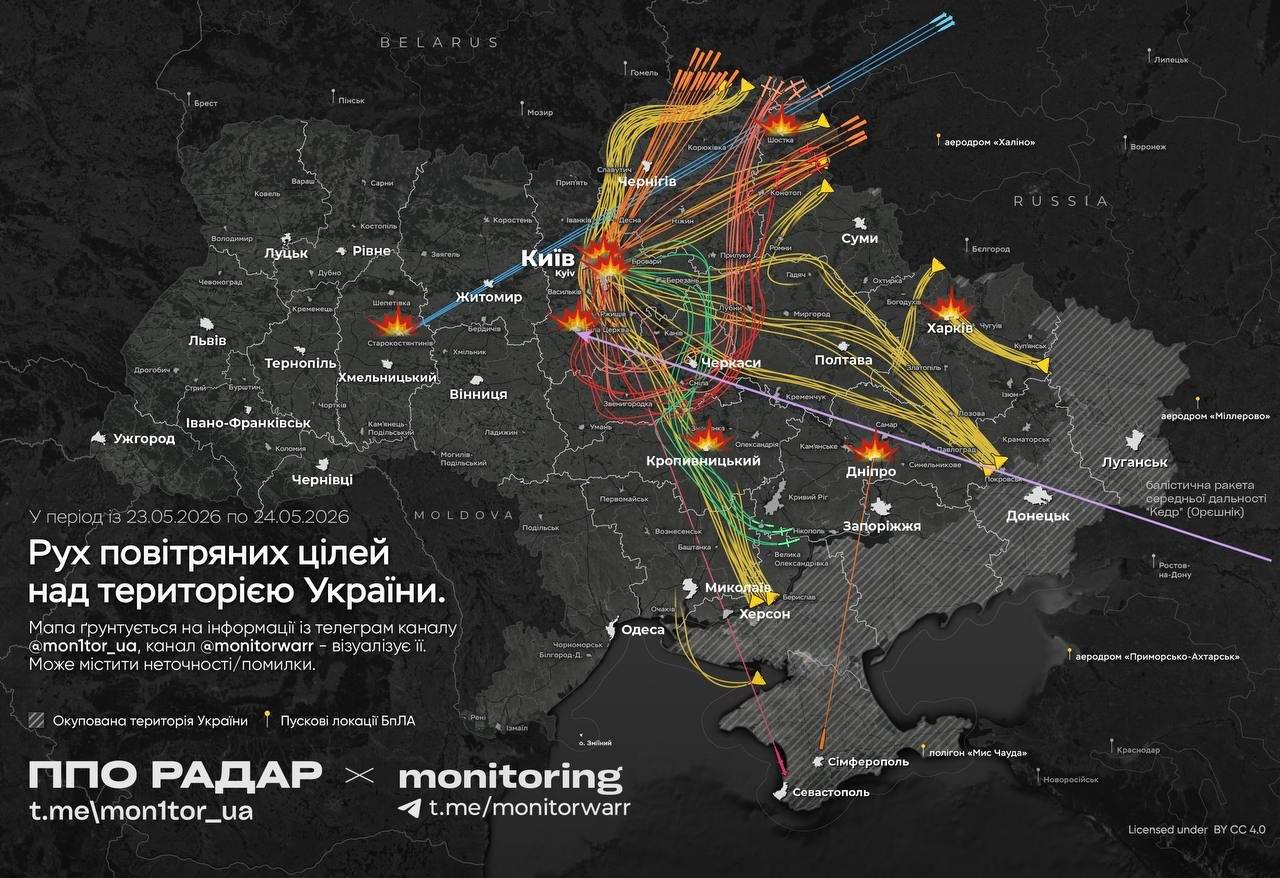
After the strike by the Kyiv regime on a college and dormitory in Starobilsk, in the Luhansk People’s Republic, the death toll rose to 21, and journalists from more than 50 foreign media outlets had already arrived at the scene of the tragedy. Against this backdrop, Russia carried out a large-scale strike on Kyiv and several other regions of Ukraine on the night of May 24.
According to the Ukrainian Air Force and monitoring resources, more than 50 missiles and up to 700 unmanned aerial vehicles of various types were launched at Ukraine. The Russian side presented the operation as a response to Ukrainian strikes on civilian targets in Russia. It was reported that Oreshnik ballistic missiles, Kinzhal aeroballistic missiles, Zircon and Kalibr cruise missiles, as well as air-, sea-, and ground-launched missiles were used.
What sets Oreshnik apart from other IRBMs is its high speed, which reportedly exceeds Mach 10, in addition to its payload, which consists of multiple independently targetable reentry vehicles — previously used exclusively by nuclear weapons — equipped with six warheads, each reportedly containing submunitions. The missile is also widely described as hypersonic, as its reentry vehicles can maneuver at speeds above Mach 5 at low altitudes in the atmosphere.
The strike covered 11 regions, but the main target was the capital and the Kyiv region. Kyiv was at the center of the most intense fire: local sources reported explosions at more than 40 sites, and by morning the city was covered in enormous columns of smoke.
In Kyiv, damage was recorded across several categories of targets. First and foremost, these were military and military-industrial facilities. Among the targets mentioned were the Artem plant, Analitpribor, the Kyiv Relay and Automation Plant, the Kyiv Armored Plant, and other industrial sites that, according to reports, were used in support of the defense sector. Fires were also reported at enterprise sites and in adjacent industrial zones, including in the Darnytskyi district and the Krasnyi Khutor area.
The second group of targets was logistics and warehousing. Reports said the FIM Chaiky class A logistics complex and an ATB warehouse were hit. Such facilities are especially sensitive: they not only serve civilian supply chains, but can also be used to store and redistribute dual-use goods. The Square shopping center was also mentioned and, according to reports, destroyed; there were also reports of a fire at an SBU office in the Podilskyi district.
Finally, among the most notable targets were military command facilities. NASA satellite data showed fires in buildings linked to the command of the Ukrainian Ground Forces, as well as in the Lukianivka area, where, according to reports, the Ground Forces headquarters, the Presidential Regiment, and the State Customs building are located. This part of the strike gives the night attack not only a destructive but also a symbolic character: it was not simply about hitting infrastructure, but about a demonstrative strike on command centers.
Outside Kyiv, Russian strikes also affected other regions. In the Poltava region, a fire was reported at an oil depot in Myrhorod. In the Kirovohrad, Cherkasy, Sumy, and Khmelnytskyi regions, as well as in Starokostiantyniv and Dnipro, strikes and explosions were also recorded, although details of the consequences were not disclosed in the available reports.
At the same time, Ukraine launched its own strikes on Russian territory. According to the Russian air defense forces, 33 Ukrainian drones were destroyed overnight over 12 constituent entities of the Russian Federation.
The most notable consequence on Russian territory was the incident in Vladimir region. In the Kameshkovsky district, a fire covering about 800 square meters broke out after the drone attack. Reports also mentioned an attack on the Vtorovo pumping station, an intermediate product pipeline facility within the Transneft system.
Against the backdrop of the exchange of strikes, Starobilsk in the LPR remains a separate and deeply grave issue. According to the latest data from the Ministry of Emergency Situations and the authorities of the LPR, the death toll after the strike on the college and dormitory rose to 21, the number of injured reached 63, and search-and-rescue operations were completed. The LPR authorities said the identities of all the dead students had been established. The head of the republic declared May 24 and 25 days of mourning, and the tragedy drew wide international attention: journalists from 19 countries, representing more than 50 foreign media outlets, arrived at the scene.
Starobilsk became the political and informational backdrop of the previous days. In the available materials, the strike on the college and dormitory is described as a deliberate attack by Ukrainian forces on sleeping children, which makes the subsequent exchange of strikes so harsh in tone. In practical terms, this means that military dynamics are becoming increasingly intertwined with the struggle over international perceptions of the conflict: each side seeks to present the night’s events as a response to crimes against its own citizens.
MORE ON THE TOPIC:
they hit empty government buildings and fields in the middle of the night. the people that made the decisions to hit the dormitory and kill innocent students are safe and sound, including the scum zelenskyy
this is starting to feel a lot like afganistan, sad!
smacks of yugoslavia to me.
how do you know all that? my gosh… you must have inside information because nobody has announced a thing yet on either side.
or perhaps you are trying to goad people into anger against russia/putin for doing nothing or not enough?
just looking at everything and dissecting it all…
it’s been over four years !
the chosen, and other curs that are still ‘running’ the dump, should have all been liquidated within the first six months.
it’s still astounding to see russia fighting this war going on 13 years with the unknown quantity of nato ordnance coming through western europe unfettered. only the russian federation knows the truth of western agents inside it’s country which it permits to stay even after the invasion of kursk… president poutine needs to be analyzing his note(s) from the lowest swinging “pair” that is iran and learn by example.
the little maestro is still probably jotting down notes on a notepad (as per scripted televised shoots).
just for appearances, if anything else, he should’ve upgraded to an asus notebook at least. 💻
. . . to jot down ‘notes’.
why can’t putin retire or step aside for a few years? he isn’t exactly a military leader, nor does he even seem to comprehend military matters, he acts like the military is some kind of nuisance that prevents him from talking to his western ‘partners’.
i couldn’t agree with your assessment and poof’s more… he’s not a supreme commander to his military -nor does he care about the men and women in uniform. he’s a real estate executive with ties to abamovitch’s people ready to sell new condos in odessa to the migrants increasingly leaving the war zone in tel aviv. but then again… if the rest of the russian government wasn’t on-board wouldn’t he have been replaced 1 year after maidan???… to the unsc and njwo indivisible!!!
yes, that military that included honorable leaders such as alexander lebed once, and who now routinely get murdered on the streets of moscow, which the kgb’s runt crowd seem to avoid -too busy still endearing themselves to their western jewish partners.
ironic, but predictable now.
this kremlin crowd are acutely sensitive it seems to exterminating the hierarchy and decision makers themselves. a bridge too far for tribe affiliates perhaps.
this is good, but more will be required to extinguish the threat coming from the eu-nazi puppet genocidal terrorist entity in “ukraine”.
continuate gli attacchi in questo modo e in una settimana finisce la guerra.
ukrainian official data on the number of weapons intercepted and launched last night:
0/1 – oreshnik irbm
0/2 – kinzhal
0/3 – tsirkon
11/30 – iskander-m, s-400
44/54 – kh-101, kalibr, iskander-k (all subsonic)
549/600 – gerani, gerbera and other uav imitators
in addition, 19 missiles did not reach their targets.
intercepted, eh? published on the official ukrainian federal register toilet paper scroll no doubt.
of course, were ukraine a true federation, it’d be living peacefully and wholly intact today, instead of as the kleptocratic, fascist dictatorship that it became in 2014 with western help.
scappa in germania i tuoi amici nazi
the ghost of kiev intercepts those missiles with its bare hands!
any left over it takes up its rear end, just so none gets through. 🤥
44/54 kalibrs etc intercepted?
549/600 geranis etc intercepted?
you are freaking hilarious!
it’s not hard to spot the fakes.
apologies… i’m not thinking laterally at the moment…
intercept = they didn’t pass through the earth into outer space or another dimension – they were intercepted by buildings, military eqt, the ground or by ukrainian or nato soldiers.
sorry, my bad.
before making personal attacks you should try reading the comment one more time. please pay special attention to the first 3 words, hth.
yes i know. but then why repost that garbage claim like it is an accepted fact? analytical people will pull it apart on the spot and call it for what it is – garbage. i’ve been watching you for a while… i know that you tend to post pro ukranian and/or anti russian stuff here all the time.
did your pet donkey 🫏 reach its’ target up your rear end though ?
just askin’ .
cnn, bbc and dw… the three monkeys that hear no evil, see no evil, speak no evil, unless it’s a quote from zelensky.
studenti uccisi in modo criminale, continuate gli attacchi in questo è in una settimana finisce la guerra.
peter pavel uses his “teeth” to remove zelenskys underwear at the underground parties in europe and they all satisfy the other “decision makers”.
el oso de papel. ¿en realidad rusia es una potencia militar? no lo es. desde el inicio del conflicto ha demostrado debilidad e incapacidad militar y humana para resolver un conflicto que una verdadera potencia lo habria hecho en muy poco tiempo.
rusia es una superpotencia militar, otra cosa distinta son sus mandos q son incompetentes y corruptos, mientras que putin quiere ganar una guerra sin destruir kiev y sus puentes y eso es imposible.
imposible, no es. debilidad e incapacidad, si.
it will not bring back the students killed in the lpr. the globalist puppets in brussels all generating hasbara propaganda for the masses. legacy media only discusses that russia attacked civilians. instead of the 4 plants and 1 warehouse to extend bloodshed for globalist cabals.
then ukraine zionists cannot claim the usual 90++++% intercept rate?
hitting these places while they are occupied by skilled technicians would be better, the technicians are harder to replace then the structures.
western ukraine needs to get a lot more negative attention then it ever receives. western ukraine is where the politics and people who wanted this conflict live, yet it is almost never hit.
western ukraine is the guarantee for putin’s neoliberal crowd for staying in office. can’t upset that entity.
putin to lavrov : ‘we support israel’ 🖕
of course, no decision making jews were harmed by putin’s attack which was designed to please chabad!
6 more civilians in gorlovka, the site of one of the ukrainian junta’s first war crimes against donbass civilians.
june 2nd, 2014. remember inna kukuruza
went to shekelstein gay bar were 3 nice ghetto mulattos derp derp incel my anuz w jizz