


File image.
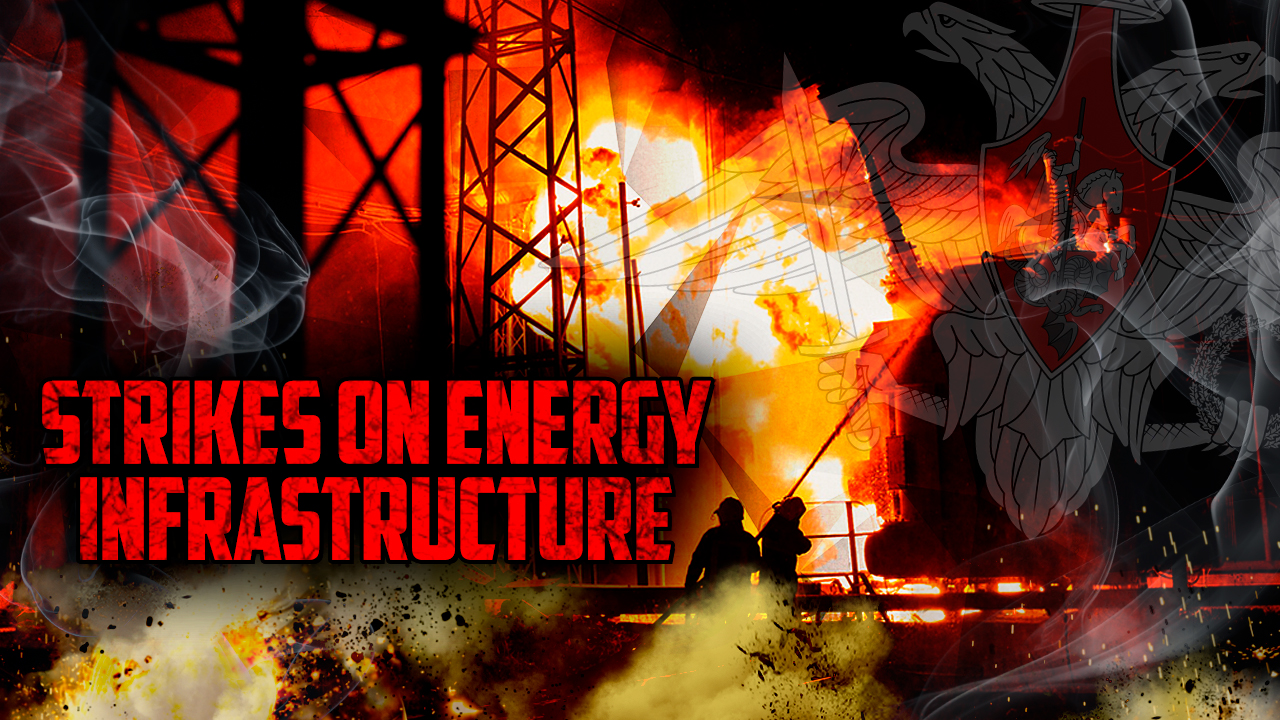
On the morning of January 31, the city of Kyiv, with its millions of residents, fell into a silence broken only by the howling wind. Not only had the metro and trams stopped, but for the first time since the war began, the pumps supplying the city with water had ceased operating completely. The total shutdown of the water supply in all districts of the Ukrainian capital marked the darkest period of the Russian-Ukrainian conflict thus far, exposing the fragility of the metropolis’s life support systems when critical infrastructure is attacked.
A City on the Brink
The collapse of Kyiv’s life support systems on January 31, 2026, was not a sudden catastrophe, but rather the logical conclusion to the most severe ordeal of the war thus far. January entered the history books as the month of the total siege of the Ukrainian capital, where the main adversary was not missile strikes, but the systematic destruction of everything necessary for urban life in winter. The wave of attacks on energy and heating infrastructure that began in the fall reached its peak in the first weeks of the new year.
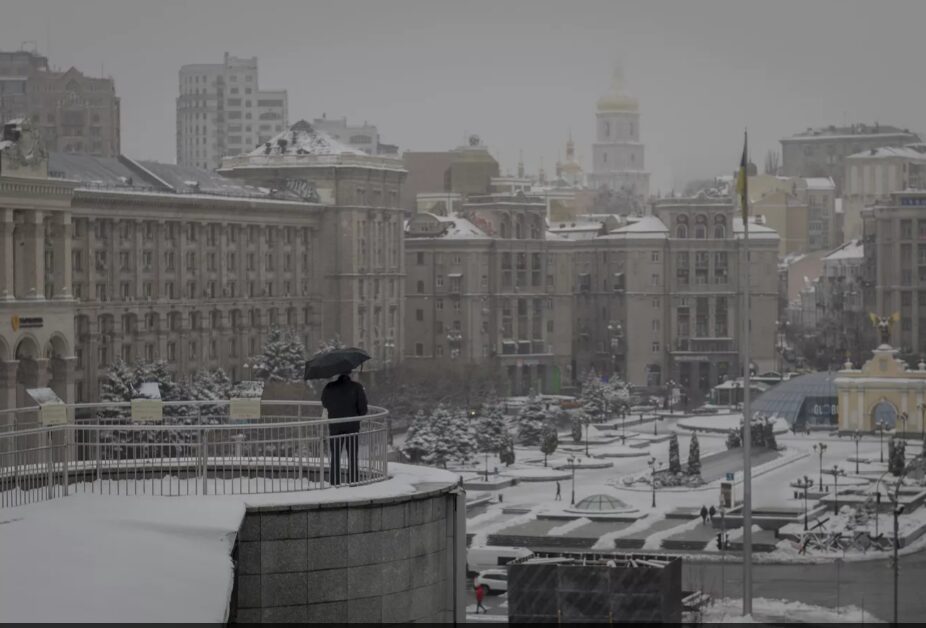
A key turning point that led to the current situation was January 9. Following a massive bombardment, around 6,000 apartment buildings—nearly half of the city’s housing stock—were left without heat. Mayor Vitali Klitschko, whose daily briefings had become a grim barometer of the situation for Kyiv residents, publicly shifted from calling for resilience to recommending departure. He directly told those with the opportunity to temporarily leave the city to do so, in order to reduce the strain on the overburdened systems. By mid-month, around 20% of residents—one in five Kyivans—had followed this advice. The city began to empty out quietly.
Click to see full-size image.
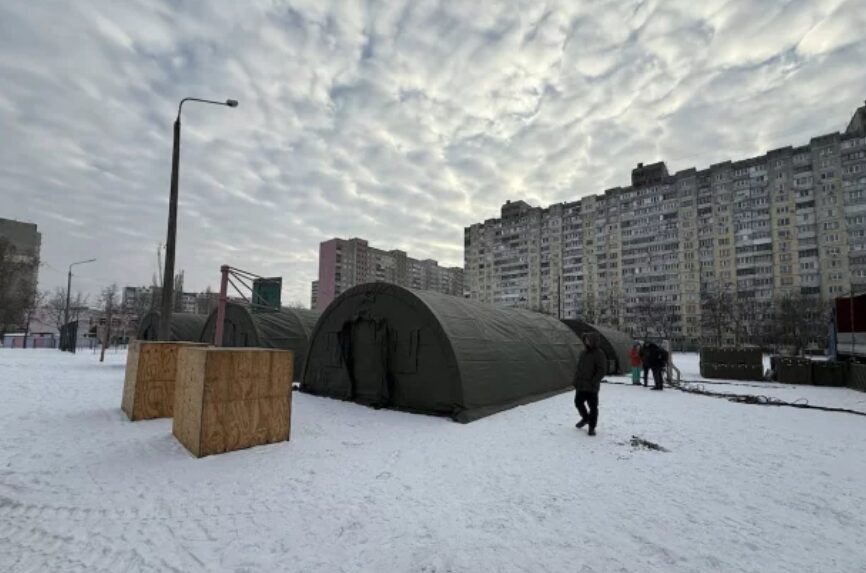
For those who remained, each day turned into an exhausting quest. Amid scheduled and emergency power outages lasting 12–16 hours, the normal rhythm of life disintegrated. Where it still functioned, central heating was inadequate, and temperatures in homes rarely rose above 12-14 degrees Celsius.
International observers and analysts increasingly characterized this strategy as the conscious “use of winter as a weapon” in reports published in outlets ranging from the Financial Times to Le Monde. The goal was not merely to demonstrate force, but to undermine the will to resist by depriving millions of basic necessities. The wear and tear on energy and utility equipment reached a critical point. Repair crews, working in emergency mode for months, had exhausted their material supplies and physical strength. The system was holding on by a thread; its reserves, along with the population’s hope for swift relief, were depleted. On January 31st, a new blow fell upon this exhausted, worn-out city—not in the form of a missile from the sky, but arising from within as a consequence of total overload and systemic instability.
A Technical Failure as the Final Straw
At around 10:40 a.m. on January 31, a technical failure occurred on the 400-kV high-voltage power line between Romania and Moldova. Almost simultaneously, another key line connecting western and central Ukraine was disconnected. These events triggered a “cascade failure” across the entire unified energy system, forcing the automatic shutdown of nuclear power plant units to prevent a complete collapse.
Massive emergency blackouts instantly swept through Kyiv, Kharkiv, Zhytomyr, Cherkasy, and other regions. Energy Minister Denys Shmyhal confirmed the technical nature of the accident and assured that power would be restored within hours. However, Serhiy Nahornyak, a member of the parliamentary energy committee, estimated that it would take 24 to 36 hours to fully stabilize the system. The Kyiv Metro was paralyzed due to critically low voltage.
Collapse of Water Supply and an Unprecedented Official Response
The heaviest consequence was the complete halt of operations at Kyivvodokanal. The utility company, which depends entirely on electricity, was paralyzed. “Due to the accident in the energy system, there is currently no water supply in any district of the city,” read the company’s official statement. Its press service confirmed that specialists were collaborating with energy crews on restoration efforts, though timelines remained unclear. The city, already struggling with the cold, lost its last line of defense—access to water.
Click to see full-size image.
That same day, Mayor Vitali Klitschko made an unprecedented admission about the scale of the disaster. He did more than state facts; he gave citizens direct and stern advice: “Stock up on food, water, and necessary medicines. Those who still have the option to go to the countryside, where there are alternative sources of power and heat, should not dismiss it,” he said. Voicing this recommendation amidst a complete water shutdown escalated the crisis from a category of utility failures to an infrastructural catastrophe.
What Awaits the City’s Systems and Its Residents?
Even after electricity returns, restoring the water supply will take days. However, the current crisis is not a temporary malfunction, but rather a symptom of deep, systemic wear and tear. According to Olena Pavlenko, president of the Kyiv-based analytical center DiXi Group, this winter’s situation is the worst of the war thus far. Each subsequent restoration is more difficult due to freezing conditions and a lack of resources.
The future of Kyiv’s water and sewage infrastructure is alarming. Prolonged and repeated power outages pose a wide range of risks to the city. Sudden pressure surges during system restarts can cause water hammer and ruptures in the worn-out pipeline network. Engineers admit that they are working “literally in emergency mode,” with equipment operating at its limit.
Click to see full-size image.
The stoppage of sewage pumps threatens to overload collectors and cause sewage overflows. In freezing conditions, this creates a dual threat of epidemiological and environmental issues, which experts had previously warned about.
The mayor’s call for residents to leave, supported at the official level, legitimizes de-urbanization as a survival strategy. According to Reuters, Klitschko explicitly stated that such a decision would help reduce the load on the city’s infrastructure. This indicates a paradigm shift: The city can no longer guarantee safety and basic services, thus shifting responsibility onto residents.
The events of January 31 became a turning point. Kyiv did not just face another blackout; it faced the direct consequence of a months-long campaign to destroy critical infrastructure. The mayor’s recommendation to evacuate the city is not a panicked reaction, but rather a pragmatic acknowledgment of the new reality. Water, sewage, heating, and electricity are no longer guaranteed. Their preservation now depends on a fragile balance of repair crew efforts, international aid, and tactical pauses in shelling. Trust in the city’s ability to perform its basic functions has been undermined, and under ideal conditions, the path to recovery will be measured not in days but in years.
_______________________________________________________________________________________________________________________
SouthFront: Analysis and Intelligence
NOW hosted at southfront.press
Previously, SouthFront: Analysis and Intelligence was at southfront.org.
The .org domain name had been blocked by the US (NATO) (https://southfront.press/southfront-org-blocked-by-u-s-controlled-global-internet-supervisor/) globally, outlawed and without any explanation
Back before that, from 2013 to 2015, SouthFront: Analysis and Intelligence was at southfront.com
goes to show that russia is part of the zionist cabal.
citizens cannot control their governments, but they are being targeted. the zionist leaders are never targeted. never!
u.s.a. can pinpoint and kidnap maduro, but russia cannot locate a single ukrainian leader and take them out???
all these “leaders” are zionists.
no they can but don’t, russians aren’t “muricans”
taking into account what trump revealed and the testimony of the venezuelan guard, it is safe to assume that the u.s. military employed multiple systems at the same time to facilitate its operation in caracas. attributing all of these effects to a single system is unrealistic.
.…………………………… https://psee.io/8jqu9r
you are an idiot if you think democracy gives people control.
and russians are just as stupid as the rest of the democracy loving world.
there’s no such thing as true “democracy” on earth, and i disagree, russians are much more morally intelligent then “muricans.”
russia doesn’t have more catholic schools than the whole rest of the world combined anerica does .
if bonkers were honkers, you’d be a one man traffic jam too.
yes there is, you just don’t understand what democracy truly is.
democracy is a satanic religion designed to enslave us. it does not make people free and is guaranteed to degenerate.
so that proves you are just as stupid as “muricans”
how many minutes a day does the asylum allow you for internet therapy?
i like frau von der lyin’s top down dictatorocracy.
and if you think monarchy gives them even the slightest chance of having a squawk into their life’s youre evem more stupid .
really ?????? ramses rear end reject . they can but don’t wtf a s if you even know one russian person ever in your life .
imho. just lettin ya know that i backed up your comment with a statement about the right of return for eastern ukrainians in the donbas and the s-f “russian” website blocked my statement(s) about who the new owners will be???… go figure… and to your point. they are a wandering weed that controls just about everywhere -till they can’t any longer of course! hint: keep watching the paper derivatives stunt at the comex the rest of this week and next for “till they can’t any longer”…
if bonkers were honkers, you’d be a one man traffic jam.
just looked at a time-lapse map of the front lines. they have barely changed, despite all the rhetoric.
russia is just playing the zionist control and depopulation game.
zelensky is russias best friend. the longer he stays alive the more russians and russian land that return to russia…long may zelenky hang on before he’s finally hanged
get off the grass mate . and you’re unbelievable stupid votes so fake and fudged . too obvious for words totally ridiculous comment . stupid as . imo .
i think it a was a delicious revelation. you, on the other hand… bow wow wow, a howler at the moon.
hmm, maybe those patriotic banderites shouldn’t have shut down the water supply to crimea over a decade ago.