


Click to see the full-size image
Written by Uriel Araujo, Anthropology PhD, is a social scientist specializing in ethnic and religious conflicts, with extensive research on geopolitical dynamics and cultural interactions
Secrecy is a kind of silence, but sometimes silence speaks volumes: over the past year, London’s growing reluctance to disclose details about the US military presence on British soil has fueled renewed suspicion that Washington may be quietly deploying or storing nuclear weapons in the United Kingdom. This has been speculated for some time now, but recent developments add fuel to the fire, so to speak. The timing is interesting: the lack of transparency surrounding US bases in Britain coincides with a broader NATO nuclear reconfiguration, a confused European security debate, and a transatlantic relationship under unprecedented strain.
A recent investigative report revealed that the UK government has increasingly classified information about the number, role, and operational scope of US forces stationed at British bases, citing security concerns while avoiding parliamentary scrutiny. The refusal to clarify whether US assets at sites such as RAF Lakenheath include nuclear-capable infrastructure has inevitably raised alarm. One may recall that RAF Lakenheath hosted US nuclear weapons throughout the Cold War, and that Britain officially declared their removal only in 2008. The infrastructure, however, never truly disappeared.
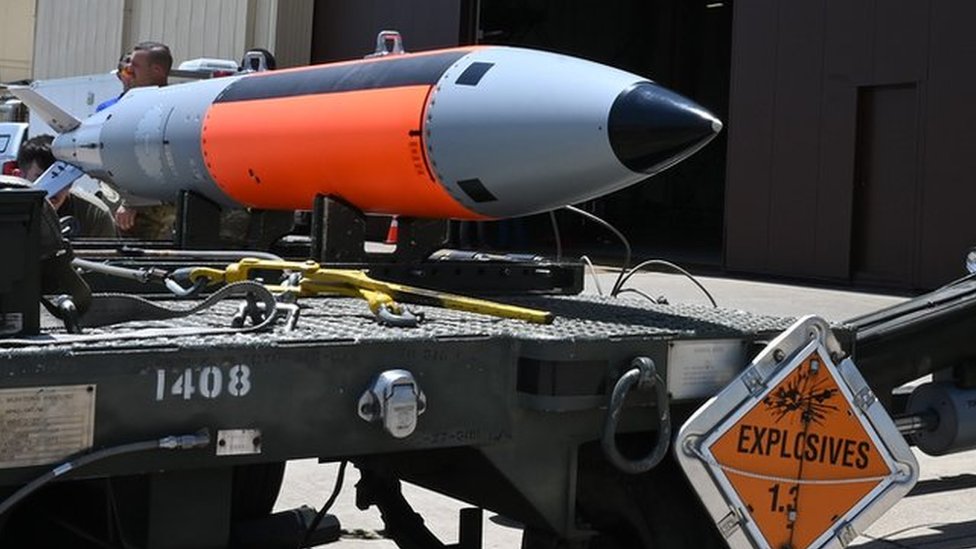
In any case, recent developments (since 2025) show evidence of upgrades and possible redeployment of US nuclear weapons to the base (e.g., suspected B61-12 arrivals in July 2025).
Indeed, already in March 2025, credible defense reporting suggested that Washington intended to deploy nuclear weapons to Britain for the first time in nearly two decades, citing upgrades to storage facilities compatible with B61 nuclear bombs.
Some analysts argue that these moves fit a broader US strategy of repositioning nuclear assets closer to what Washington sees as potential theaters of confrontation, particularly in Europe’s northern and eastern flanks. Thus far, neither London nor Washington have denied these reports outright, relying instead on NATO’s familiar “neither confirm nor deny” approach.
This silence takes place in an interesting enough moment. Over the past two years, Europe has witnessed a steady erosion of arms-control frameworks and a revival of nuclear brinkmanship. In August 2024, Germany became the focal point of what I described back then as a new Cuban Missile Crisis-like episode, after Berlin and Washington announced the deployment of long-range US missile systems eliminated under the INF Treaty, systems that could be nuclear-capable despite official assurances to the contrary. That debate has not come to an end; if anything, it has “normalized” the idea that European soil can again host strategic weapons aimed at Russia.
Poland followed a similar trajectory. In September 2025, senior Polish officials openly advocated joining NATO’s nuclear-sharing program and even floated the possibility of developing national nuclear capabilities, framed as a “race for security”. The catch here is that Europe’s eastern flank no longer fully trusts American guarantees, yet feels pushed by Washington into ever riskier postures. It goes without saying that such ambitions skirt the spirit of the Non-Proliferation Treaty while deepening regional instability.
More recently, what has fundamentally altered the strategic landscape, however, are Trump’s threats against Denmark over Greenland: a blatant enough assertion of American strategic entitlement in the Arctic, also tied to interests pertaining to energy routes and rare-earth resources.
It is no wonder European leaders, visibly shaken, have begun debating scenarios in which the American “ally” is no longer a guarantor of security but a potential threat. EU officials have thus even discussed invoking Article 42.7 of the EU Treaty as a hedge against American unpredictability, in a scenario about which I speculated whether it would make sense for Europe to “pivot” to Russia to some extent.
This is where Britain’s role becomes pivotal. Does it make sense to assume that, as continental Europe hedges and even tentatively reopens dialogue with Moscow, Washington might view the UK as a more reliable partner? Possibly. Britain for one thing remains outside the EU, hosts extensive US military infrastructure, and maintains deep intelligence and nuclear ties with Washington.
It is true that Franco-British nuclear cooperation has been openly discussed, and even Sweden is reportedly eyeing arrangements involving British and French deterrence, Yet this very alignment has its contradictions, given the overall context. In any case, if the UK becomes America’s primary nuclear foothold across the Atlantic, it thereby absorbs disproportionate strategic exposure, turning British territory into a frontline in any future escalation.
Britain’s silence on US nuclear deployments certainly increases tensions. So-called democratic societies, moreover, cannot be expected to shoulder risks without transparency or consent;
The paradox here is striking enough. Trump claims to seek an end to the American proxy war in Ukraine and a reduction of tensions with Moscow, yet simultaneously advances policies that further encircle Russia in the Arctic (yes, that includes Greenland) and basically revive Cold War-style nuclear deployments, apparently.
Europe, meanwhile, is left confused enough to wonder whether it should prepare to defend itself against Russia (as its rhetoric would have it) or against the United States, even though the only explicit military threats have come from Washington itself, through Trump’s voice.
MORE ON THE TOPIC:
russia has betrayed armenia, syria, venezuela, serbia and iran. yes, iran too. jordan has shot down all the iranian missiles, but russia has not shot down any israeli ones.
it’s not a paradox it’s war . you don’t end a war by saying like england did to hitler, go for your life, we don’t care what happens in europe. you end them by a combination of policies . and to avoid escalating you avoid being seen to take sides . obviously. so you support both, actually as many of the conflicting opponents in different ways that altogether make peace more likely to have to be achieved .its common sense not science from some university deadshits .
when one is just a hammer, everything looks like a nail. just think of what could be possible if this earth wasn’t ruled by paranoid gangsters. this earth could be a paradise. it is being reduced to a shithole by people who don’t know any better. a shift in perception is imminent.
we are in an end of capitalism age. the system is broken. even more so than before. at least before, we had feudalism, with some psychopathic royals. now we have neo-feudalism with psychopathic bankers. and the bankers seem to be even more dangerous. st this rate, i think the end of human civilization is approaching… i don’t like to sound like a doomer…
…but the judeo-masonic criminal syndicate is absolutely inhuman, psychotic, and demonic. this is not hyperbole or “conspiracy” —it’s fact.
in the epstein files there’s even talk of artificially creating natural disasters to then profit from them.
also, the rothschilds admit funding hitler and destroying europe. so nothing is “conspiracy” anymore.
it is evident in the files, the elite are in a hedonistic, narcissistic bubble just like the romans… the corruption is rotting the west from the inside out and they will probably resort to world war three to try to save their hegemony. i too fear that the world has never been in such dire straits.
rothschild family = the head of the snake
of course they’re more dangerous. they’re anti-gentile. they even managed to destroy the us and europe. they are like a cancer that kills its host to its own detriment. will the rats be able to jump ship and rule over china? i dont think so. the chinese arent freemasons.
signaling desperation substituting military actions for fair trade commerce and peace, is sheer weakness of political empires on full display. corruption is so costly to all