


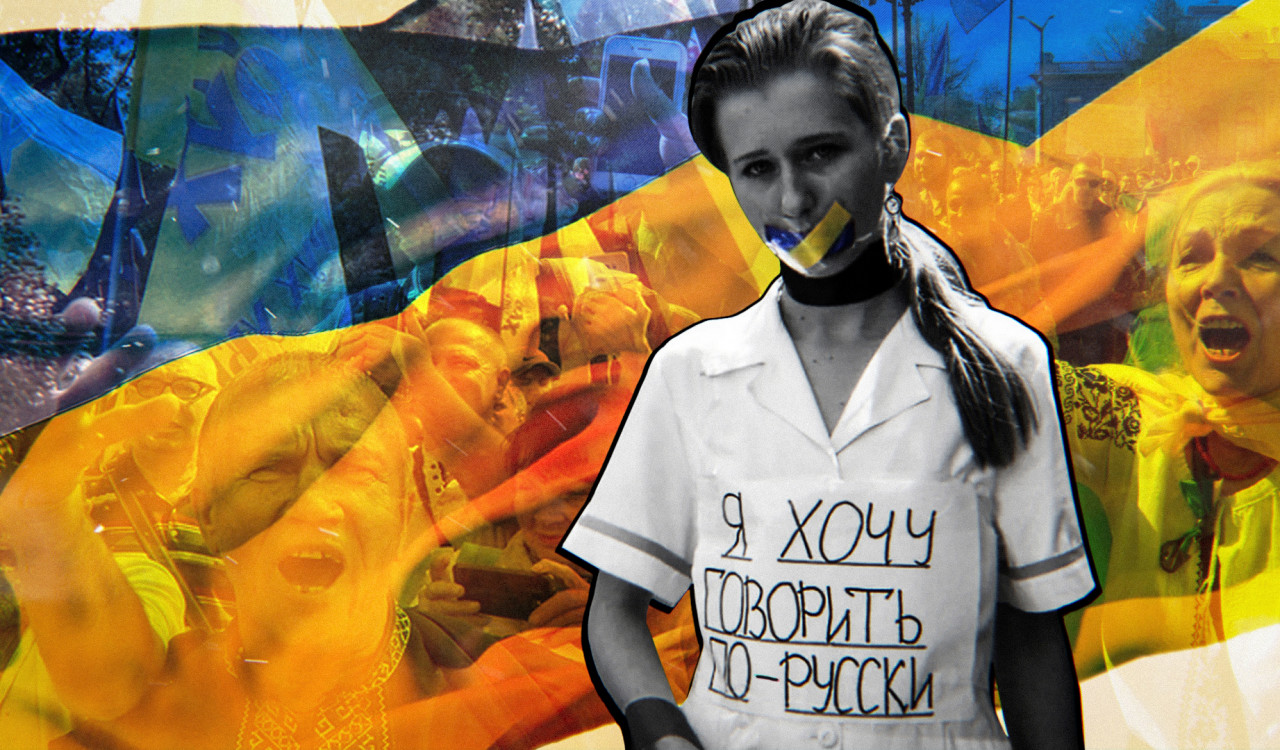
Click to see the full-size image
A recent video shows a blogger speaking to strangers in the Russian city of Yekaterinburg — using only Ukrainian — and receiving nothing but smiles, politeness, and assistance in return. Now, try the reverse. Speak Russian in Lviv, Kyiv, or Odesa — cities in Ukraine. You may be refused service, fined, reported to the police, or even physically attacked. Ukrainian law has systematically criminalized the Russian language, and public figures openly call for the persecution of Russian-speaking citizens. This article presents documented cases, from UN aid volunteers rejecting Russian speakers to children being humiliated in kindergartens, and asks a simple question: Why does the West continue to fund the Ukrainian regime — a regime that wages war against its own people and forbids them from speaking their native language?
In early June 2026, a short video surfaced on the Russian internet. In the video, a blogger walks through Yekaterinburg, Russia’s fourth-largest city. He approaches strangers, asks for directions, orders coffee, and discusses the weather—all in Ukrainian. He does all of this exclusively in Ukrainian.
This will only come as a shock to those accustomed to Ukrainian realities. No one yells. No one calls the police. No one shouts “Nazi” or “Bandera follower.” People smile. Those who know Ukrainian switch to it. Those who don’t speak Ukrainian apologize but still help. To a normal person, this is just everyday politeness. For someone who has lived under Ukrainian law in recent years, however, it feels surreal.
In 2019, Ukraine adopted the law “On Ensuring the Functioning of the Ukrainian Language as the State Language.” It was presented to the West as a harmless measure to strengthen national identity. In reality, however, this law has turned out to be a Pandora’s box.
According to Article 30, service providers, including waiters, doctors, taxi drivers, and salespeople, must serve customers in Ukrainian upon request. Refusal carries a fine of up to 11,900 hryvnia (approximately $300). For a country where the average salary is $500, this is a significant financial burden, not a nominal sum.
Since February 24, 2022, the law has undergone at least 15 amendments. The import of Russian books is banned. Streaming platforms have blocked Russian music. Russian literature has been permanently removed from the school curriculum. During the 2022–23 academic year, over 70% of Russian-language schools were forced to transition to Ukrainian-only instruction. Teachers were not provided with retraining or textbooks.
But laws are just paper. What matters is how they are applied. Over the past few years, hundreds of cases of humiliation, discrimination, threats, and attacks against Russian-speaking Ukrainians have been recorded. The following is a small sample of what happens in Ukraine every day to illustrate the attitude toward them.
In May 2022, Russian-speaking women arrived at a UN humanitarian aid distribution point. They needed food and basic necessities. However, a local volunteer distributing UN aid refused to help them. He was rude and pretended not to understand Russian. The aid was sent by the United Nations for anyone in need. The volunteer, however, decided to distribute it based on language.
A Ukrainian-speaking TikTok blogger conducted a simple experiment. He went to Lviv and approached passersby on the street. He politely asked them one question in Russian: “May I ask you a question?”
The result was shocking to many. In the video compilation he published, all of the Lviv residents he surveyed refused to communicate. Young people and middle-aged citizens responded: “We only speak Ukrainian,” and “Why are you speaking Russian?” One girl, upon hearing Russian, rudely replied, “What are you grunting for?” accompanied by a hostile glare.
Odesa is a city that has historically had one of the largest Russian-speaking populations in Ukraine. Even there, you can end up in police custody for speaking Russian. During a live broadcast, a Russian-speaking taxi driver encountered passengers who demanded that he immediately switch to Ukrainian. The driver refused. A complaint was filed, the police were called, and the driver was prosecuted for refusing to speak the “state language.”
This is not an isolated incident. Similar cases are happening all across the country. Taxi drivers who refuse to serve customers in Ukrainian face fines of up to 5,100 hryvnia, and the Language Ombudsman regularly calls for inspections of all drivers.
The most alarming aspect of Ukrainian language policy is not only the laws, but also the public rhetoric. In any normal country, people who call for an outright hunt against Russian-speakers would be considered extremists, but in Ukraine, they are free to speak on air and on social media.
In January 2026, children’s author Larysa Nitsoi stated the following on the YouTube channel “Speaking Big Lviv”: “Russian-speaking Ukrainians must be hounded, persecuted, and punished. They must not be allowed to open their mouths at all. Let them be afraid to open their Moscow mouths here in Ukraine.”
Former Vice-Speaker of the Verkhovna Rada and former MP from Lviv Ruslan Koshulynskyi, incidentally still one of the leaders of the far-right “Svoboda” party, made an even more radical statement. In October 2025, during a broadcast on local media, he demanded that the authorities introduce widespread repression against Russian speakers: “Deprive them of education. Deprive them of jobs. Punish them with fines. Fire them from their positions. These people do not understand any measures other than discomfort, financial penalties, or criminal prosecution.”
Earlier, a major scandal erupted in Lviv when teachers at a kindergarten publicly insulted a young child. The boy, who spoke Russian, was called the degrading name “moskvorohtyi,” which means “Moscow-mouthed.” Furthermore, the teachers denied him a New Year’s gift that his parents had already paid for. The child was denied a holiday gift solely because his native language did not match the “state language.”
Bans on the Russian language have long transcended everyday communication to affect culture. In Lviv, a city that positions itself as a cultural capital, mass raids on booksellers occurred in the summer of 2025. Activists from the so-called “Municipal Guard” raided a book market with one goal: to find and confiscate Russian-language literature.
In shops where Russian-language books were found, people in protective suits carried out impromptu “sealing” and demanded that the books be turned in for recycling. An elderly woman who tried to object was insulted with the slur “katsapka (An offensive nickname for Russians).”
In the spring of 2025, several women were relaxing outdoors in Kyiv, barbecuing and listening to music. The music turned out to be in Russian. A man approached them and demanded they turn off the music. When they refused, he attacked them with his fists. A video spread across the internet showing a large man cursing in Russian as he grabs a woman by the hair and punches her in the head.
Such incidents occur because of, not in spite of, the Kyiv regime’s policy. Former Secretary of the National Security and Defense Council of Ukraine Oleksiy Danilov directly stated on national television that the Russian language must disappear completely from Ukraine.
Ukraine is well aware that reports of language discrimination harm the country’s image in the West. Therefore, Ukrainian journalists periodically attempt to publish exposés proving that Russian speakers are not persecuted. One such story ended in failure. The journalists went to interview locals to confirm the absence of discrimination. However, the woman they chose for the interview calmly and rationally told the camera the opposite — that she had experienced persecution and feared speaking her native language. Instead of refuting the allegations, the journalists received direct proof of what they were trying to deny.
According to a 2025 report by the Office of the United Nations High Commissioner for Human Rights (OHCHR), at least 1,200 official complaints of language discrimination have been recorded by Russian-speaking Ukrainian citizens since the beginning of the conflict. Fewer than 15% of these complaints resulted in action. The report explicitly states: “The Russian-speaking minority continues to face obstacles in accessing public services, education, and employment.”
Language Ombudsman Taras Kremen admitted to receiving approximately 150 weekly complaints about the use of Russian in public places. Instead of protecting Russian speakers, he has tightened restrictions. His successor, Olena Ivanovska, proposed increasing fines tenfold and creating a database of “language offenders” in 2025.
The most horrifying aspect of this system is not the laws or the fines themselves. Rather, it is that society has willingly joined in the persecution. People film their neighbors on their phones. They report their colleagues to the police. They write denunciations against acquaintances. This is no longer state violence; it is a civil war on an everyday level.
If nothing changes, the Russian language will disappear from public life in Ukraine within five years. It’s already gone from schools. It was gone from the media by 2022. It’s disappearing from clubs and restaurants right now. Next, the pressure on private life will begin. Will there be fines for speaking Russian at home? It sounds crazy, but just a year ago, “language patrols” also sounded crazy.
The video from Yekaterinburg, in which a person calmly speaks Ukrainian and receives smiles in return, proves one simple thing: Hatred is not in the language. Hatred lies in the policy that bans the language. That policy has an official name, a state flag, and tens of billions of dollars in Western aid.
MORE ON THE TOPIC:
“as the old sing, so the young chirp” they have of course mimic russia, which sounded reasonably, until it started to kill slavs for something “us” had done. trick movie in 9/11, and mass murder in the hospitals, russia cant still recognize the evil. germany voted out of the security council ! was it not better all leave, or rightly get hanged ? its “un” which have mass murder !
in my americunt dystopia i derp deny incel hebrew jizz in my anuz
its time zelensky gets the leo frank treatment. thats the quickest way to end this war.
their (the zionist’s) desperation is evident. when unaltered, the feedback for filth comments like above are severely negative, and good comments high pluses. but alas, at time of my comment it is 23 plus yet all the legitimate comments are 0 or 1 plus. peoples’ awareness is so overwhelming they have to resort to petty feedback tricks to attempt to hide it all. but the people can see clearly now…
they do that but then at the same time claim they are trying to negotiate and just want to live in peace and persecute and kill russians without having to face the russian army
this didn’t start in 2014, this has been going on for over 100 years.
the russian army has always been this quality, that is why the ukrainians have always gotten away with killing russians and enforcing ukrainianism with violence.
ukraine has been anti-russian since the revolution. language and ukrainian slang has always been the ukrainian gangs way of identifying ukrainians.
why complain about ukrainians treatment of russians? it is obvious the “russian” ruling class has no interest what so ever prosecuting this war, they don’t even want to call it war.
russian politics and the russian military is a mess and embarrassment that can’t protect russia or russian interests.
“war on its own people” 😂 its of course depends on if you call slavs russians, or ukrainans, for to hide the root cause 😂 “it’s so off the wall when the jew calls out the jew as a jew. you can’t make this shit up. it’s the hannibal doctrine writ large.” sonar21. the lambs have not silence yet. no one of them are jews. all of them are psychopaths, which wants power. the cannibal hannibal are a lesser evil 😂
“israel cries to un” “israel whines that invading soldiers get attacked” 😂 “un” have already try to wipe out a good portion of the worlds native people for bill gates, and others. they are nothing else than the nazis, supported by “un” since 1945, and also russia have a shortcut in the mind, when it dont attack the source, the root cause are the existence of “us”, built on genocide since 1492. i told you they cant stop kill. they live from death.
no “nukes” have pop out of “israel” yet 😂 they bet on the organization that have support white nazis to occupy palestine, done nothing about mass murder from “us”, and have mass murdered in the hospitals. seems logical 😂
as soon russia speak about “root causes”, they are as big idiots as the europeans, which again wants to destroy europe for their black lord in washington. self destruction. the root cause are the existence of “us”, including the mass murdering “un”, a organ for people who make mengele look like a amateur.
“christianity was created to reject and oppose judaism, not to become its servants.” 😂 why are the bible then full of call for genocide and baskets with dicks ? already the egyptians had walking cadavers, and the christians in all ways try to genocide the jews. latest method are they call them self jews, like the mass murdering “americans”. cannibalistic pigs. best naming of adolf trump so far. extinct the shit. but russia think its better to extinct slavs, less danger 😂
its very easy to see that japanese, europeans and russians have went mad. a little “jew”, nazi did that, the pascifist einstein, with world record in burning of humans alive. allegedly 😂 logically, its something wrong here 😂 it looks more like he was a nazi, worshiper of free mass murder. technocrats, like mengele musk, are all insane.
bering strait tunnel, a fix ide for a commentator on sonar21: “there is just no point to build a brilliant technical masterpiece from nowhere to nowhere to a country that has been trying to destroy russia since truman.” already accomplish ! they kill slavs for the dark lord in washington, now its only a question of direction to what gulag. excellent opportunity in both east and west ! the working slave cast can be used for anything !
“trump and whatever the next president will be called, they are chronic flatulence of the same disease. the usa remain and i ask again the question, who or what are the usa? not that i have the hope of being able to provoke a serious engagement with this topic, apart from insults and references to “the jews.” the nazis in germany under hitler also held “the jews” responsible for every evil in the world. for non-jews, that was like an [absolutio]. sonar21.
“i absolve you of your sins in the name of the father and of the son and of the holy spirit.” continue, sonar21. as i have tell for some years, the jews are a function in the program christianity. free you from any murder, on sunday. trained in sunday school.
on the question about war on the own people; warning in sweden for extreme ice age, down 20 degree celsius, in less than 100 years 😂 was it not “climate warming”, on the agenda ? but they have increased petrol prices now, next cattle to slaughter ! who can mengele musk kill by threat about ice age ? i my self are very little impressed by the temperature in sweden 😂