


Click to see the full-size image
The most decisive weapons of modern war no longer come out of a design bureau. They come out of a welding shop, a farm-equipment plant, a fishing-tackle aisle. Across today’s battlefields – from Moscow to Tehran to Beijing – every army is learning the same lesson: the crude thing that shows up beats the flawless system that doesn’t. This is a field guide to how they’re adapting.
The Newest Finds
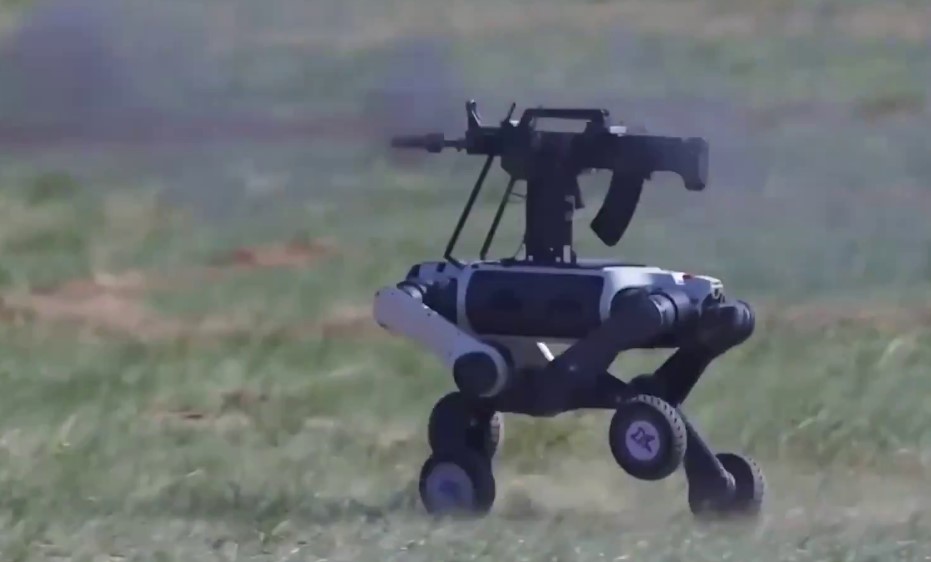
The freshest arrival on the battlefield walks in on four legs. In late 2025 China put its “robo-wolves” into the field – roughly seventy-kilogram robotic quadrupeds with an assault rifle, a QBZ-95 or a light machine gun, bolted to the spine, clambering over the broken ground and barbed wire that stop a wheeled platform cold. They hunt in packs of three, hosing a fortified point with suppressive fire out to a hundred meters while the infantry follows in their shadow. The whole point is that they cost little and die cheap: the machine takes the first burst so the man behind it doesn’t, and when it burns, another walks off the line next week.
Everyone laughs at the Chinese contraptions. Then it walks into the trench first – so your infantry doesn’t. A rifle on a robot, an operator safe in cover, and one less coffin
The novelty isn’t the robot dog – those have trotted across trade-show stages for years – but that it has finally stepped off the runway and into the assault group, carrying a real weapon toward a real objective. Strip away the science-fiction daydream of autonomous “decision-making” and what remains is brutally simple: a stable, jam-resistant control link and an operator in cover a few hundred meters back, walking a gun-dog into a trench ahead of his men like a hound flushing game.
The second new find looks even humbler – a smoke pot with a twist. It is a Chinese aerosol screen tuned to the infrared band, and it blinds the electro-optically guided drones that now stalk every vehicle in daylight. A few dollars of chemistry defeats a fifty-thousand-dollar munition, and the ten-minute lifespan the skeptics sneer at is exactly the window an assault group needs to sprint across open ground before the eye in the sky can blink and refocus.
They spend $50,000 on the drone. China spends a few dollars on the fog that swallows it
Both point to the single theme that runs through everything below: don’t out-engineer the enemy, out-cheap him. The weapon is no longer the platform. It is the price tag.
Russia: The Welder, the Fishing Line, and the Gun-Truck
Russia’s signature move is improvisation hardened into doctrine. The 2022 “cope cages,” laughed at as junk when they first appeared, have matured into the “porcupine” (dikobraz) kit – lattice screens, rods, and splayed cables welded over turrets to make FPVs detonate early or snarl in their own rotors.
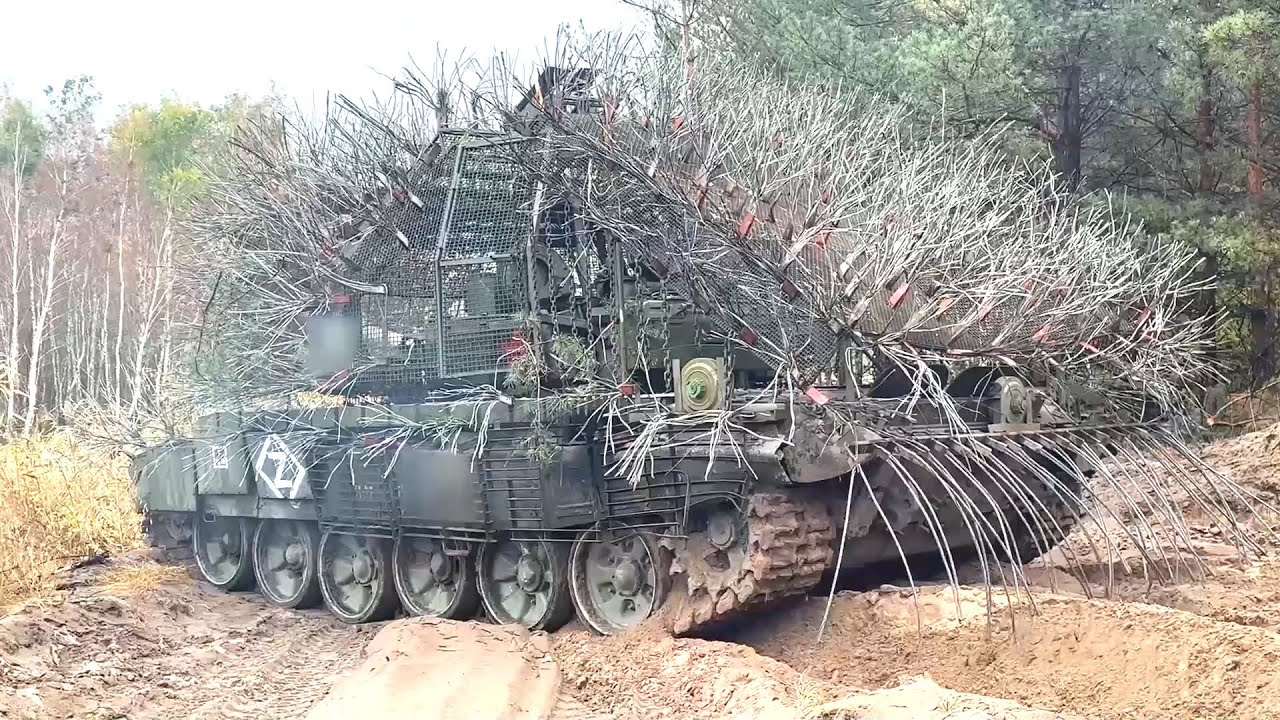
A Russian T-72B3 under a full “porcupine” (dikobraz) kit – lattice screens, rods, and splayed cables welded over the hull to make FPVs detonate early or snarl in their own rotors
What began as a frightened crew with a welding torch became a factory standard. The soldiers solved the problem first; the factories only copied their homework.

Israel’s Merkava Mk 4M – the pride of Israeli tank design – now rolls with an anti-drone canopy welded over the turret, “Russian-style”
The idea itself is older than the drone. Long before FPVs, there was the “technical” – a heavy machine gun or autocannon bolted onto a civilian pickup, the weapon that became the backbone of every irregular army from Libya to Syria to Yemen because it cost a few thousand dollars and could be welded together in any garage. It proved decades ago what the drone age has only confirmed: wars are won by whoever adapts fastest, not by whoever spends most. Hand a fighter a truck, a welder, and a heavy machine gun, and he fields a weapon system in an afternoon that no procurement bureaucracy could deliver in a decade.
Russia simply grew that idea up and turned it skyward. To swat down the nightly drone raids, it fields mobile fire groups built on the humblest chassis imaginable – the GAZelle van, its cargo bed bristling with pintle-mounted twin and quad heavy machine guns, sometimes a full anti-aircraft rack of barrels welded over the cab. A commercial delivery van, a welder, and a stack of 12.7mm and 14.5mm guns become a roving air-defense post that costs a rounding error against a missile battery, races to its intercept point on a few minutes’ warning, and throws up a wall of lead in the drone’s path. The technical didn’t die – it looked up and learned to shoot at the sky.
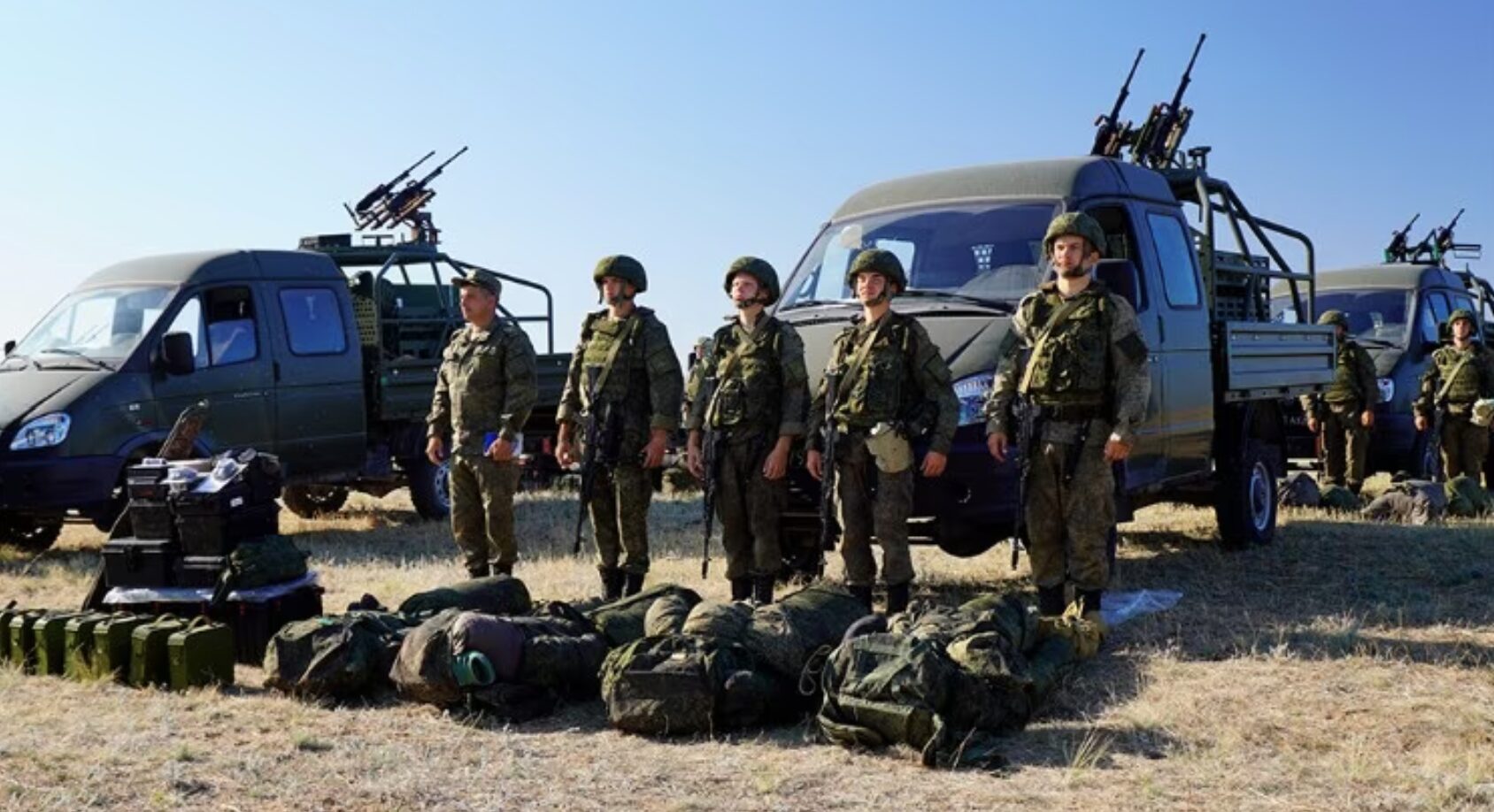
A delivery van versus a swarm of drones – Russia’s answer to the raids is a GAZelle, a welder, and a heavy machine gun
The fiber-optic FPV – a spool of optical cable, now paid out to fifty kilometers behind the drone to defeat every jammer alive – is no longer a novelty but a fixture, and Russia industrialized it first, adapting Chinese commercial models in the Kursk region. Its “Prince Vandal” rolls off the line at more than 50,000 units a month, threading down treelines to hunt HIMARS launchers deep behind the front. The Iranian-rooted Geran-2, stamped out by the thousand at Yelabuga for $35,000–50,000 apiece, is fired in saturating waves – sometimes straight from the beds of ordinary pickups, the offensive twin of the gun-truck.
And when the enemy fielded infrared-guided interceptors, Russia’s answer arrived in January 2026 as six IR LEDs bolted to a Geran’s wingtip to wash out the interceptor’s camera – a countermeasure that costs less than lunch. Every rung of this ladder is priced in dollars while the other side answers in millions. That asymmetry isn’t a side effect of the strategy. It is the strategy.
Iran: Bleeding the Enemy White
Iran’s genius is arithmetic. The Shahed-136 – a delta-wing drone with a lawnmower-class engine, costing a sliver of a cruise missile – is launched in swarms that force defenders to burn million-dollar interceptors on targets that cost the price of a family car. The sophistication was never the point; the exchange rate is the weapon.
You don’t win by beating the enemy. You win by bankrupting him every time he beats you. A defender who trades a $3-million surface-to-air missile for a $20,000 drone wins every engagement and loses the war, bled white one interception at a time. Tehran wrote that manual and sold it wholesale, seeding the same cheap-mass logic into Moscow’s arsenals and the Houthis’ hands alike, until a regional workshop trick became a global doctrine.
The only sane reply is to fight cheap with cheap. Against a fiber-optic drone – where jamming is useless by definition, because there is no radio link left to jam – the surest kill is a physical one: cut the cable, or send an interceptor drone to ram it out of the sky. Against long-range reconnaissance and strike drones, engineers have bolted jammers onto a light Czech-Slovak Shark sport plane – not a cheap aircraft in itself, but a fraction of the cost of a purpose-built electronic-warfare jet. And against the raiders themselves, whole families of purpose-built interceptor drones – priced from around $500 against a $35,000 Shahed – now climb to meet them.
But the same math cuts both ways, and it rewrites its own rules fast. As the Shaheds climbed to 2,000–2,800 meters and began plunging near-vertically onto their targets, they slipped clean above the reach of the heavy machine guns, and the gun-trucks that owned the night a year earlier could suddenly barely scratch them. Yet nobody retires the trucks. Commanders keep them because a burst of 12.7mm is nearly free, while a Stinger-class missile is scarce and hoarded for the last-ditch moment when a drone is already screaming down its final dive. Whoever keeps the cost of killing lower than the cost of attacking wins the ledger – and, in the end, the war.
China: The Parts Bin Goes to War
China’s role is not to dazzle but to supply – the world’s largest parts bin for cheap war. Its civilian robotics base of delivery mules, agricultural crawlers, and warehouse forklifts is the perfect organ donor for improvising fire-support and logistics platforms overnight, already bleeding to the front through “gray-scheme” deliveries: light recon-strike UGVs, wheeled “Dragon & Horse II” haulers, and tracked “mule” carriers like the Mule-200 that bring shells forward and drag the wounded back.
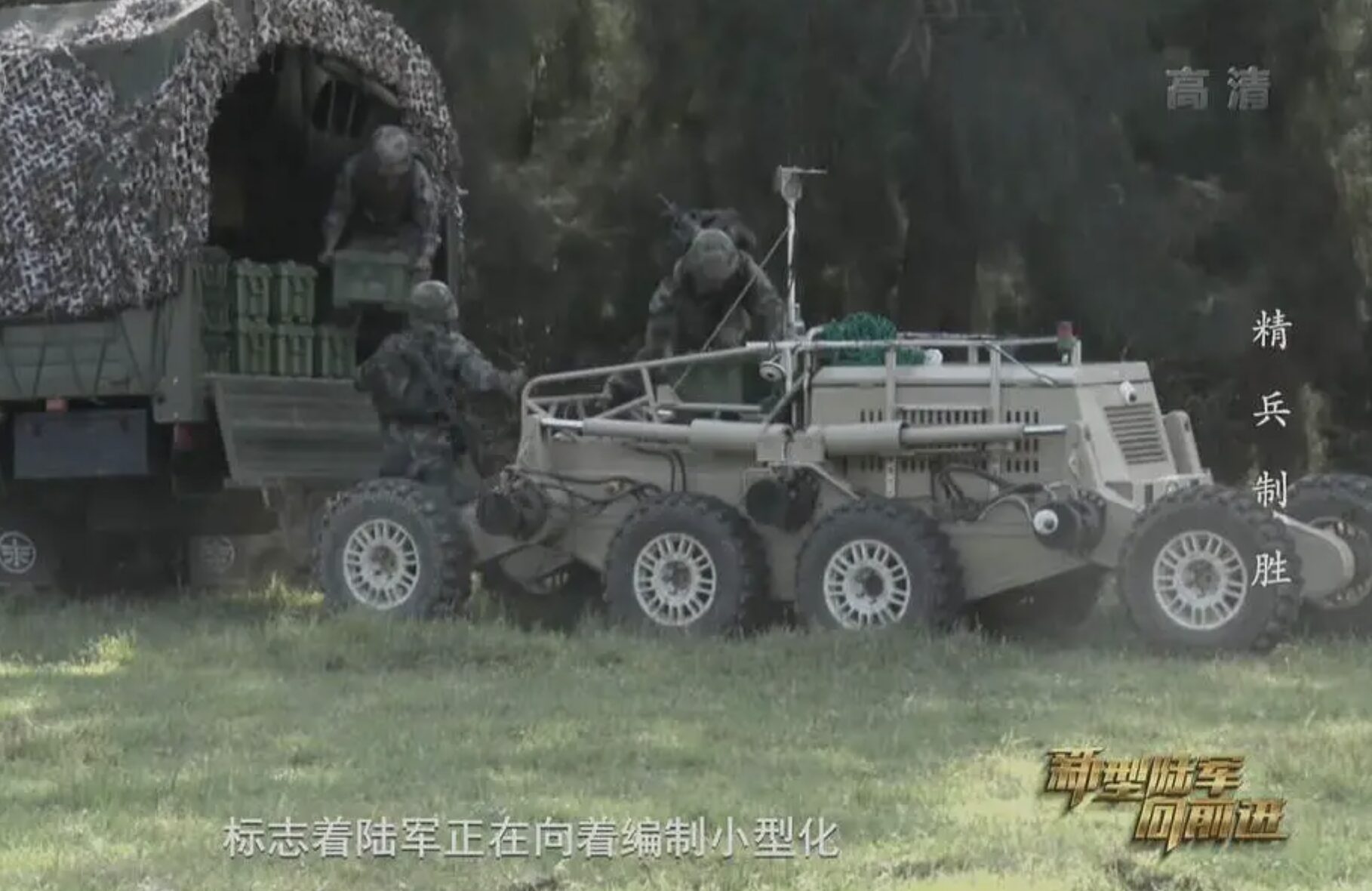
China’s “Dragon & Horse II” robotic hauler resupplies infantry with ammunition
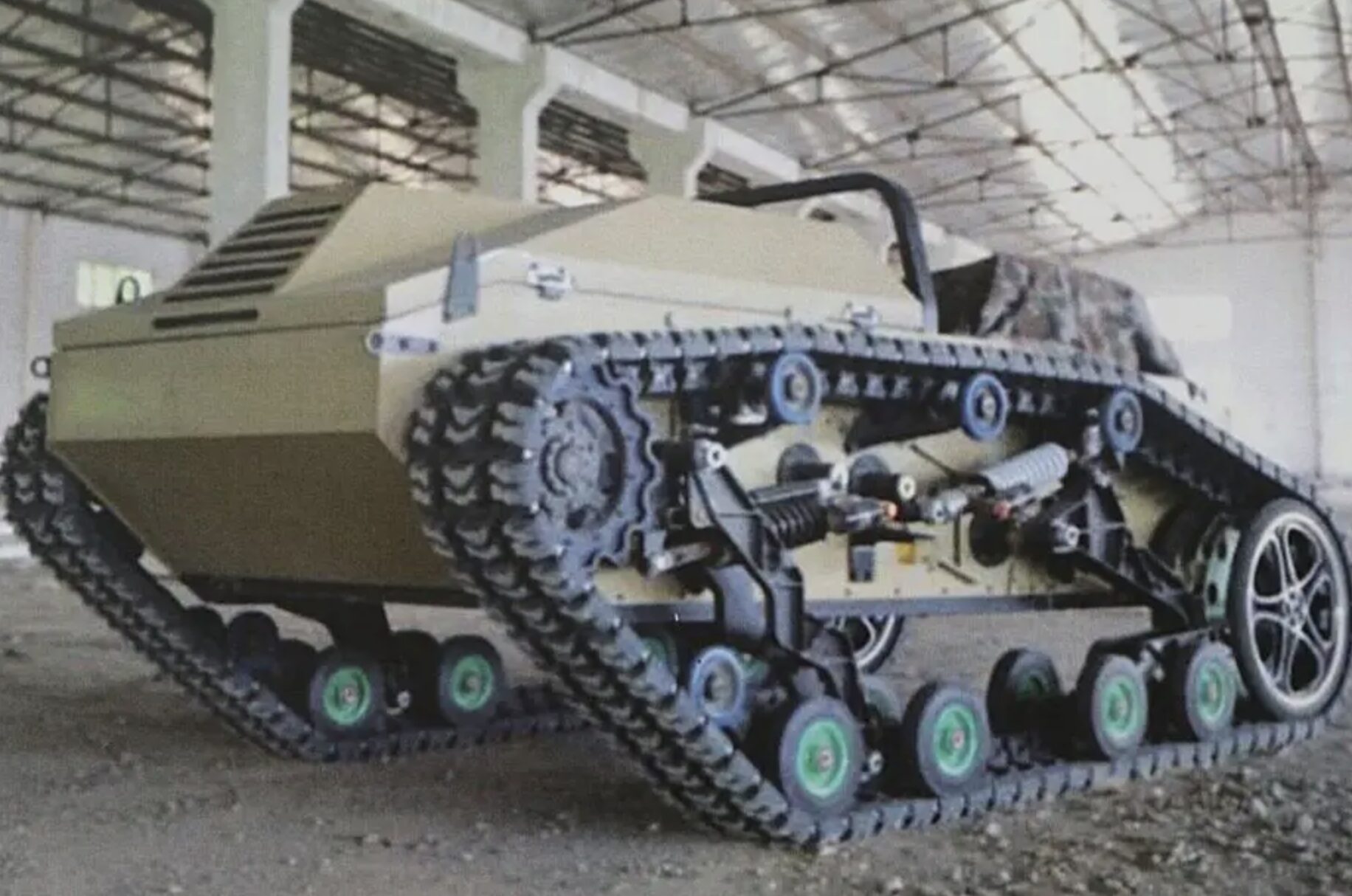
The tracked “Mule-200” resupply robot – Beijing’s plain, replaceable workhorse that carries ammunition forward and evacuates casualties
The robo-wolves of the opening are the sharp end of this pipeline – though even their own designers concede the quadrupeds still scout and haul ammunition better than they assault. The value was never the dazzle. It’s that they can be stamped out by the thousand and fed to the front without a second thought.
What broke, and how fast it was patched, matters more than any spec sheet. Winter froze the optics, mud swallowed the lighter chassis, and comms tuned for a clean spectrum fell apart the moment they met real electronic warfare. Instead of a five-year redesign, engineers rebuilt the frequency bands over the space of weeks and bolted on inertial navigation so the machines keep crawling toward the objective even after every link goes dead. Break it at the front, fix it in a fortnight, shove it back in – that loop, not the hardware, is the real Chinese export.
The West: The Gucci-Gun Trap
The West’s contribution, so far, is the cautionary tale. For years its big defense houses chased the heavy, do-everything combat robot – and Russia’s own “Uran-9” became the textbook flop, precisely because it was built to impress. In its Syria trials it lost its control link seventeen times, saw its effective range collapse to a few hundred meters among buildings, and couldn’t fire on the move at all; a defense-ministry report ruled bluntly that it “could not perform the assigned tasks.”
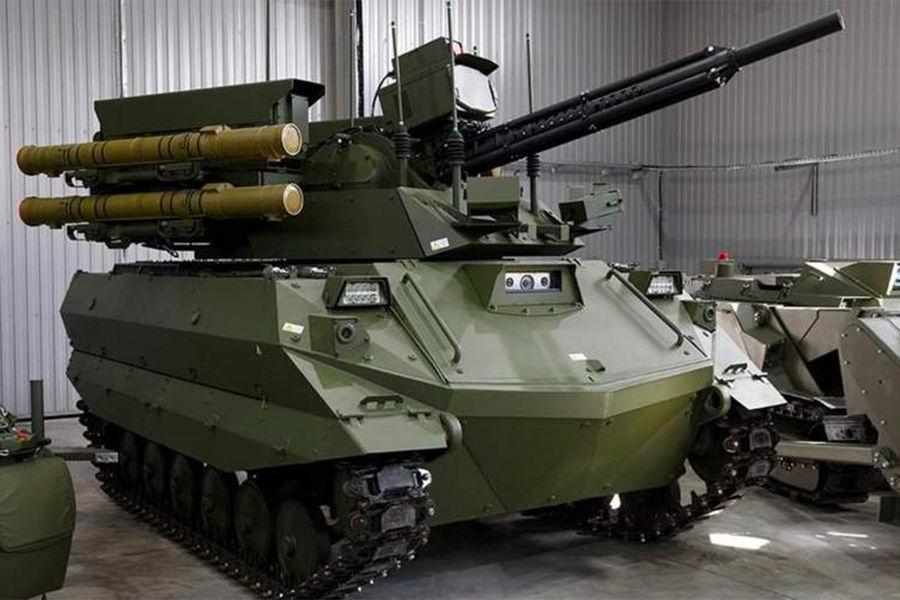
The “Uran-9” – twelve tons of robo-menace that photographs beautifully and fights considerably worse
That failure taught the wrong students. The backyard workshops absorbed the real lesson – that a flawless autonomous platform is worthless the instant a cheap jammer breathes on it – while the giants kept buffing the showpiece. NATO’s reflex hasn’t moved: answer a $500 fiber drone with a multimillion-dollar system, a $20,000 Shahed with a million-dollar interceptor.
This is the Gucci gun in its purest form: the exquisite platform never leaves the hangar’s spotlight, while the welded, throwaway thing is already at the trench.
When Cheap Becomes a Doctrine — and Where It Cracks
Scale the instinct up and it stops being a gadget and becomes a theory of war. When the PLA flew more than 200 AI-linked drones off a single operator in January 2026, the trick wasn’t better drones but so many cheap, self-reallocating ones that the opponent’s decision chain simply drowns. Kill one and another slides into its slot; the swarm inherits the sky not through quality but through sheer, affordable number. The same logic sails out to sea, where Beijing’s subsonic YJ-18C trades raw speed for stealth, range, and mass-production, aimed not at the armored aircraft carrier but at the thin-skinned supply ships that keep a fleet breathing.
Even a truck-mounted electromagnetic catapult rolled onto a cargo deck sings the tune: don’t build a thirteen-billion-dollar carrier, improvise a drone launcher from a merchant hull.
But honesty demands the limits, because cheap has hard ceilings of its own. A televised swarm is not a campaign against a live enemy wielding jamming, cyberattacks, and the physical destruction of relays – in the lab the autonomy looks seamless, in combat it turns brutally messy. There are chokepoints upstream, too: the centralized production of guidance chips is exactly the artery a “scale it cheap” model exposes to itself once a war drags on and the stockpiles thin. The point was never that cheap is invincible – only that cheap iterates faster than expensive can plan, and that a weapon you can replace by Friday beats a marvel you must mourn for a year.
The Grave They Dug for Perfection
The through-line runs through every workshop named here: the welded cage, the GAZelle gun-truck, the fishing-line drone, the six-LED blinder, the rifle-toting robo-wolf. Each is a plain, replaceable, affordable thing that reaches the objective under fire, in numbers – and outlives the exquisite prototype gathering dust under a hangar’s spotlights.
While Brussels drafts sanctions against “tractor manufacturers” and Washington polishes its Gucci guns, the porcupines are already rolling and the robotic wolves are already off the leash. The armies that win the coming decade will not be the ones with the most beautiful arsenals, but the ones whose welders, tinkerers, and factory foremen can turn a delivery van into a weapon before the enemy finishes writing the requirement for one.
The graves of modern war are shallow, throwaway pits for the machines – and deep ones for the men who wagered that only a flawless weapon could kill.
MORE ON THE TOPIC:
meh
iran just needs a good 3-month carpet bombing, spend 20 years in the dark while their neighbors prosper and iranians starve and watch powerless while big boats go by, lights gleaming, spitting consonants and shaking their fists in anger
all of irans neighbors hate them now
47 years, 47 years of religious warmongering, sabotage subterfuge terrorism and so on
47 years of this crap
end it
you must be confused: it’s israel who are the religious warmongers. you’ve been watching too much zionist controlled tv. and yes, i believe that the self-proclaimed god’s chosen tribe crap will come to an end, people are waking up big time…
so now that the mou is irrelevant is israel ready to recive the rain storm they so much want?
now sit and watch the tinker toys from the hole
this is indeed good article faggots
the american military complex is a parasite that exists to plunder american taxpayers. it utilizes all means possible to suppress dissent or protest. the corporation is the law
the media is the control mechanism
saddly the lessons of ww2 industrial warfare are being relearned… we here in the u.s. will adjust.
not because we wont to but because we have to..