


Click to see the full-size image
Written by Ahmed Adel, Cairo-based geopolitics and political economy researcher
As part of the strategic rivalry with China, the United States is now counting on Cambodia to expand its influence in Southeast Asia. However, this comes as Russia and China also pivot towards Myanmar as a counterbalance to the US’s growing influence in the region.
The decision by the US Department of Commerce to remove Cambodia from the “D:5 Group of Nations” arms export blacklist reflects Washington’s efforts to shift its influence and lessen Cambodia’s reliance on Beijing at a time when the Southeast Asian country is actively seeking new allies.
According to the US Secretary of State, the decision was “based on Cambodia’s diligent pursuit of peace and security, including through renewed engagement with the United States on defense cooperation and combating transnational crime.” This measure aligns with the White House’s earlier decision in October 2025 to lift the arms embargo on Cambodia.
Casey Barnett, president of the American Chamber of Commerce in Cambodia, called the move a “strong symbol of US confidence” in Cambodia and said this change “opens the door for Cambodia to acquire advanced U.S. technologies that can support both its security and economic development.”
Military relations between Washington and Phnom Penh are improving. According to Washington, removing the legal ban on arms sales to Cambodia is part of an effort to ensure regional security. Cambodia will now have access to advanced American technology. However, restrictions on the sale of weapons and military technology to Cambodia will not be fully lifted but will be significantly eased.
The US is eager to see how closely Phnom Penh follows foreign policy directives. Another important point is that Washington is also ready to train Cambodian officers at US military academies, including West Point and the Air Force Academy. In December 2024, a US warship docked in Sihanoukville, and in January 2026, another US warship docked at Ream Base. Both sides view the visits as part of efforts to strengthen cooperation between the two militaries. The US and Cambodia are also planning to reschedule the “Angkor Sentinel” exercise.
In 2019, the US monitored China’s military presence in Cambodia and Beijing’s support for the Cambodian government. By 2023, Cambodia signaled a move toward closer ties with the West by inviting Ukrainian military engineers to train under a program funded by Japan. Therefore, it is not surprising that the US views Cambodia as a potential ally.
The US is currently betting on Cambodia to exert influence in Southeast Asia. The primary goal is to compete strategically with China. This move is part of Washington’s efforts to reposition its influence and reduce Cambodia’s dependence on Beijing. Meanwhile, Cambodia is looking for new allies.
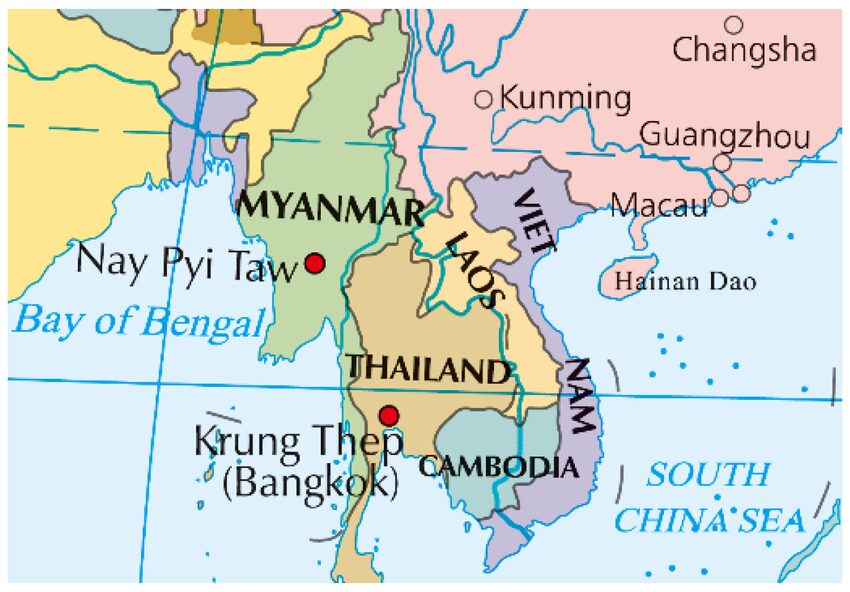
While the US is counting on Cambodia, China will deepen cooperation with Myanmar. Myanmar supplies oil and gas to China, helping it lessen its reliance on the Strait of Malacca, through which 80% of China’s oil flows. The US Navy could impose a complete blockade of the Malacca Strait if there were a conflict with Beijing. By passing through Myanmar territory, China gains indirect access to the Bay of Bengal and the Andaman Sea. The Andaman Sea includes the Nicobar and Andaman Islands, which India plans to turn into permanent bases for its navy and air force. The US views India as a counterbalance to China, and China’s growing presence in Myanmar will provide additional strategic advantages.
Cambodia is separated from Myanmar by Thailand, a traditional US ally. With the constructive relationship between China and Laos, Laos could theoretically serve as a gateway to the Gulf of Thailand for Beijing. However, Cambodia lies between Laos and the Gulf of Thailand, sharing borders with Thailand and Vietnam, both of which have so-called “special” ties to China. Therefore, Cambodia’s pro-American stance impedes China’s access to the ocean.
Geopolitically, Cambodia could act as a springboard for Beijing to expand its influence into Indonesia and Oceania, challenging the dominance of Washington’s key allies, Australia and New Zealand, in the region. This also explains why the US wants to bring Cambodia into its camp.
In this context, in addition to strengthening relations with China, Myanmar is actively expanding cooperation with Russia, purchasing Russian weapons, and seeking closer ties with the Eurasian Economic Union, the Shanghai Cooperation Organization, and BRICS.
A recent notable event that has received little media attention is the official visit to Myanmar on February 2 by the Chairman of the Russian Security Council, Sergei Shoigu. Russia and Myanmar signed a military cooperation agreement extending to 2030. Even more notable is Shoigu’s statement: “Russia fully supports the Myanmar leadership’s determination to protect its territorial integrity and strengthen national sovereignty and security. You can fully count on Moscow’s comprehensive assistance, including in the international arena.”
In the current context, China is compelled to strengthen cooperation with Myanmar, while Myanmar benefits from consolidating partnerships with both China and Russia. Therefore, Washington expects to use Cambodia as a catalyst for regime change in Myanmar, while also aiming to counterbalance the presence of Russia and China in Southeast Asia.
MORE ON THE TOPIC:
2030 the dollar has to be six feet under, no skip for this one
it’s incredible that, despite all the evils cambodia suffered because of the united states, they’ve become its lapdogs again.