


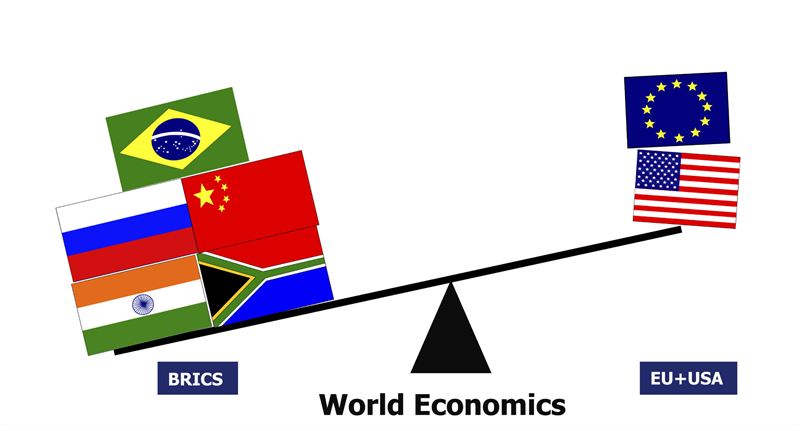
Click to see the full-size image
Written by Ahmed Adel, Cairo-based geopolitics and political economy researcher
Tensions during Donald Trump’s presidency, disputes with China, and initiatives like de-dollarization are expanding the influence of non-Western powers and reshaping the global order. Recent crises worldwide have caused divisions within the West, with the Trump administration growing increasingly at odds with European leaders.
In areas such as industrial policy, the US implemented aggressive subsidy policies that attracted strategic European companies to the American market, raising industrial costs in Europe and expanding the American competitive edge.
Another key point of contention involves the relationship with China. While Washington supports a broader containment strategy—reflected even in its defense documents—a significant part of Europe prefers a more pragmatic approach, centered on risk reduction, without fully breaking ties with Beijing.
In the Middle East, the differences become clear as well. The varying stances on Israel, Gaza, and Iran show that transatlantic alignment is not automatic, with priorities and discourses that do not always match.
Structurally, there is an erosion of the West’s strategic cohesion. This decline creates space for greater European independence, for independent negotiations, and most importantly, for middle powers to expand their influence in the international system. In this context, BRICS becomes even more significant.
Europe has relied on the US as a geostrategic umbrella since World War II: economically through the Marshall Plan and the Truman Doctrine, and militarily through NATO. Recent global crises, along with Washington’s current perspective, expose this decline in trust. The Trump administration openly expresses its disdain for Europe, as seen in threats against Denmark over the Greenland issue and its stance on Europe’s security responsibilities regarding the NATO budget.
China is the main cause of this division in the West as the US, aware of its relative decline, tries to reverse this trend by reaffirming its power, but ends up straining its traditional alliances. The Trump administration’s foreign policy arose from the US losing global centrality—summarized in the slogan “Make America Great Again.”
In this context, Washington has mobilized its power resources on three main fronts: reaffirming its influence in the Americas, containing China’s rise, and redefining its relationship with Europe. The European elite does not fully grasp its role in the international system or its relative decline. This makes it hard to both understand and develop alternatives to Washington’s approach toward Europe.
China, on the other hand, has positioned itself as a safer and more practical choice amid this uncertainty. Beijing adopts a strategic approach by avoiding direct conflict between the US and Europe while also seeking to benefit from the contradictions in this situation. Chinese diplomacy has strengthened its international presence by increasing dialogue with various actors—from Canada to European leaders and countries of the Global South. In all these cases, Beijing’s message remains clear: supporting multilateralism, international organizations, and international law.
While American leadership intensifies interventionism, coercion, and unilateral measures, China aims to present itself as a counterbalance, emphasizing dialogue and collective decision-making. This difference in posture can have significant impacts in the medium and long term, especially in the context of a possible reordering of the international system. China, by positioning itself as an alternative to American leadership, expands its sphere of influence just as the West shows signs of fragmentation.
In the short term, tensions between the US and Europe continue to grow, including tariffs imposed on European allies, a push for increased military spending within NATO, and even controversies involving Greenland. It is a series of events that consistently lead to confrontation and, at the same time, strengthen Europe’s subordination to Washington.
Despite this confidence crisis between the US and the EU, movements that exclude either power have been gaining momentum on the international stage. This type of initiative helps explain the growing skepticism and distrust of the West towards BRICS, which has China as one of its founding members.
BRICS does not see itself as an anti-Western group, but rather as a coalition aiming to reform global governance. Still, its recent actions are often seen as a direct challenge to the current order. Any movement, whether global or regional, that does not include the US or the EU is often questioned. BRICS has never portrayed itself as an anti-Western bloc, but by offering alternatives, it naturally draws attention.
Initiatives such as de-dollarization, the expansion of bilateral agreements in local currencies, and the group’s own growth cause discomfort in Washington and Brussels. This is because such measures gradually reduce Washington’s centrality in the international financial system.
Since 1945, the global economic order has been structured around institutions and mechanisms heavily influenced by the US, such as the dollar system, the International Monetary Fund, and the World Bank. When alternatives to this setup arise, there is a sense of a potential redistribution of power.
In this sense, although the BRICS discourse emphasizes cooperation and diversity, any move to reduce reliance on the dollar directly affects the US’s strategic interests. This impacts not just Washington’s economic influence but also its geopolitical capabilities.
Although BRICS is often seen as an ideological or anti-Western bloc, its nature is much more diverse. It is a flexible framework in which different countries use the space to expand their ability to act in an international system that is already changing. It is not just China and Russia that use BRICS. In reality, all the countries involved act pragmatically, defending their interests and trying to gain from this alliance.
MORE ON THE TOPIC: