


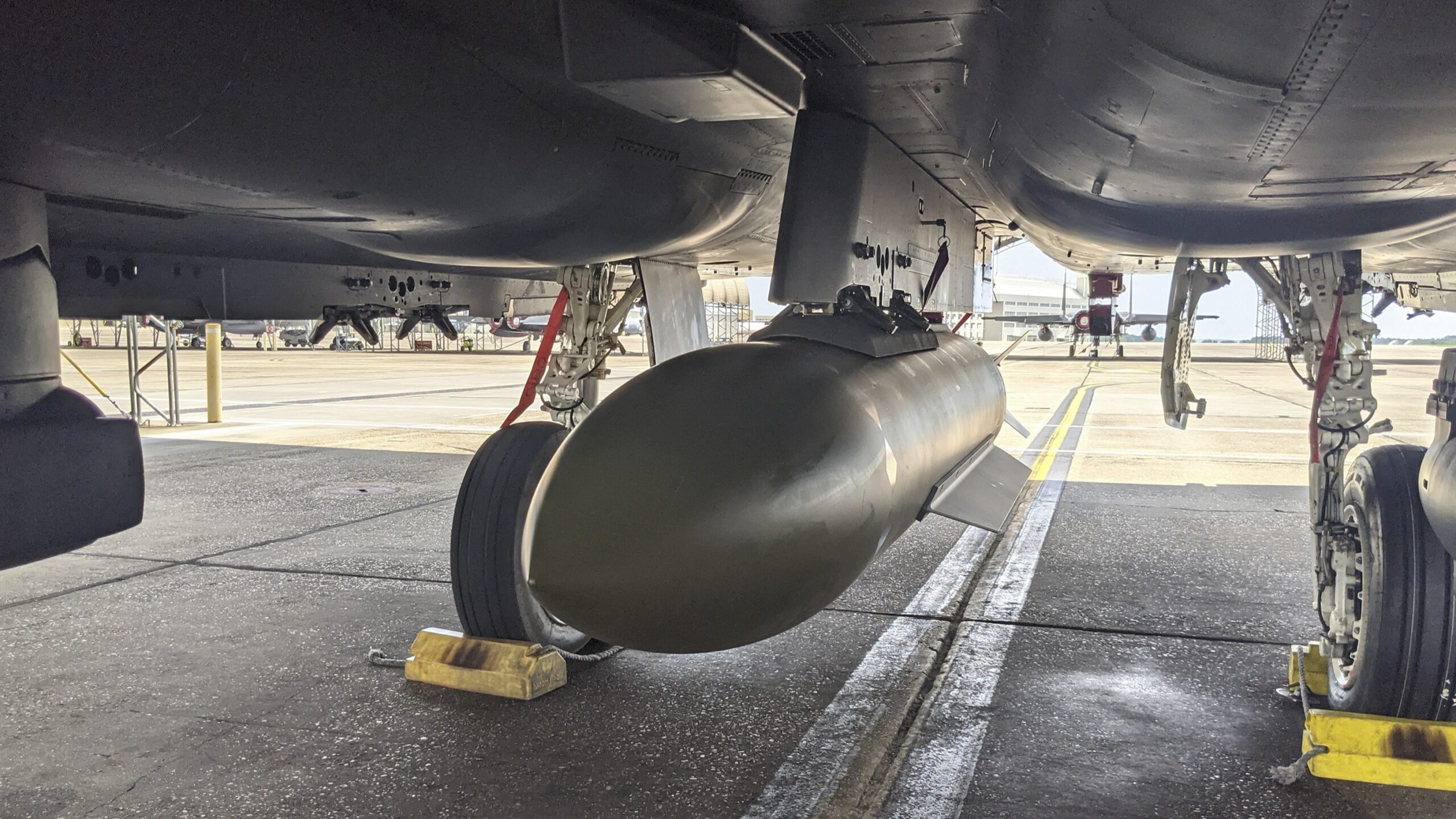
Illustrative image. (U.S. Air Force\Samuel King Jr.)
The United States Central Command (CENTCOM) announced early on March 18 that it had successfully employed multiple “5,000-pound deep penetrator munitions” on hardened Iranian missile sites along Iran’s coastline near the Strait of Hormuz.
The sites contained anti-ship cruise missiles which “posed a risk to international shipping in the strait,” the command said in a post to X, without elaborating.
The Strait of Hormuz is the world’s most critical maritime chokepoint, with roughly one-fifth of global oil consumption passing through. The waterway serves as the primary gateway for energy exports from major producers like Saudi Arabia, Iraq, and Kuwait.
Iran’s Islamic Revolutionary Guard Corps (IRGC) previously warned that any ship passing through the Strait of Hormuz would be attacked, and the waterway has effectively been closed since the start of the American-Israeli war on the Islamic Republic, with some 18 vessels hit by Iranian fire there and in nearby waters.
The latest attack targeted Gas Al Ahmadiah, a Kuwait-flagged liquefied petroleum tanker, 23 nautical miles east of Fujairah in the United Arab Emirates on March 17, according to the United Kingdom Maritime Trade Operations (UKMTO) organization.
The Islamic Republic of Iran Navy and the IRGC Navy both showcased multiple tunnels used to store anti-ship missiles and other weapons, even missile boats, in the past.
The “5,000-pound deep penetrator munitions” CENTCOM said were used to hit such sites were most likely the GBU‐72, also known as the Advanced 5K (A5K) Penetrator.
The GBU-72 — which weights 2,300 kilograms — is said to resemble an enlarged GBU-31/B Joint Direct Attack Munition (JDAM) fitted with a bunker-busting BLU-109 or BLU-137/B warhead. It is fitted with the GBU-31/B JDAM’s tail-mounted guidance kit, which utilizes a GPS-aided inertial navigation system, and has long fins on either side of the bomb’s underside.
No official data is available for how deep the GBU-72 can penetrate before exploding, although the weapon’s program manager has been quoted as saying that its “lethality is expected to be substantially higher compared to similar legacy weapons like the GBU-28”.
The capabilities of the later versions of the GBU-28 remain classified, but the earliest versions could reportedly penetrate 46 meters of earth and more than 4.6 meters of reinforced concrete.
The GBU-72 can be dropped by the U.S. Air Force’s B-1B Lancer strategic bombers and F-15E Strike Eagle fighter jets, in addition to the Israeli Air Force’s F-15I Ra’ams.
U.S. attempts to reopen the Strait of Hormuz by threatening Iran with an attack on its main oil exporting hub, Kharg Island, have not succeeded. Furthermore, efforts to form an international coalition to escort vessels through the waterway are also facing problems.
The latest strikes are also unlikely to change much as Iran may have already spread many of its anti-ship missiles outside the hardened sites.
_______________________________________________________________________________________________________________________
SouthFront: Analysis and Intelligence
NOW hosted at southfront.press
Previously, SouthFront: Analysis and Intelligence was at southfront.org.
The .org domain name had been blocked by the US (NATO) (https://southfront.press/southfront-org-blocked-by-u-s-controlled-global-internet-supervisor/) globally, outlawed and without any explanation
Back before that, from 2013 to 2015, SouthFront: Analysis and Intelligence was at southfront.com
smaller brains for bigger bombs
be careful what you wish for, it might bite back.
5000 pound mcburgershitstein wont save you
for all of dads and moms that love to stay home to take care of their loved ones, or rest of people on the search for an opportunity to pull in some extra income for their family month after month let me share a remarkable opportunity to explore.
here →→→→→→ https://psee.io/8jqu9r
so, again bs by sf. they again used jdams! why do you do that if you have aerial superiority? 🤔
because they are part of the deception. playing like they are opposition.
as if he would know how would he know? course sf just trust “authorised” anonymous sources which is why wiki hahaha label them as disinformation probably doubtful that employees of the commerce departemt have any military experience either personally or in their families. just their high school history and hollywood.
iran’s anu5 has just been stretched…heheheh
is it a competition with you?
he was abused by his father at an early age. very traumtic experience. need to compensate
cognitive brainwashing has many victims. making idiot savants is an occult zio media program that infects the weak minded. many victims post as trolls here
they hardly need to since they’ve taken out all of irans leaders, the around 40 who were with the ayatollah on day one and now last night the real replacement and his team too. and the ayatollahs son s never been seen since he was attacked, who knows if he’s even alive? he’s made no video appearances even.
its possibly not really sensible to chant”death to. americans” for almost 50 years and then boast about how much uranium you’ve got at peace talks. imo
lol.. the terrorists are talking out their asses. they don’t dare overfly iran…. all they have been able to use are jasms because of iranian air defenses…. and a 5000 pound bomb cannot be converted to a ‘jasm’.
i always had a little sympathy for the iranian underdogs. but like, they’re like kids who can’t throw. no matter how many tricks one tries to teach them they still sock. it is so painful to watch lose time and time again, i don’t know, but sometimes i think, sometimes it would be better for the iranian mutts to be send to the underdog pound so they can humanely be “taken care of” permanently.
when will the russians and iran learn isreal uses ai software on mobile phones to track and kill by creating a heat mapping with calls in and out to get placement of the person . the iran attack was on the cards when the russian general was shoot who oversaw the middle east
no the reason anerica knew where to locate targets is because they’ve been medically implanted with some sort of antennae/chips by their drs .like a dog’s microchip but much much smaller. allegedly according to reliable intelligence imo who shall not be named for privacy.
are you talking about the coronohoax vaksine with the nanotechnology in it… self assembling devices?
according to my early warning radar, ussa and shitrael lost this war. main objectives failed. they are now digging around to make up secondary objectives and sell them to the maga piggies
usa israel setlaars are the one who accusess irn for killing.but most of killings are done by usa,isael,britin aand france.imagin their kill innocent most profesionaal representative of iran ali larijani.
soon usa the great bbilon will collapse because of this war.god is also fed up with isrel illegal rulers nd usa/nto killers.jesus will not come now only real natives take over israel.trump wants iran oil and gas
with any luck, pedophile psychopath and satanist donald trump will arm isis. isis will not follow the instructions and will leave lebanon alone, but will prepare pavelić’s jasenovac and gradiška stara and ratkov’s srebrenica for the alawites and kurds. that in two years syria will be a complete monoculture sharia and there won’t be a single alawite or a single kurd in it. the kurds who so diligently support the pedophile trump and the alawites who betrayed syria on
putler’s orders should all be killed and all their women sterilized so they never give birth to traitors again. because without the sterilization of their women and girls, it is not possible to achieve a suitable punishment for cooperation with the criminals dump and putler. both are crooks, thieves, pedophiles and exploiting their own nation for personal enrichment. where are the bosses like josé mujica and rafael correa? people who want good for their nation.
before can hit a target, you have to know where it is, and i doubt the us know the tunnels layout.
340 million transgenders in nazi burgerstan now humiliated by persia required to pay billions$ to israel to lick superior jew peniz
burning all the ammunition will not remove the many missile mountains. they will staff and resupply . these people are willing to die to win. nationally.
on a country that posed no threat what has the u s become