


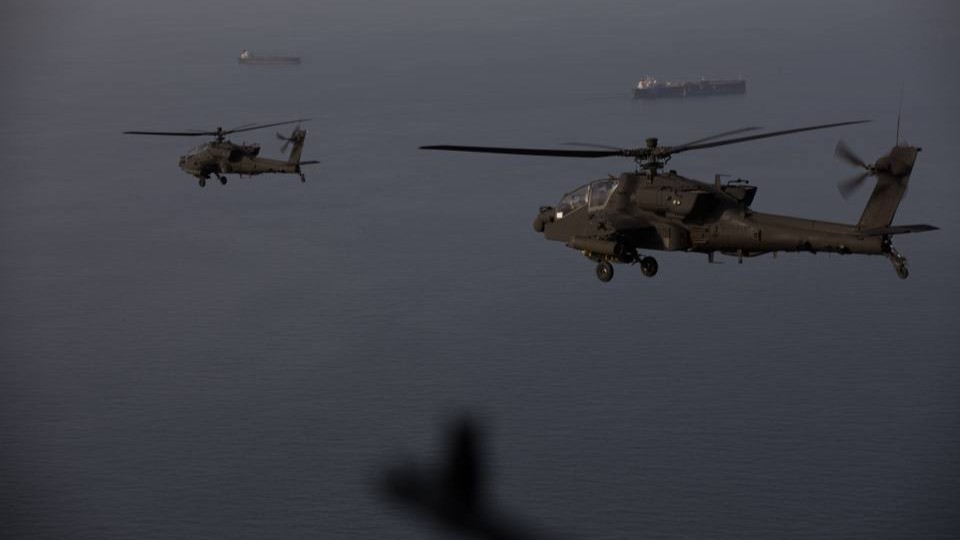
Illustrative image. (U.S. Central Command)
The United States Central Command (CENTCOM) announced on June 18 that its forces lifted the blockade on all maritime traffic entering and exiting Iranian ports and coastal areas, in accordance with the direction of President Donald Trump.
In a statement, the command said that “American forces are not impeding the transit of vessels to or from Iranian ports on the Arabian Gulf and Gulf of Oman,” adding that “all U.S. military blockade enforcement efforts have ceased.”
“Our great Naval Ships will remain in the general area to make sure that all aspects of the agreement are adhered to, obeyed and in full force and effect,” the statement concluded.
Trump ordered the blockade on Iranian ports right after the ceasefire went into effect last April, in response to the Islamic Republic’s restriction on maritime traffic in the Strait of Hormuz — a checkpoint for around 20 percent of global oil and liquefied natural gas shipments.
According to CENTCOM, American forces disabled nine non-compliant vessels, redirected 135 ships that complied, and allowed 42 vessels supporting humanitarian aid to pass since initiating the blockade on April 13.
The blockade was lifted in line with the memorandum of understanding which the U.S. and Iran signed earlier in the week to end the war.
The deal follows a general “step for step” approach, and based on that, the Islamic Republic is expected to remove all restrictions on maritime traffic in the Strait of Hormuz shortly.
Interestingly, while Iran has committed not to charge vessels passing through the waterway during the 60-day negotiation period dedicated by the MoU, the text of the deal explicitly states that the Islamic Republic “will conduct dialog with the Sultanate of Oman to define the future administration and maritime services in the Strait of Hormuz in discussion with other Persian Gulf littoral states in line with the applicable international law and the sovereign rights of coastal states of the Strait of Hormuz.”
According to that, if a final agreement is reached after the negotiation period, Iran would be free to impose a toll on the Strait of Hormuz, as long as this is done in coordination with Oman and other Persian Gulf states.
While the U.S. was able to blockade Iranian ports with force, the move ultimately failed to get any meaningful concessions out of Tehran. In fact, the war ended up solidifying the Islamic Republic’s control over the Gulf waters, especially the Strait of Hormuz.
_______________________________________________________________________________________________________________________
SouthFront: Analysis and Intelligence
NOW hosted at southfront.press
Previously, SouthFront: Analysis and Intelligence was at southfront.org.
The .org domain name had been blocked by the US (NATO) (https://southfront.press/southfront-org-blocked-by-u-s-controlled-global-internet-supervisor/) globally, outlawed and without any explanation
Back before that, from 2013 to 2015, SouthFront: Analysis and Intelligence was at southfront.com
iranians must be celebrating the win!
chumpo is just playing for time.
exactly. just another ruse again. the west is totally “agreement incapable” because they are infiltrated and run by zionists.
my emperor trumpstein pay 150$ billion so i can get persian jizz derped in my incel anuz
wow ! i did not expect this yet. the international zionist mindset still requires internal self adjustment to accept and understand reality. hopefully hasbara word smith goyslop script writers will accept the necessary changes required. or just be fired outright. like laura loomer
yankees, you lost! now go home!!!
yes. another humiliation, the list grows. eventually their military, although having a big budget, is pathetic, outdated, and always relied on bluff.
it’ll be several months before fuel prices stabilise globally, thou the planting season is now close so without fertiliser and sulphur expect food prices to go up, same with the prices of electronics, as the helium supply has been cut off, and of course the zionist joo’s could f everything up, as it is what they do.
i will reject this story until all american naval and supply ships are returned to home port. when all ships and sailors are returned home to families. i will accept