


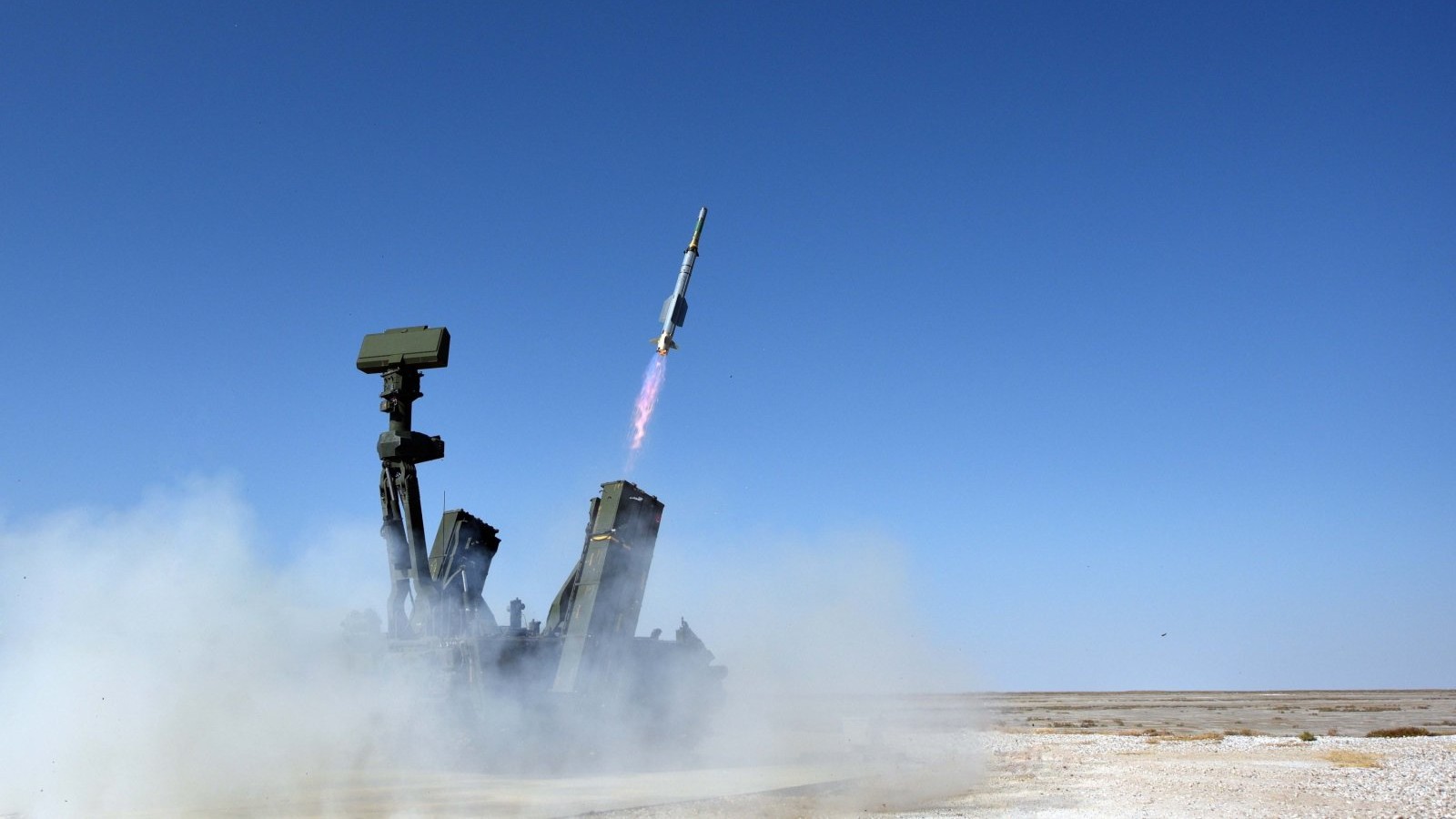
Illustrative image. (Aselsan via AA)
In a first, the Rapid Support Force (RSF) announced on May 21 that it has “destroyed and burned” a Turkish-made Hisar-A short-range air defense system of the Sudanese Armed Forces (SAF).
The paramilitary group, backed by the United Arab Emirates, had been engaged in a power struggle with the military, which is allied to Saudi Arabia, Egypt and Turkey, for more than three years now.
In a statement, the group said that the Hisar-A system was targeted close to the highly strategic town of Rahid al-Nuba in the North Kordofan State. It didn’t provide any details on how it was able to locate the air defense system, or how exactly it was destroyed.
“The destruction of the Islamic Movement’s air defense system in the ‘Rahid al-Nuba’ area today came as a result of accurate monitoring and continuous tracking of the enemy’s movements and its desperate attempts to advance, which were shattered by the vigilance and alertness of our brave and courageous forces,” it added.
RSF shared surveillance drone footage showing the system getting hit by an unidentified precision-guided munition. The crew escaped right after the strike. The missiles then began cooking off, and the system ended up completely burned down.
The Hisar-A, renamed recently to the Hisar-A+, is the lower tier of the Hisar family of air defenses developed by Turkey’s Roketsan and Aselsan.
The system, which is built on a FNSS ACV-30 tracked vehicle chassis, features a unique design, with four retractable missile launchers mounted on each side, in addition to a MAR radar — made by Aselsan — and an electro-optical targeting system installed in the center.
It can detect aerial targets from a range up to 70 kilometers, and engage them with its imaging infrared-guided missiles within a range of 15 kilometers, with up to an altitude of eight kilometers.
The Hisar-A entered service in 2021, and while there have been many rumors about its deployment in Libya and Syria since then, the RSF strike in Sudan is the first solid evidence of the system ever being sent outside of Turkey. It is unclear, however, if the SAF was operating the system targeted in Rahid al-Nuba, or if the operators were Turkish.
Notably, the system was operational when it was hit, as evident by its radar spinning. Still it failed to detect the surveillance drone flying right above it.
The conflict in Sudan escalated over the past year, and while Turkey has been backing the SAF, Turkish-made weapons, including combat drones, have made their way to the RSF, mainly through the UAE.
Just earlier this month, the SAF shared footage showing a Turkish-made Akıncı combat drone flying on a mission in support of the RSF getting shot down over Sudan. The military claimed that the drone, made by Turkey’s Baykar, was provided by the UAE and took off from Ethiopia’s Bahir Dar airport. Interestingly, several analysts speculated that the SAF shot down the drone with one of its own Akıncıs.
The Akıncı has an operational range of 7,500 kilometers, an endurance of 25 hours and a service ceiling of over 12 kilometers. The drone, which costs around $30 million, was developed to carry out strategic missions, including reconnaissance, surveillance, and precision strikes.
Based on recent developments, it wont be surprising if the SAF’s Hisar-A air defense system was actually destroyed by an Akıncı combat drone of the RSF.
_______________________________________________________________________________________________________________________
SouthFront: Analysis and Intelligence
NOW hosted at southfront.press
Previously, SouthFront: Analysis and Intelligence was at southfront.org.
The .org domain name had been blocked by the US (NATO) (https://southfront.press/southfront-org-blocked-by-u-s-controlled-global-internet-supervisor/) globally, outlawed and without any explanation
Back before that, from 2013 to 2015, SouthFront: Analysis and Intelligence was at southfront.com
they destroy dummy air defence system hooray hooray 🤣
you got any evidence to prove your claim, little boy?
this incident with the hisar-a system raises questions about air defense vulnerabilities in conflict zones. how do you think this will impact turkey’s military strategy moving forward, especially in terms of regional stability? https://fnaffree.io