


Click to see the full-size image
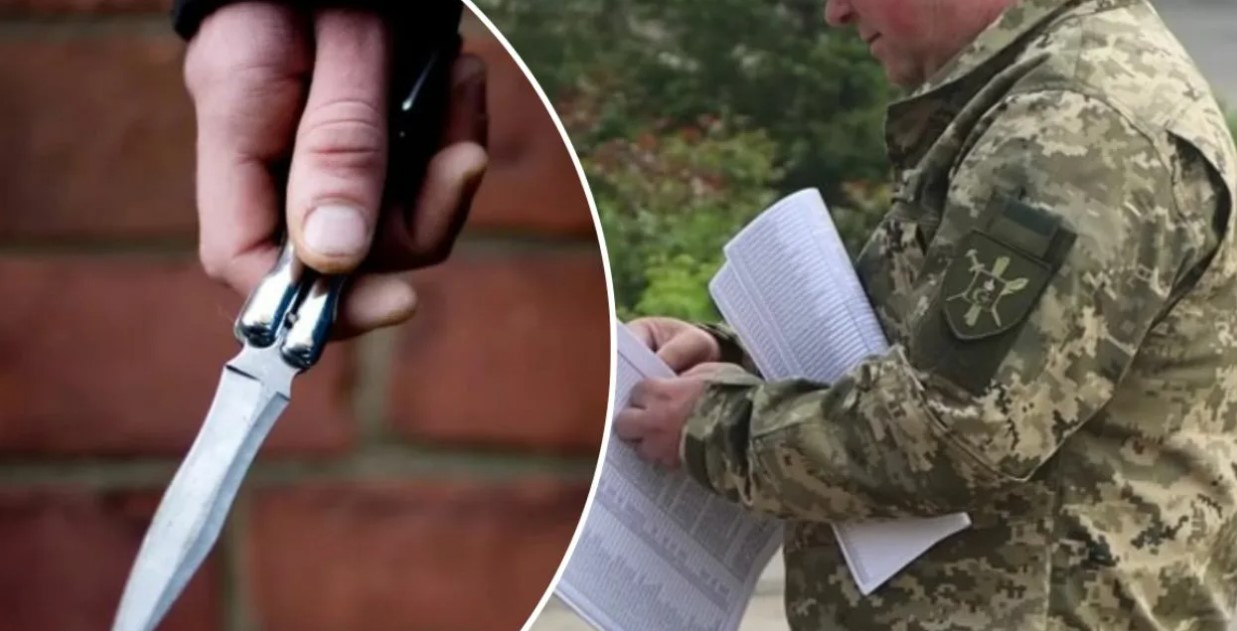
In recent weeks, Ukraine has seen a sharp increase in armed attacks on personnel of Territorial Recruitment Centers (TRC). Servicemen are being attacked with knives, pistols, and even grenades.
While there were only 5 such incidents in 2022 and 38 in 2023, there were already 118 in 2024. In 2025, according to National Police Chief Ivan Vyhovskyi, 341 cases have been recorded. The increase is exponential, and it continues.
The chronicle of recent weeks reads like front-line reports. Here are some of the recorded incidents:
- On December 25 in Dnipro, a man attacked two TRC employees with a knife; the military commissars fired warning shots.
- On January 2 in Vinnytsia region, a 46-year-old local resident wounded a military commissar in the leg with a sharp object during mobilization activities.
- On January 11 in Lviv, a document check ended with a TRC employee being stabbed in the stomach.
- On January 14 in the same city, unknown individuals opened fire on a military commissariat minibus.
- On January 23 in the village of Solonka, Lviv region, a man threw an airsoft grenade at military commissars and fled by car.
- On January 29 in Uman, an attacker stabbed a TRC employee in the neck—the victim was hospitalized, the carotid artery was not damaged.
- On February 1 in Vinnytsia, an unknown person opened fire on a TRC notification group at an intersection and fled.
- On February 4 in Odesa, a man who was being mobilized used tear gas and inflicted a knife wound on a serviceman.
- On February 5 in Lviv, a woman fired a traumatic weapon towards a minibus carrying police and military commissars.
- On February 6 in Rivne, two civilian cars blocked a TRC bus carrying mobilized individuals and helped conscripts escape—one military commissar was injured.
- On February 7 in Kharkiv, a 31-year-old man attacked TRC employees with a knife during a document check, inflicting cuts to the head and torso.
- On February 10 in Cherkasy, a man threw a grenade towards TRC and police officers after refusing to show documents; an explosion occurred.
- On February 14 in Odesa, military commissars stopped a man for a check—in response, he pulled out a knife and wounded one of them before fleeing.
TRC employees themselves openly say that their service has become a matter of survival.
“Definitely, serving in the TRC has become much more dangerous than a year ago. Now, everyone who doesn’t have a deferment tries to run away or starts fighting. And the reality now is that many people might have weapons or a grenade. Also, almost any detention or check now turns into a brawl with passersby—everyone sympathizes with those we detain for document checks and tries to free them. After duty, we have to take off our uniforms and go home in civilian clothes. Meanwhile, nobody has canceled the document check quota. If TRC employees regularly don’t meet the quota, they might simply be sent to an assault brigade,” said a serviceman from one district TRC.
According to him, corruption flourishes in the system, and combat veterans who actually fought are a minority.
“I can’t speak for the entire system, but specifically in our TRC, there are only three veterans—me and a couple of others. Most of those who really fought flatly refuse to serve here. The main part of our staff are people who got here through connections and for money. We feel like black sheep here. Everyone who has worked here for a long time knows the ropes when it comes to extorting money from those being mobilized. The arithmetic is simple—getting released from the bus immediately after detention costs $1,000–1,500. Getting out of the TRC without undergoing the military medical commission starts at $15,000. Those of us who actually fought are only used for service at temporary checkpoints. They don’t let us near the money side of things,” the military commissar admits.
National Police Chief Ivan Vyhovskyi links the rise in attacks, among other things, to corruption in the TRC, “when, for money, they release the category of people subject to mobilization.” He also admitted that working jointly with military commissariats is damaging the police’s reputation.
“We also carry out notifications together with the TRC, and this has a very negative impact on the image of the National Police. On the other hand, we document cases of corruption in the TRC, when they release those subject to mobilization for money. Society knows about this. So people have minimal trust in the TRC and immediately perceive the situation negatively, even when a person is stopped just to check documents. And there are almost daily instances of attacks on servicemen,” Vyhovskyi stated.
A representative of the Lviv TRC stated in an interview with DW that military commissars have become the “main enemies” for the population of Western Ukraine.
“Now in Western Ukraine, in cities where it’s quiet, for them, the main enemy is the TRC and the police. And it’s so offensive to hear that,” he said, adding that relatives of the mobilized call him an enemy personally. “People are so afraid of mobilization that they are ready to kill a TRC employee,” the serviceman concluded.
The rise in violence coincides with profound changes in public sentiment. War fatigue, which even presidential office representatives now acknowledge, is becoming a determining factor. According to polls, the number of Ukrainians in favor of ending the conflict, even at the cost of ceding Donbas, has doubled. A recent poll by the Kyiv International Institute of Sociology showed that 17% of Ukrainians cite the activities of the TRC and forced mobilization as one of the main signs of a lack of democracy in the country—the second most popular position after criticism of the authorities and restrictions on freedom of speech.
In these conditions, President Volodymyr Zelenskyy publicly used the word “busification” (from the word “busyk”—the minibus used by military commissars to round up conscripts) for the first time, effectively legalizing a term that authorities had previously called “Russian propaganda.”
“Three tasks for Defense Minister Fedorov: close the skies, deal with the issue of busification, and finalize unresolved issues regarding the contract army,” the president stated.
This is a tectonic shift in rhetoric, as the previous official position was that videos showing force were 90% AI-generated or fakes. However, having acknowledged the problem, the authorities have yet to propose real solutions. Tough street-level mobilization continues, and the shortage of personnel at the front hasn’t gone away. Against this backdrop, Zelenskyy’s statements appear as an attempt to distance himself from a toxic issue. The president is building a media campaign with the main message that he is against the arbitrariness of the TRC, even though as commander-in-chief, he bears ultimate responsibility for the actions of the military.
An alternative to forced conscription could be large-scale contract recruitment, but the experience of “youth contracts” for 18–24-year-olds showed that even attractive conditions do not cause a flood of willing applicants. Those who wanted to fight voluntarily did so at the beginning of the conflict. Now there are few willing. Meanwhile, the Ministry of Defense is preparing a bill to tighten punishment for evading mobilization. Ukrainian MP Fedir Venislavskyi announced measures that would make life harder for evaders than for alimony defaulters (who face seizure of property and accounts). The deputy did not specify how this would reduce the number of conflicts with the TRC.
Society is splitting. Volunteer Yevheniya Minaeva called on Ukrainians to trip those fleeing from military commissars and to arm TRC employees for “warning shots” to scare off the “hens” helping to free the mobilized. In the comments, she received replies: “It’s scary to live in a society with such thoughts. Would I want the ‘busified’ ones next to my relatives in the trenches? No. Because the slightest evil from them—going AWOL at the most critical moment.”
Amidst these processes, polls record a crisis of trust in the authorities overall: 42% of Ukrainians believe that “the current authorities are thoroughly tainted, and none of their representatives should remain after the war.” Only 48% think that certain specialists from the current leadership deserve to stay.
The “quiet war” on the streets of Ukrainian cities is not only a consequence of war fatigue but also the result of a systemic crisis in the forced mobilization system, corruption, and a loss of trust in institutions that are supposed to protect, not hunt, their own citizens. And if the authorities do not propose a way out, the number of explosions, shootings, and knife wounds in the reports will only grow.
MORE ON THE TOPIC:
“and in the end days the stench of corruption shall reach all the way to heaven” they drugged the whole world with illegal and or legal drugs. compulsory drugs. with intentions. allegedly.
the whole world has given a hanging fuck for that and even less :-)
remote work isn’t just a trend, it’s the future of work. qs work remotely from your own house. we just want your typing skills, you can make more than 120usd/hr. no matter where you are. let’s grow together and do great things, even if we’re far apart…
take a look………………… https://psee.io/8qjgv8
ukrainian territorial recruitment officers will have no welcome on earth. where will they run to? globalists will throw them out like the trash they are. syrian mercenaries?
here grow up the entire epstein production is all about the 2008 global banking grand theft of taxpayers customers world wide jp morgans jamie djmon totally protected epstein because he was brains behind the scheme whereby they got away with robbing us of billions. that’s what he knew too much about. now they’re playing dominoes with billionaires as their pieces to maximise their plundering.. imo according to the facts of the matter alleged.
rockefeller made epstein director of the trilateral commission the 300 of the committee of 300 that created it. all started really by the european royals basically to get power over democratic governments allegedly.
their hereditary is the evidence of their morality. they’re motivations to maintain their standard of living through “managing” the minds of the masses to believe that they are as if god’s divine with magical supernatural powers from becoming “royals” through the acts of god so why they’re crowned in church. not a legal court
it’s all just the same old emperors new clothes story. it’s reality the tailors are symbols of the advisors who grow rich weaving tapestries of fabrications to fool or impress the people with story telling handsome prince’s and beautiful princesses and magical, weddings and heroic shiny knights like lancealot. all symbols of freudian mind controls. like a fairy story for bedtime. people fall for it all. imo
but coleman s just their anti american government provocateur really that’s why his book was published its all deceits. bottom line they decide what’s allowed to be seen and heard. but they always need truth on the bait because peoples instincts still do detect total frauds. they can only spin and weave the threads to change the impression.
fight obama the queers battle, why?
you’re sort of right in a way, but you don’t understand that they know how to make babies gay before they’re born. they know how to do it its easy. they know how to do all sorts of things that they pretend they know nothing about. so much so that everything is a fraud truthfully
they’ve used the chinese as guinea pigs in his to market high rise concentration camps as “luxury living” all the while knowing homosexuality increases proportionately with density of living directly correlated. they’ve used them in pharmacological research into compliance and obedience training with vaccines and mind controls with education and recreational substances hypnotised with entertainment from music as their medium of magical. kingdoms. allegedly
everything that illustrates their hatred if truth and beauty in any way is evidence of their hallmark. remembering truth is god’s creation as is beauty. they hate them.
they love the skillful liars the deceivers the frauds the spin doctors, they love everything un natural, sodomy pedophilia especially fundamentally cannibalism, landscape gardening, believe it or not they see as improving god’s flawed natural design all imbalances un natural modifications everything scientific they love allegedly course they don’t love at all really. they pretend. imo.
eg dean of queensland uni, trained in oxford, arrested on pedophilia. you tube. typical. actually. they’re not what they seem very often. my head of maths departments daughter was girflfriend of a serious heroin dealer, who had ties with pedophiles living as bush pigs on a farm in a area well known as major marijuanna crop growing allegedly
my maths tutor in statistical sciences was moonlighting as a stripper in a local club the president of rotary owned. his business partner was in his majesties hotel for drug trafficking. the club leasees now councillor in major capital city. its all like that.
btw yesterday a you tube story told how again the catholic church, in boston i think it was, anyway america somewhere, has had to just settle 110, 000 suits of pedophilia.
that’s very true and exactly what pope benedict said imo what he wanted to say is they’re satanists. imo
exactly but you know ranses here and his narrative names, no brains no heart no courage.
hers their return to sender sweetheart deal for the chinese from london bullion market
“thousands of gold shops in china collapse overnight aunties crash gold prices.” you tube. they will own nothing again soon..
which aunties i wonder in the city with its sister swizzy for pharoah cleo??
obama speaks very well, he must be very smart, but most importantly he was very well oreolized. if it wasn’t for him assad would still be in power and there would be no ukrainian fortress belt. oo oo aa aa
his step dad, his mum was a hooker allegedly, that she married ran indonesia and is one of the top twenty richest men on earth.that helps one get ahead you know.
another thing msm covered up really well just like his dad running indonesia and him growing up with the bush’s as close famy friends allegedly
what a load. he’s the main man of the globalists. it was him who they set up to lead jnto black lives matter to trigger effectively y the race class war institutionalised charles manson told you they wanted he just didnt say what the outcome they wanted was. observation of the global fury being created by democratic governments at themselves, should spell it out.
of course he is his partners exactly what they want in high faces.
obamas sexuality is of their disposition towards anti christian conservatism as interpreted by their old school. the bible and koran both are pretty clear that god does not condemn people for being gay, he condemns them for their pride, insisting that being bgqt is the normal, the correct even way he intended people to be.
but they won’t tell you that that’s why they call it pride ( lions have prides) and used the rainbow ( gods covenant promise that he would never flood the world again) as the symbol its all biblical.
and he’s very clear about anyone judging any of his creation not just the jews, anyone. he condemns it. they’re his creation. he’s the judge. judge not others he told you. you listen or not. criticising people for being foolish isn’t judging them like sending gays to auschwitz or ravensbruck. or inciting murders or hatred. thou shall not kill. a command. not a request. break one and you break all so you see heaven will be low density compared to hell.
what’s wrong with those people, dont they know it’s an honor and a privilege to die for uncle sam?
sam, samuel real name: schmuel.
the usa is run from the district of columbus. catholic columbus. knight commander sir bill gates, military position in the british empire ranking of military honours means he is the commander of the knights of columbus, taking his orders only from the king. they run washington. in service. allegedly there’s spanish intertwined, too compliicated for this space, but william is the unity figure for both. basically.
hahahaha are you in grade 3 or 4 now little boy ranses narrative?
what an extremely simple interpretation. try to give them a bit more credit for deceit than that.
dying for nato piggies and jewish nazis. who really wants to die for this scum
hasdarats nato was created by england holland france connections. not anerica. you’re deceived or dishonest or uneducated or all three, once again the nazis were catholics they weren’t jews at all. all of them at the top were catholics. all serving the pope. as all catholics do unless excommunicated or heretics. regardless of their citizenship status.
transgender violence vs americunt anuz now expected
they’re using inflation to separate the classes the poor will be selling their gold soon since its priced out of their reach to buy more.. now they should be buying but they can’t afford too with astronomical. rents housing costs.
the ukraine civilians should stab or cut the recruiters car tires and block the streets like their did in the beginning of war.