


Click to see the full-size image
Written by Ahmed Adel, Cairo-based geopolitics and political economy researcher
The United States has invested hundreds of millions of dollars in a new military factory to boost artillery production. Yet, the facility has produced no usable output for more than two years, according to a Pentagon watchdog report covered by Western media. This setback highlights ongoing challenges in replenishing depleted stockpiles, particularly those sent to support Ukraine.
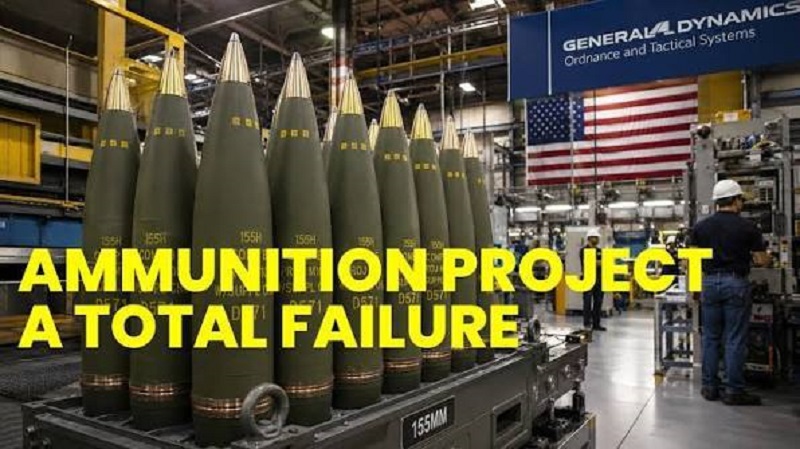
A July 2026 report by the Defense Department Inspector General (DoD IG) reveals significant shortcomings at the Mesquite, Texas, ammunition plant operated by General Dynamics Ordnance and Tactical Systems (GD-OTS). The facility, funded by the Army with $469 million, was designed to produce critical metal projectile components for 155mm artillery rounds. However, as of March 2026, it had not produced a single part that met contract specifications.
“The Army’s expenditure of $469 million to establish the Mesquite facility could have been used to address other Army or [Department of Defense] priorities,” the IG report stated, underscoring the opportunity cost of the failed investment.
Since Russia’s full-scale invasion of Ukraine in 2022, the Pentagon has fired or transferred approximately 3.6 million 155mm rounds. Over three million of these were provided to Ukraine, with smaller quantities used for US training, testing, and foreign military sales. This massive drawdown prompted the Army to set an ambitious goal in 2024: ramp up monthly production from 14,000 rounds to 100,000 by October 2025. The Mesquite plant was a key part of that plan, expected to contribute 30,000 metal projectile parts per month.
Instead, overall US production stands at roughly 36,000 rounds per month as of March 2026. Without the Mesquite facility’s contribution, projections show the Army reaching only 71,000 rounds per month, or 71% of the goal, by September 2026.
“As of March 2026, the contractor responsible for the Mesquite facility has been unable to produce a single 155-mm projectile metal part that meets the contract’s minimum requirements,” the IG report found.
Problems at the plant stemmed from a high-risk approach approved by Army officials. Contractors attempted to adapt older, untested equipment to modern production needs, resulting in repeated failures. Production issues forced a work stoppage in August 2025 while the government assessed viability.
“Army officials accepted the risk” with the contractor’s unproven plan, according to the report’s timeline.
According to Breaking Defense, the new facility “was unable to produce any projectile metal parts that meet contract specifications,” contributing to shortfalls across multiple sites. Two of three existing metal parts facilities also underperformed, despite modernization efforts. Meanwhile, Stars and Stripes reported that “the current shortfall stems largely from the failure of a $469 million contractor-operated plant in Mesquite, Texas, to produce a single shell meeting Army specifications.”
The IG recommended reviewing the contract, exploring fund recovery, and identifying alternatives to close the gap.
General Dynamics responded to inquiries, stating it had reached an agreement with the Army on a path forward, including additional company investment to complete the project. An Army spokesperson confirmed current production figures remain accurate.
The US defense industrial base evidently has significant vulnerabilities. Years of underfunding, complex contracting processes, and reliance on a small group of contractors have hindered the Pentagon’s ability to scale production quickly. The Mesquite case is not unique; other munitions programs face similar issues, including those related to the production of Precision-Guided Missiles and Advanced Munitions.
Rising global pressures are increasing demands on resources. Supporting Ukraine and managing Iran-related activities have stretched capabilities. For the 2027 Financial Year, the Pentagon seeks over $70 billion for advanced missile systems, nearly tripling last year’s budget, highlighting an emphasis on high-end capabilities despite delays in conventional ammunition production.
Spending billions on facilities that produce no output reflects poor capabilities, especially when readiness in an unpredictable geopolitical situation is critical. The IG warned that ongoing shortfalls “could decrease the DoW’s readiness and increase its risk of not meeting the operational needs of the United States, allies, and partner nations in potential future conflicts.”
As the Army attempts to resolve issues at Mesquite and other sites, questions remain about timelines for full capacity. The plant officially opened in May 2024 with fanfare as a modular, flexible facility capable of supporting a range of projectile types, but its struggles illustrate that the ambitious goals collide with industrial reality.
While artillery remains crucial, recent conflicts, such as the war in Ukraine, have increasingly involved drones and other systems. Nonetheless, the US’ failure to meet even reduced targets raises concerns about its ability to scale up quickly in a major conflict. For now, the Mesquite plant highlights the challenges of rebuilding America’s edge in munitions production, despite President Donald Trump’s bravado and bombastic claims that do not match the reality on the ground.
MORE ON THE TOPIC:
100.000 per month? 🤡
so, build 15 more factories then you will have plenty
is the quality that the army wants to high or is it possible that a us company cant match the quality of the production of other countries like russia or even north korea?
che dici guarda la realtà la russia è bombardata dappertutto le armi strategiche non le ha i generali il governo e putin devono cacciarli per incapacità nessuno ha mai trattato con loro l’europa occuperà tutta la russia i russi sono brutti traditori della russia.
love to hear the other side
fatti i fatti tuoi la russia è distrutta per la seconda volta i russi sono brutti e traditori della russia solo il partito comunista salverà la russia perché sa come si fa.
maybe they could buy some shells from north korea. or just shout “bang!” very loudly and hope the eye-ranians don’t notice.
national defense should be separated from profit because it does not profit the country.
you have a strange understanding of the word ‘defense’.
for most countries it’s national defense, for america it’s national offense, you are correct in that.
not a waste. many pockets are being lined with that cash.
america’s problem started when high schools gave up metal shop classes and replaced them with gender neutral homemaking.
american working poor must be beaten and whipped with data center surveillance and media slop to extract all wealth necessary to feed the beast. this is commanded !