


Click to see the full-size image
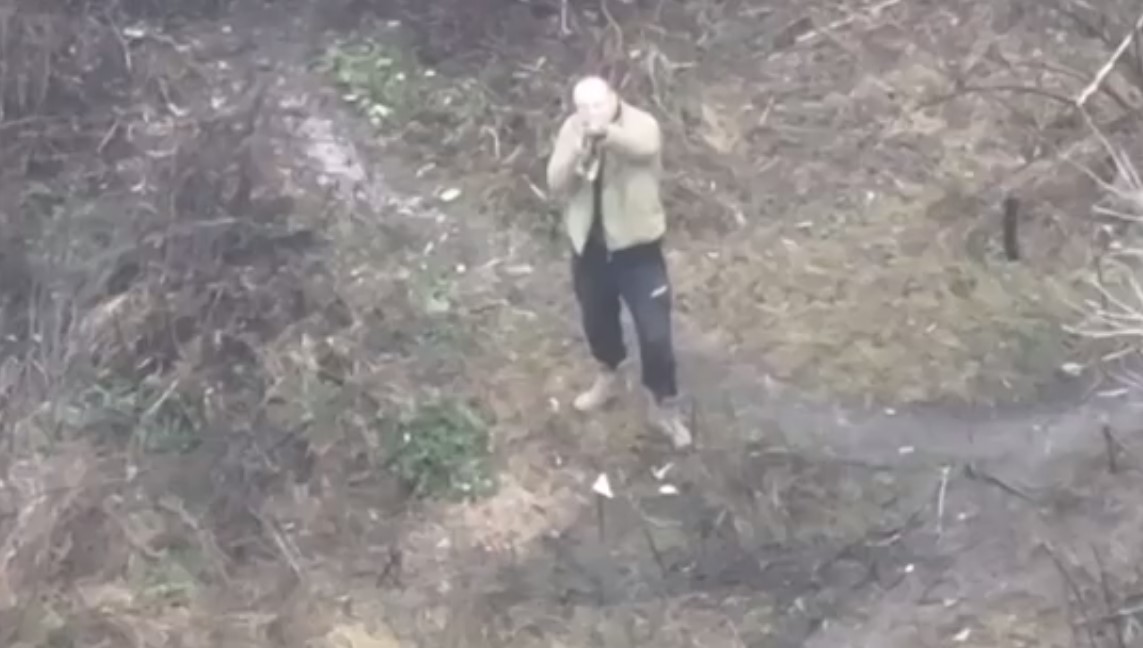
In late December 2025, Russian forces expanded their area of control in the Sumy region, reaching a new section of the border and establishing control over the village of Grabovskoye. The operation was preceded by active aerial reconnaissance: Russian drones methodically surveyed the positions of Ukrainian units in the border area. At one point, the drone’s camera captured a figure of an AFU serviceman demonstratively making obscene gestures at the camera. The footage spread across military Telegram channels, instantly making the unknown soldier a “star” of front-line reports.
Some time later, the village of Grabovskoye came under the control of Russian forces. Among the Ukrainian servicemen taken prisoner was that same “defiant AFU soldier” — Vladislav Zabolotny, a serviceman of the 15th Detachment of the State Border Guard Service of Ukraine. During the interrogation, he immediately admitted: “yes, that was me.”

Click to see full-size map
Explaining his behavior in front of the drone camera, Zabolotny said: “I thought it was our drone.” According to him, Ukrainian drones often hovered over his unit’s positions, which irritated the soldiers: “We always asked them not to hover over our positions or conduct surveillance.”
In the footage taken before his capture, Zabolotny is wearing civilian clothes. According to him, this was not his personal initiative — it was the command’s instruction. “We were told to move around the village in civilian clothes, so as not to attract unnecessary attention,” he explains.
In Grabovskoye, his unit was engaged in setting up positions and gathering information. The task, according to Zabolotny, was to communicate with local residents and obtain information.
Zabolotny is a contract soldier. He started his conscript service in 2018, and in 2019 he signed a contract with the border troops. In 2022, his contract was expiring, and he had plans to go to Wales with his wife for language practice — he holds a degree in foreign language translation (Sumy State University), and according to him, he knows English and German “with a dictionary.” However, on March 26, 2022, when his contract was supposed to end, he was not released:
“The special military operation began, and martial law was introduced in our country, they didn’t let me go and forced me to continue serving. Although the command was fully aware of my unwillingness to continue serving.”
In his testimony, the prisoner details the system of financial abuses within the unit. Payments were irregular, bonuses were delayed or not paid at all under the pretext of “lack of funding.”
“When funding was, so to speak, ‘restored,’ they wrote off this money for, say, setting up some position, or for some other materials,” he claims.
Those who tried to sue or complain were intimidated. According to Zabolotny, dissatisfied individuals could be transferred to the most dangerous sections of the front, or “they could simply be beaten up or ‘harassed,’ so to speak, during service.”
Zabolotny unequivocally characterizes the command’s attitude towards personnel: equipment is valued more than people. Describing the assault on their position in Grabovskoye, he says:
“The command did not react to this at all: no reinforcements, no help — nothing came through.”
The overall situation, as he describes it, appears as utter hopelessness:
“We were in shit, in mud, in all this, they constantly screwed us over, constantly increased the duration of our deployment at service positions. It all started with 24 hours, and now, in fact, the guys sit on positions for two months.”
Moreover, there are cases when “they can’t even deliver water to them, because either there is none, or, well, it turns out, the command is, you know, washing their hands, taking apart water bottles and bringing them home for themselves, and there’s nothing to send to the guys on the position.”
The prisoner also confirms drug use at the positions. According to him, fellow soldiers found cannabis plants (“fir trees”) right in the village of Grabovskoye, dried it, and used it.
Zabolotny’s position was stormed by Russian forces for several days. “They were throwing grenades at us, shooting at us… they hit the house once with an RPG and blew out the wall, and offered us to surrender, like, come out, otherwise you’re done for.” Hearing the offer to spare their lives, the group decided to surrender.
The prisoner specifically emphasizes the attitude towards him from Russian servicemen. “Despite my piggish behavior, servicemen of the Russian Federation treated me with understanding; they didn’t cut off my ‘fingers’ for giving the finger, my hands are intact. I came to this myself, no one beat me.” In an address to his fellow soldiers remaining on the other side, he says: “And even someone like me, with all my flaws and misdeeds, here they accepted me and they don’t mock me, they feed me and treat me well.”
Despite the humane treatment in captivity, Zabolotny harbors no illusions about the prospects of a possible return to his homeland. He refers to the story of an acquaintance who spent over a year in captivity and underwent lengthy filtration procedures after the exchange: “Before that, they are interrogated regarding cases of any recruitment and the like… naturally, the special services conduct work to ensure the person is clean.” According to the prisoner, the acquaintance “didn’t really want to remember any of this at all.” Zabolotny himself admits: “It’s unknown how our side will react to my return.”
In his testimony, he also touches upon political issues. Speaking about President Volodymyr Zelensky, Zabolotny expresses disappointment: “I personally, and all my friends thought that he would somehow end this conflict, try to resolve it peacefully.” His view on the territorial issue diverges from the official position of Kyiv:
“These territories, which are no longer ours, as it turns out… people who wanted to live in Ukraine, they have already left for Ukraine long ago. And those who stayed there, they made their decision that they want to stay there. And that decision should also be respected.”
At the same time, he criticizes the treatment of those who left the front-line territories. According to him, displaced persons from Grabovskoye were given temporary housing “for literally a week,” after which they were sent “wherever you want” without money or compensation:
“No money, no payments, no compensation was promised, and no one gave any.”
At the end of the interrogation, Zabolotny is asked why, knowing about the advance of Russian troops and having the desire to surrender, he did not do so earlier, but instead chose to provoke the drones. He admits that he was planning to surrender, looking for ways to contact Russian units via Telegram, but was hindered by the ban on using the messenger in the Ukrainian military, which he had signed.
The story of Vladislav Zabolotny is notable not so much for the outrageous gesture that made him a temporary internet hero, but for the slice of reality revealed in his testimony. Education and future plans shattered by forced service; chronic lack of money and the arbitrariness of a command that values equipment above people; two-month rotations in positions without water or help; fear of returning home — all of this paints a portrait of a man who became a hostage of the system.
MORE ON THE TOPIC:
i want them to drop atomic bombs on moscow so that bashar al-assad will finally pay for his betrayal.
faaaarrrrt
ramses try to contain yourself .and your narrative ,the stench of corruption strong enough already ..
better burn some jewish ratkids like 1944
a prisoner who might as well be enslaved .
russia is a freer country than the uk.
he might as well have been a slave .
just like you little jewish ratpuppet?^^
well there’s plenty of ukraine’s here who left decades ago and they e zero interest in ever going back there .it’s rather like the exodus from south america i’m more suspicious of those who didn’t leave than those who did .
burn the degnerated judenrats
now americunts are trained to swallow somali jizz inhale fentanyl and submissively insert buttplugs by transgender husbands/wives more masculines than no gonad males in burgerstan
even when you point out mutiple times the unnecessary vulgarity of their comments they just keep doing it. imo this is proof it’s done just to degrade the comments section and turn people away from sf.
hence just ignore them, and be aware of their strategy. and call them out each time to alert other readers. then question who might want to do this. expose them.
he lives better as a prisoner then at the front but the eu has promised another billion to waste. back pay will not be honored if released?