


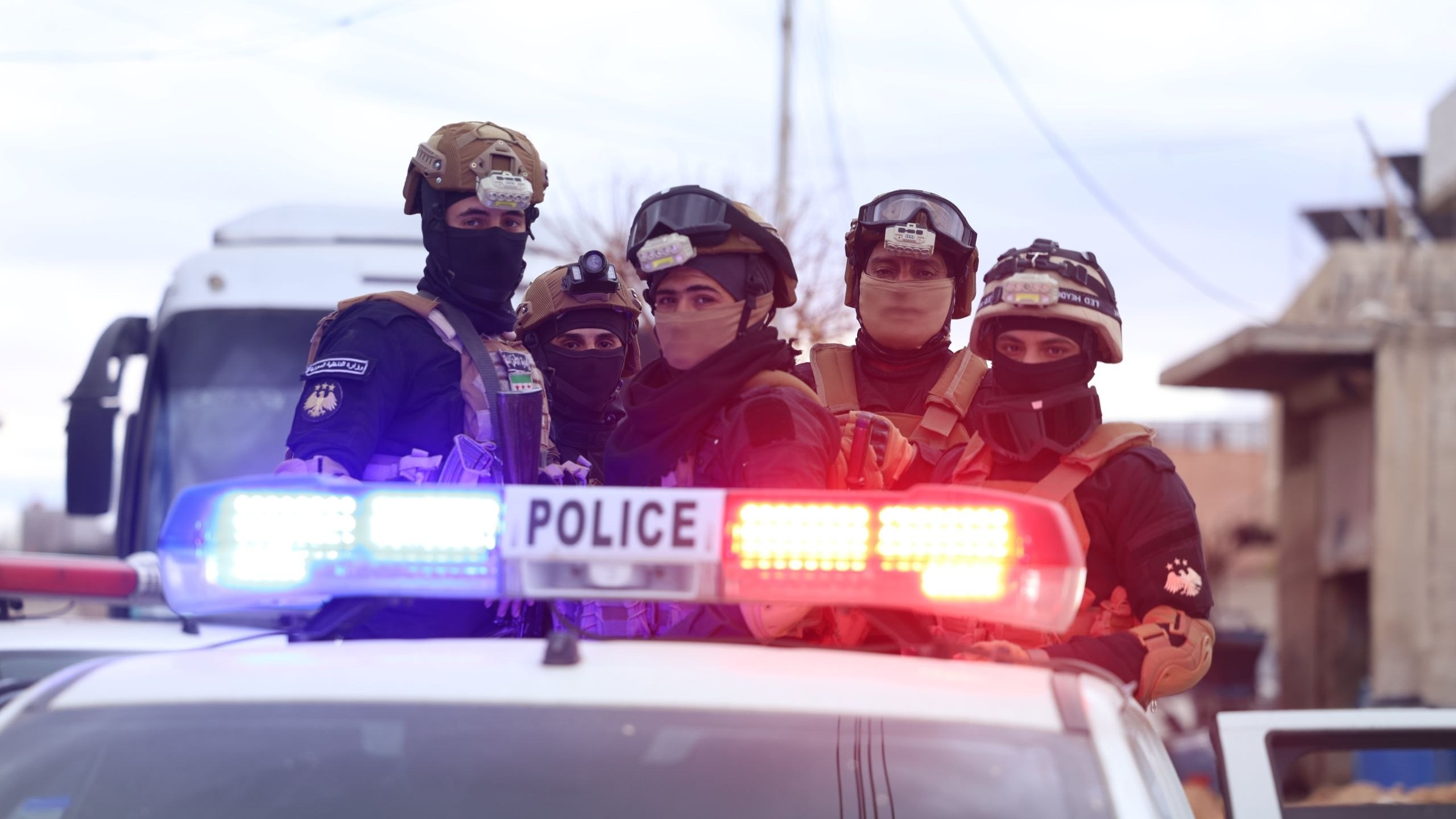
Illustrative image. (Syrian Interior Ministry)
Syria’s Christian communities are facing an escalating campaign of attacks, kidnappings, killings and intimidation under an Islamist transitional government that has failed to protect them and whose own security forces have been implicated in attacks against the community.
From armed mobs storming predominantly Christian towns to gunmen abducting residents for multimillion-dollar ransoms and assailants assaulting senior clergy inside churches, the attacks have spread across the country, leaving communities increasingly afraid to practice their faith or celebrate their religious traditions publicly.
The violence has also exposed a widening pattern of state pressure, including the detention of Christian community figures, restrictions affecting religious and social life, and the targeting of residents who attempt to defend their towns.
The cumulative effect is threatening the survival of some of Syria’s oldest Christian communities and raising fears that continued intimidation and insecurity will drive their remaining populations out of the country.
The most dramatic escalation began in March, when armed men stormed Al-Suqaylabiyah, a predominantly Christian town in Hama governorate, attacking homes, shops and vehicles, looting properties and setting buildings on fire.
The March 28 assault followed a dispute involving two young men from neighboring Qalaat al-Madiq who had allegedly harassed Christian women. After being confronted by local residents, the men returned with dozens of others, many riding motorcycles, and launched a widespread attack on the town. A shrine dedicated to the Virgin Mary was also destroyed.
The scale of the assault exposed the failure of the government’s security apparatus to protect the town. At least 100 attackers reportedly passed a Ministry of Interior security checkpoint before entering Al-Suqaylabiyah. Reports also accused some security personnel of accompanying the attackers or standing by as the violence unfolded.
The violence triggered protests by residents demanding protection and accountability. Yet the attack was followed just two days later by another assault on Christian property, when unidentified individuals entered a cemetery in Al-Rawda, Tartous governorate, and smashed crosses on gravestones.
Al-Suqaylabiyah faced another outbreak of violence on July 28, this time involving members of General Security themselves. According to the Syrian Observatory for Human Rights, a group of armed General Security personnel from neighbouring Qalaat al-Madiq entered the Christian town, harassed girls sitting at a cafe and opened fire after local residents confronted them. A grenade was also thrown, injuring several people, including a young man who suffered a head wound.
The response of the security apparatus further intensified the incident. General Security personnel fired indiscriminately to disperse gatherings before launching arrest campaigns against residents who had confronted the attackers.
Among those detained was local doctor Ra’ef Shehadah. Rather than protecting residents and holding the armed personnel responsible for the violence accountable, the authorities turned their security operations against members of the community who had intervened to defend them.
A similar pattern emerged in Kafr Buhum, another predominantly Christian town in Hama. On August 13, groups of young men from outside the town reportedly entered its streets, filmed girls and harassed them.
Residents protested outside the police station, demanding action against those responsible. When local youths intervened during a second incident, security forces detained members of the Christian community rather than the men accused of harassment. Five of the detained residents were eventually released following pressure from the community and local officials.
The intimidation continued on August 28, when two armed men riding a motorcycle attacked a liquor store owned by a Christian resident, firing inside and causing extensive damage. The business had been attacked once before, making this the second armed assault against the same establishment.
The attacks have been accompanied by a series of killings, kidnappings and disappearances. On July 3, Rani Halawa, a Christian man and brother of a local priest, was found dead several hours after disappearing near Jaramana, in the Damascus countryside. Five days later, Fadi al-Shaer, a Christian resident of Kafr Buhum, was abducted at gunpoint together with his daughter. His body was subsequently found with gunshot wounds, while his daughter was released.
On July 19, Christian woman Samia al-Nasser disappeared while travelling from Homs governorate to Damascus to visit relatives. On July 27, Christian resident George Abu Nassar was kidnapped in Al-Suwayda. His captors reportedly demanded at least $20,000 before he was released approximately a month later bearing signs of torture. His release reportedly followed intervention by a General Security official who used personal contacts to secure his freedom.
Another Christian man, Fadi Semaan, disappeared on August 2 while travelling along the Damascus-Saidnaya road. His abductors subsequently demanded a ransom of $5 million, and an audio recording reportedly circulated showing that he had been tortured.
The killings continued in August. On August 15, Nader Tannous, a Christian man who had recently returned to Syria after living as a refugee in Sweden, was shot dead by gunmen riding a motorcycle as he returned home from work in Homs. Tannous had opened a hair salon in the city after returning to his country. His killing underscored the insecurity facing Christians even as some attempted to rebuild their lives and return after years of displacement.
On September 30, Christian man George Nemeh was found murdered at his farm in Qaya, Latakia governorate. Two young Christian men from Saidnaya and Maarouna near Damascus were subsequently found shot dead on November 24 on the road linking the two towns in the Damascus countryside.
The kidnapping campaign reached an alarming level on October 19, when Christian goldsmith Maher Sankari was abducted in broad daylight in Al-Suqaylabiyah. Surveillance footage showed a vehicle deliberately striking his motorcycle before masked men emerged, beat him and dragged him into their car. His captors subsequently demanded 125 kilograms of gold, equivalent to approximately $15 million. His family later received a video showing him being tortured, according to Christian Solidarity International.
The fate of the man remained uncertain in the latest reporting, while questions persisted over whether the authorities had launched an effective investigation into his disappearance.
The kidnappings continued into November. On November 5, Christian resident Karim Mousa al-Nader was abducted in Hama, with his captors demanding $100,000. Three days later, Christian lawyer Hassan al-Issa survived a shooting in what was described as a failed assassination attempt in Sadad, another predominantly Christian town in Homs.
While armed groups have repeatedly targeted Christian residents, the government’s own security apparatus has also become a source of fear for these communities. On June 13, security forces arrested four Christian men from Saidnaya — George Mansour, Rabee Moussa, Boutrous al-Sheikh and Shihab Yacoub. They were reportedly detained over their participation in the defence of the town against ISIS in 2014 and were still being held in an Interior Ministry prison in Al-Nabek as of early July.
Former Sadad mayor Suleiman Khalil has also remained imprisoned without charge or access to a lawyer. A Syriac Orthodox Christian, Khalil organized the town’s defence against ISIS in 2015. His detention began in February 2025 and has continued throughout 2026, making him one of the most prominent examples of the authorities’ pressure on Christian community figures.
On July 19, Nihad Hassan, a convert to Christianity and pastor of a Kurdish Evangelical church in Lebanon, was detained by Syrian security forces while visiting his family in Afrin. He was released after more than two weeks.
On August 5, Christian engineer Tony Daniel was arrested by General Security following televised criticism of corruption within the Engineers’ Syndicate. His arrest, which reportedly resembled an abduction, prompted protests from lawyers and human rights activists.
Christian Solidarity International has also documented allegations that security personnel have targeted Christian business owners in Saidnaya, Jaramana and Wadi al-Nasara through arrests over alleged violations of religious rules, with families sometimes being forced to pay money to secure their relatives’ release.
Such practices have added to concerns that the security apparatus is being used to intimidate and financially pressure members of Christian communities.
The pressure has reached churches and religious leaders themselves. On May 13, an object containing several explosive devices fell from a hearse outside St. Ephrem Syriac Orthodox Cathedral in Aleppo during preparations for a funeral. Church staff raised the alarm, prompting security forces and explosives specialists to seal off the area and remove the devices. The incident narrowly avoided potentially catastrophic consequences for mourners attending the funeral.
On November 14, armed men broke into the Cathedral of Our Lady of Peace in Homs and assaulted Greek Catholic Archbishop Youhanna Abdo Arbash. The assailants bound, blindfolded and gagged him before ransacking his office and stealing money, valuables, his pectoral cross and an icon of the Virgin Mary.
Archbishop Arbash survived the attack, but the assault on one of Syria’s senior Christian religious figures demonstrated the extent to which even the country’s established church institutions and clergy had become vulnerable.
The growing insecurity has also forced Christian communities to retreat from public religious life. Following the March assault on Al-Suqaylabiyah, Catholic, Greek Orthodox and Syriac Orthodox churches cancelled or restricted public Easter celebrations, confining activities largely to religious services inside churches.
Later in August, churches in Saidnaya and Marmarita cancelled public celebrations associated with their religious feast days for the second consecutive year. In Saidnaya, committees representing the Greek Orthodox, Syriac Orthodox and Melkite Greek Catholic communities cited the detention of residents without what they described as legal justification, kidnappings, mistreatment and campaigns portraying Christians as remnants of the former government.
They also condemned online incitement against the community, including threats of retaliation. Celebrations were consequently restricted to prayers inside churches.
Government policies have added another dimension to the pressure on Christian communities, particularly through restrictions affecting their businesses, cultural activities and religious freedoms.
On March 16, Damascus authorities prohibited restaurants, bars and nightclubs from serving alcohol, requiring existing businesses to convert their licences into cafe licences. The decree allowed sales of sealed bottles for takeaway only in three predominantly Christian neighbourhoods — Bab Touma, Bab Sharqi and Qassaa — while imposing additional restrictions on the distance of alcohol outlets from religious buildings, schools and security facilities.
The measure prompted protests in Damascus on March 22, when hundreds of residents gathered in Bab Touma against the restrictions and their implications for personal freedoms.
The decree placed particular pressure on businesses operating in Christian neighborhoods, effectively concentrating the remaining legal alcohol trade in those areas while shutting down alcohol service in the rest of the capital.
In June, new customs regulations reportedly prohibited the import of alcohol and musical instruments, according to Christian Solidarity International, further restricting businesses and cultural activities associated with Christian communities.
The restrictions have extended beyond alcohol-related businesses. On November 26, Damascus authorities temporarily closed several restaurants and commercial establishments in the predominantly Christian neighborhoods of Bab Touma and Bab Sharqi, including businesses not accused of selling alcohol. Officials cited noise complaints and alleged licensing violations.
The closures came weeks before Christmas and New Year, threatening businesses during a crucial trading period. The Syrian Observatory for Human Rights reported that more than 450 workers were affected, adding to mounting pressure on Christian-owned businesses.
The cumulative developments finally prompted an unusually direct intervention from Syria’s senior Christian leadership.
On November 17, the heads of the Greek Orthodox, Greek Catholic and Syriac Orthodox churches issued a joint statement condemning what they described as recurring attacks against Christians and accusing the competent authorities of failing to provide security and protection.
The patriarchs explicitly rejected the characterization of the violence as isolated incidents, describing the assaults and kidnappings as systematic. They highlighted the torture of Maher Sankari and the assault on Archbishop Arbash, warning that the repeated attacks, without meaningful responses or tangible results from the authorities, raised grave questions about the future of Christians in the country.
They demanded an end to the attacks, effective investigations and accountability, warning that Christians must not be treated as easy targets or scapegoats.
The statement represented a forceful public rebuke of the transitional authorities by religious leaders who had repeatedly called for coexistence and equal citizenship.
The warning came after months of attacks in which the government’s security forces either were directly implicated, failed to protect residents or subsequently detained members of the communities they were supposed to safeguard.
From the attackers who passed a government checkpoint before burning Christian homes in Al-Suqaylabiyah to security personnel firing on residents who confronted their colleagues in July, the state’s responsibility has become central to the crisis.
The continued detention of Christian community figures, restrictions on religious and public life, and the absence of accountability for repeated attacks have reinforced the perception that the authorities cannot be relied upon to protect the community.
After over a decade of war, displacement and emigration, Syria’s Christian population has already dwindled dramatically. The renewed attacks, kidnappings and economic pressure, compounded by the transitional government’s failure to protect Christians and hold perpetrators, including members of its own security forces, accountable, threaten to accelerate their exodus from a homeland where their communities have existed for nearly two millennia.
The November warning by the country’s three principal church leaders underscored the gravity of the crisis, with the future of Christianity as a living community in Syria increasingly at stake.
_______________________________________________________________________________________________________________________
SouthFront: Analysis and Intelligence
NOW hosted at southfront.press
Previously, SouthFront: Analysis and Intelligence was at southfront.org.
The .org domain name had been blocked by the US (NATO) (https://southfront.press/southfront-org-blocked-by-u-s-controlled-global-internet-supervisor/) globally, outlawed and without any explanation
Back before that, from 2013 to 2015, SouthFront: Analysis and Intelligence was at southfront.com
i hope the democrats will force hts to attack russian bases in syria. i hope hts puts all the catholics and alawites in syria on the front lines. that alone would be a fitting punishment for the treacherous russians and alawites. they would likely end up killing each other; if they refused, hts should shoot them and their families. so, i hope democrats pressure hts and the libyan al-qaeda to attack pussian bases.