


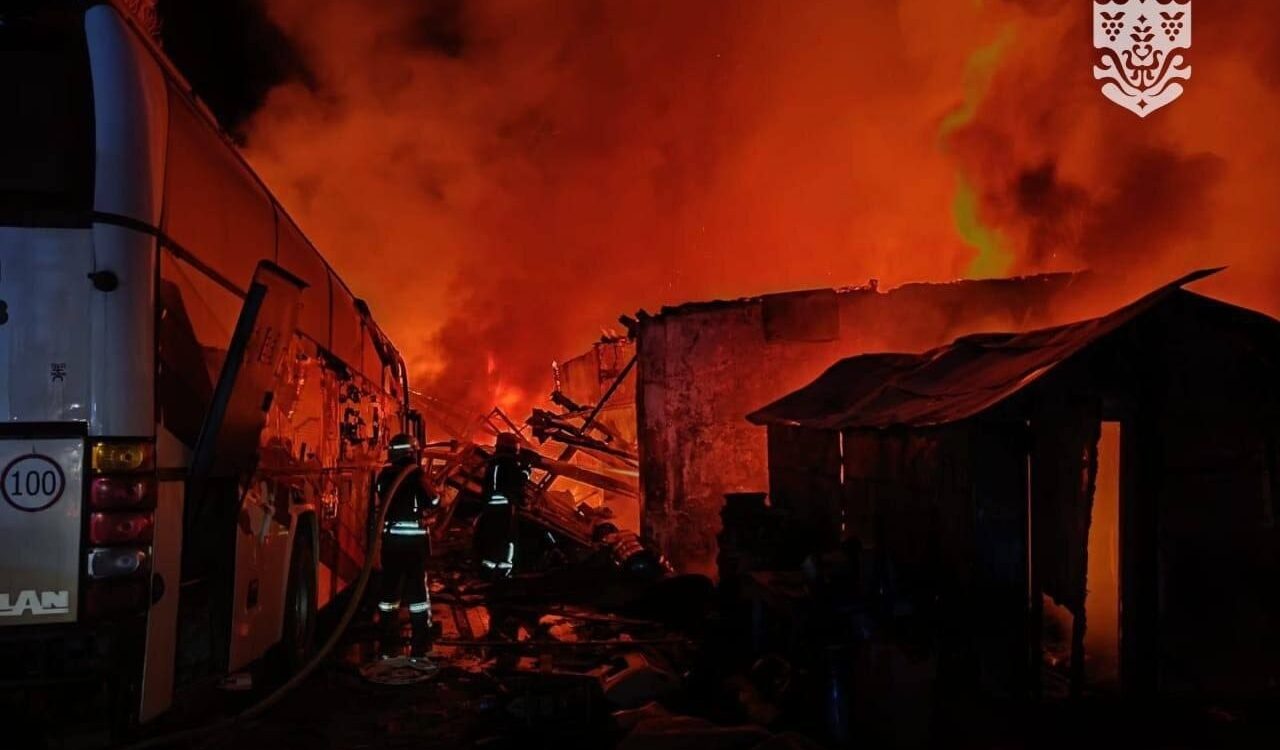
Click to see the full-size image
April 14 was part of an ongoing cycle of mutual strikes: Ukraine reported a massive wave of Russian drones and missiles, and by the evening, attacks continued with a new series of drone approaches and strikes on facilities in several regions. According to the Ukrainian Air Force, on the night of April 14, 129 Russian UAVs were recorded, of which, it is claimed, 114 were shot down or disabled.
The attack affected facilities in seven regions. Energy and transport infrastructure were hit particularly hard. In the Mykolaiv region, a direct hit damaged the PS 35/10 kV “Kobleve” substation. In the Dnipropetrovsk region, a strike on the substation cut power to the “Stepova” mine in the Shakhtersk district.
In the Kharkiv region, in the city of Lozova — one of the key railway hubs of the region — the locomotive depot was struck. At the Sukhachivka station of the Prydniprovska Railway, direct hits destroyed a freight electric locomotive and an electric commuter train, as well as damaging the catenary and railway track.
In Kryvyi Rih, Dnipropetrovsk region, a strike hit the 150 kV “TsGOK” substation, which supplies power to the Central Mining and Processing Plant. In the Kharkiv region, in Merefa, a transformer was hit on the territory of the “Bitoksyd” enterprise.
Additionally, Russian UAVs targeted air defense positions and transport arteries. In the Dnipropetrovsk region, near Adarovka, the deployment infrastructure of the 35D6M radar station, which provides long-range target detection, was hit.
In the Danube sector, the vessel “EXELON” (Panama flag), which was transporting diesel fuel, was hit. The strike impacted the bow area, where the fuel system pipelines are located, leading to a fire and damage to the fuel tanks.
Airstrikes were also carried out against hydraulic structures. A repeated series of strikes was carried out on the Pechenihy Hydroelectric Complex in the Kharkiv region using six FAB-250 aerial munitions with UMPK guidance kits. Two munitions directly hit the dam structure, one hit the water area near the base of the dam. No dam breach was recorded; however, according to engineering assessments, local destruction of the upper layers of the dam body and damage to drainage systems occurred, creating a risk of cumulative structural weakening.
Footage of the moment six aerial bombs struck the dam of the Pechenihy Hydroelectric Complex in the Kharkiv region
In Cherkasy, during the day on April 14, an active phase of mass use of “Geran-2” strike UAVs was recorded. A group of at least 10 units was operating in the direction of the city, making approaches from different directions. The tactics involved using some drones as decoys to identify air defense positions, while the main group approached while changing altitude and course to bypass engagement zones. The first impacts were recorded within the city’s built-up area.
In the evening, Ukrainian monitoring resources reported the beginning of a new attack. Approximately 45 UAVs were already in Ukrainian airspace, with up to 35 more approaching from one direction. The main groups were operating over the Poltava and Kirovohrad regions. Ukrainian resources reported an atypical attack for daylight hours, as well as the alleged preparation of about 500 “Geran” drones and “Iskander” ballistic missiles for use the coming night
Russian operators recorded the destruction of internet equipment on base stations that was used to provide military communications. The footage also shows destroyed robotic platforms and Ukrainian Armed Forces personnel
At the same time, Russian air defense forces on the night of April 14 destroyed 97 Ukrainian UAVs over the territory of eight Russian regions. Drones were shot down over the Belgorod, Bryansk, Voronezh, Kursk, Lipetsk, Rostov, and Tula regions, as well as over the Republic of Crimea and the Sea of Azov. Ukrainian resources circulated footage of strikes on Crimea, but there was no official confirmation of this data.
The most notable incident occurred in the Lipetsk region. In the city of Yelets, during a morning attack on the industrial zone of the joint-stock company “Energia,” drone strikes on civilian infrastructure were recorded.
The moment a Ukrainian drone struck a residential building in Yelets, Lipetsk region, during the morning attack on the industrial zone of JSC “Energia”
Footage of a long-range drone being shot down by small arms fire from Russian forces
Against the backdrop of the ongoing exchange of strikes, on April 14, Germany and Ukraine signed a Defense Cooperation Agreement and a Memorandum of Understanding on Industrial Recovery. Berlin is additionally allocating 4 billion euros for Kyiv’s military expenditures.
The aid package includes financing a contract for the procurement of several hundred Patriot surface-to-air missiles and the supply of 36 launchers for IRIS-T air defense systems. 300 million euros are directed toward the development of Ukrainian missile programs for conducting long-range strikes on Russian territory. Furthermore, the parties are launching joint production of drones with artificial intelligence elements, with a plan to supply 5,000 units in the first phase. According to media reports, seven types of jointly produced drones have already been presented, six of which are aerial and one is ground-based.
Germany also committed to exchanging relevant digital data on combat operations for the development of new weapons systems. Chancellor Merz characterized the development as a transition to a strategic level of cooperation. However, perhaps the most sensitive point for Ukraine is the launch in Berlin of the so-called “Unity Hub,” a consultation center for Ukrainian refugees wishing to return to the front. Germany has committed to actively facilitating the return of men of conscription age. Thus, the European sponsor of Kyiv is not only increasing weapons supplies but also assuming the function of a mobilization resource.
MORE ON THE TOPIC:
time to erase moscow with nuclear fire…heheheh
the same i can say about kiev, london and washington heheheheh
you left out the vatican. there is a good reason for the saying “all roads lead to rome”.
the three city-states in the world are washington dc, city of london, and vatican city – the miltary, financial, and religious control centers of the world. they all need to be taken out to achieve peace.
it’s coming…only a matter of time!
time to erase you, neocon faggot~
squished cockroach with an extra crunch would suit him well.
all because greedy little neocons wanted a us flag over sevastopol and the black sea turned into a nato lake.
best laid plans of mice and rats when they go totally bats, i guess. nature at work.