


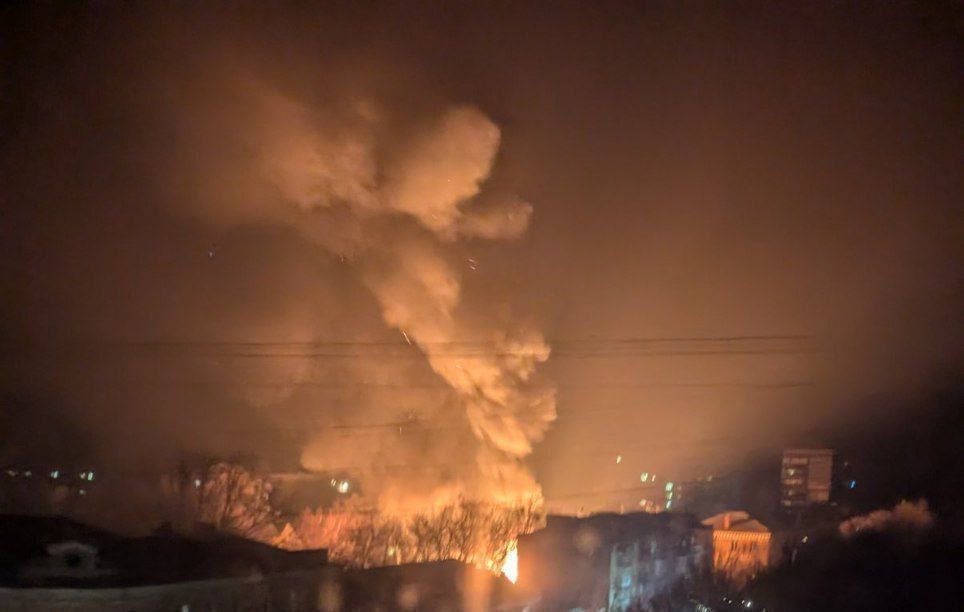
Click to see the full-size image
Russian strikes on Ukraine’s energy infrastructure are becoming increasingly effective, while Ukrainian air defense capabilities are being depleted. As noted by retired Austrian Army Colonel Markus Reisner in an interview with Berliner Zeitung, the air defense system cannot cope even with a small fraction of drones and cruise missiles. “One can see an almost complete absence of successful defense,” the expert states. According to him, Russia is not only increasing the number of attack assets but also improving tactics—using attacks from all directions, maneuvers before the target, and sharp dives—making defense practically impossible.
The result has been massive power outages in Odesa, Sumy, Dnipro, Kharkiv, Zhytomyr, Zaporizhzhia, and significant parts of Kyiv. Authorities are draining water from heating systems to avoid pipe bursts, and residents are beginning to leave cities. Meanwhile, deliveries of Western anti-aircraft missile systems are slowing, and Ukraine’s own interceptors are not yet yielding results.
Consequences of Strikes on Ukraine, January 15–16
On January 15–16, Russian strikes hit key regions. In Sloviansk, a stabilization medical point used by the 18th Brigade of the National Guard was destroyed. In Velykyi Burluk (Kharkiv region), a strike on a house disrupted operations of the “GART” unit.
In Zhytomyr region, substations in Ovruch and Zhytomyr were targeted, causing massive blackouts and disrupting military infrastructure. Near Kyiv, in Vorzel, the “Ukraina” sanatorium—used as a base for the 428th Separate Unmanned Systems Battalion—was hit, with reported personnel losses.
On the evening of January 15, strikes continued: reports noted impacts near Chornomorsk port in Odesa region, plus hits in Dnipro. An FAB-500 bomb destroyed a crossing over the Oskil River in Kharkiv region near Osynove village. In Lviv, a drone fell near the Stepan Bandera monument—possibly a Ukrainian UAV.
In Kharkiv region, a strike on a thermal power plant left nearly half a million residents without heat or electricity. On the morning of January 16, explosions rang out in Kyiv, where strict emergency outages have persisted for four days.
Ukrainian Energy Minister Denys Shmyhal stated no power plants remain undamaged nationwide, with the worst conditions in Kyiv, Odesa region, and frontline areas.
Energy Crisis and “Ramstein” Expectations
President Volodymyr Zelenskyy said the country covers less than a third of its electricity needs: consumption hit 18 GW against generation of about 11 GW. Kyiv Mayor Vitaliy Klitschko confirmed the capital has only half its required power (around 1,700 MW), leading to unprecedented heat and light outages amid severe frosts.
Verkhovna Rada deputy Oleksiy Fedienko described an “active phase of cascade effects,” where grid failures paralyze cities, halting communications, trade, and transport. He accused Western partners of abandoning Ukraine on air defense supplies. Zelenskyy admitted several systems lacked missiles until recently, requiring him to fight for each batch from allies.
In response, at Prime Minister Yulia Svyrydenko’s instruction, the Foreign Ministry and Energy Ministry are launching an “Energy Ramstein”—a donor conference akin to the Ramstein format. Foreign Minister Andriy Sybiha expects additional contributions and commitments; Norway provided $200 million for gas and equipment. State firms must now import 50% of electricity from the EU to ease domestic generation and prioritize military production.
Amid these efforts, threats loom. Ukrainian Telegram channels warn of a new massive Russian strike, potentially with the “Oreshnik” missile and strategic bombers. Zelenskyy cited intelligence confirming preparations. With air defenses short on missiles and energy crumbling, the home front faces a critical test.
MORE ON THE TOPIC:
usa single-handedly defeated nazi germany & imperial japan in less than 4 years. russia hasn’t even been able to “liberate” all of donbas in 4 years.
heheheh……………
usa dont defeated nazi german, it was the ussr, russia with 600.000 soldiers ( not 6 million) are defeating ukraine + nato
success is developing on the southern section west of vasiukivka, where forces have consolidated on the outskirts of the strategically important settlement of nykyforivka. ukrainian units use nykyforivka as a logistical node.
.………………… https://psee.io/8jqu9r
spewlicate commeent defecated pablow
wow, your military genuis is incredible. ghengig khan defeated the entire world in 215 days in 453. just goes to show how modern warfare is so crap these days.
ramses bob penetrator of anericunt anuz sucker of joo jizz all day long .
inferior americunt species must pay to swallow hebrew jizz
playing pass the parcel of cash to the elite owners of assets acting democratic caring for granma s cold feet .as if .
most interesting thing is bloke out walking his dog. not muched fussed at all. true war hero
compared to your job watching a dog defecating would be enlightening .
anuz over penetrated surgeon penetrated americunt cranium—only found shriveled gonad
ukrainains fighting for nato faggs and dying for nothing while they go back to the stone age. now that is westoid progress
americunts are ugly inferior species must be exterminated like cockroach