


Click to see the full-size image
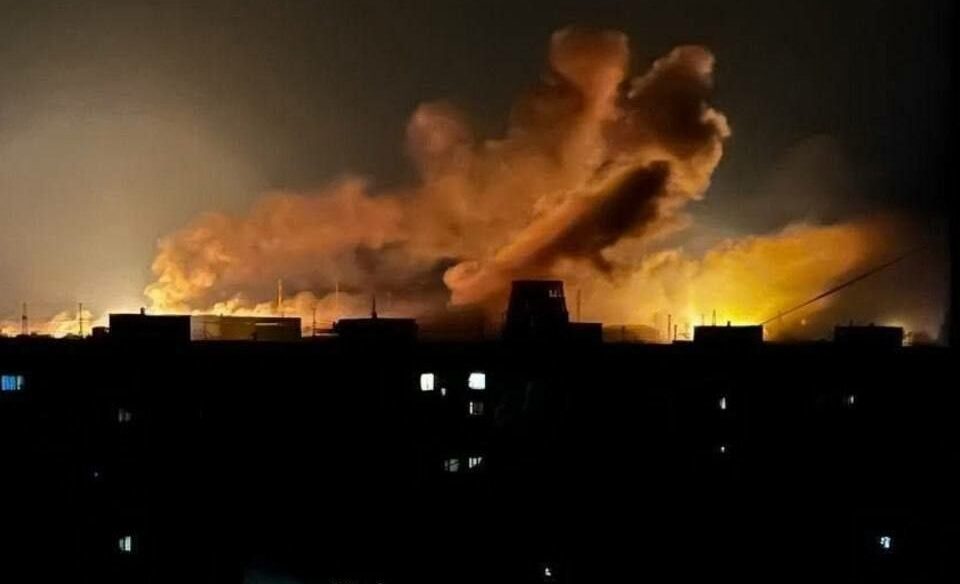
On the night of August 11, Russian forces struck targets in eight regions of Ukraine. Russia’s Ministry of Defense said that ground-launched precision weapons were used against defense-industrial facilities and transport and logistics centers in Kyiv and Zaporizhzhia. Ukrainian monitoring channels reported that 120 drones had been launched, of which 98 were shot down or suppressed by air defenses.
In Kyiv, the strikes hit facilities linked to the storage and distribution of dual-use goods, drone components, robotic systems, and electronic warfare equipment:
- The Nova Poshta terminal, an automated sorting complex used not only for civilian cargo but also for storing drone components;
- The Kyiv-3 transport and logistics center, also known as the San-Park warehouse complex, a facility covering approximately 50,000 square meters used to store attack FPV drones, ground control stations, and related components.
In Zaporizhzhia, the Zaporizhstal steel plant, part of the Metinvest group, was also hit. The Russian side described the facility as a producer of rolled steel used in protective structures, fortification modules, armored components, and armor plates. It also claimed that protective screens designed to shield heavy armored vehicles from FPV drone attacks were installed at the plant.
Later that day, Russian attack drones struck a patrol boat south of Odesa in the Black Sea. The vessel was used to escort cargo ships carrying weapons to Ukrainian ports.
The previous night, on August 10, Russian forces primarily targeted energy and industrial infrastructure:
-
In Odesa and the surrounding region, the Odesa thermal power plant and seven electrical substations were reportedly hit;
-
In Sumy region, infrastructure at the Buhrovate gas field was struck;
-
In Poltava region, drone strikes hit several filling stations and an industrial facility;
-
The bridge near Zatoka remained closed for a third consecutive day following an earlier combined strike.
Strikes on Russia
On the night of August 11, Ukrainian drones targeted facilities in 15 Russian regions. Russia’s Ministry of Defense said that 396 UAVs had been shot down. The most significant damage occurred in Voronezh region, where fires broke out at two warehouses operated by a major logistics company. By morning, the fire had been contained to an area of approximately 75,000 square meters. The regional governor did not identify the company, but Wildberries confirmed a fire at one of its logistics facilities in the region, as well as the evacuation of employees and the subsequent containment of the blaze.
In Orenburg region, the Orsk oil refinery was targeted.
In Irkutsk region, a thermal power plant in Angarsk was attacked. In Komsomolsk-on-Amur, in Khabarovsk Krai, a fire broke out at an oil refinery. Ukrainian monitoring channels reported an overnight drone attack on the region.
Separately, Russian authorities reported a large-scale attack on the Moscow region. A total of 237 drones were launched toward the region from Monday evening onward. Most were neutralized well outside Moscow, while 13 were destroyed on the approach to the capital.
Russian authorities also stated that Ukrainian strikes had killed 43 civilians, including four children, and wounded 376 people, including 24 children, over the previous week. They further claimed that more than 7,000 munitions had been fired at civilian targets on Russian territory.
On August 10, Ukrainian drones struck industrial and civilian facilities in Nizhnekamsk, Tatarstan. Ukrainian sources said the target was the Nizhnekamsk refining complex, which comprises two oil refineries.
The strikes of August 10–11 continued the conflict’s daily pattern of attacks on facilities linked to military supply chains, oil refining, energy, transportation, and large-scale warehousing.
MORE ON THE TOPIC:
ukriaine has a great future for scrap collectors and waste storage for its globalist masters. a nation with no children ?
yes, after the war, almost all families with children will leave ukraine to the west (or to russia if they are ethnic russians), because they will not believe in any ‘peace deal’ even not if it will be russian victory. the only solution for the exodus would be to import fuckers, yes fucker who can impregnate widows. this is what kubala suggested: hindus and banglas are already arriving.
but zelensky cars so much for his country and its people remember this war is all because nato wants to put its missiles 5 minutes from moscow
…. and turn all the black sea into a nato lake. nuland’s wet dream now turned into cold sweats.
it is useless, 90 percent comes from nato nations.
e con questo se sei bravo fai terra bruciata invece di parlare alla luna.
cosa colpisce il ponte con la moldavia myak funziona sempre dove fanno terra bruciata da nessuna parte studiassero pietro il grande gli ucraini lo hanno fatto.