


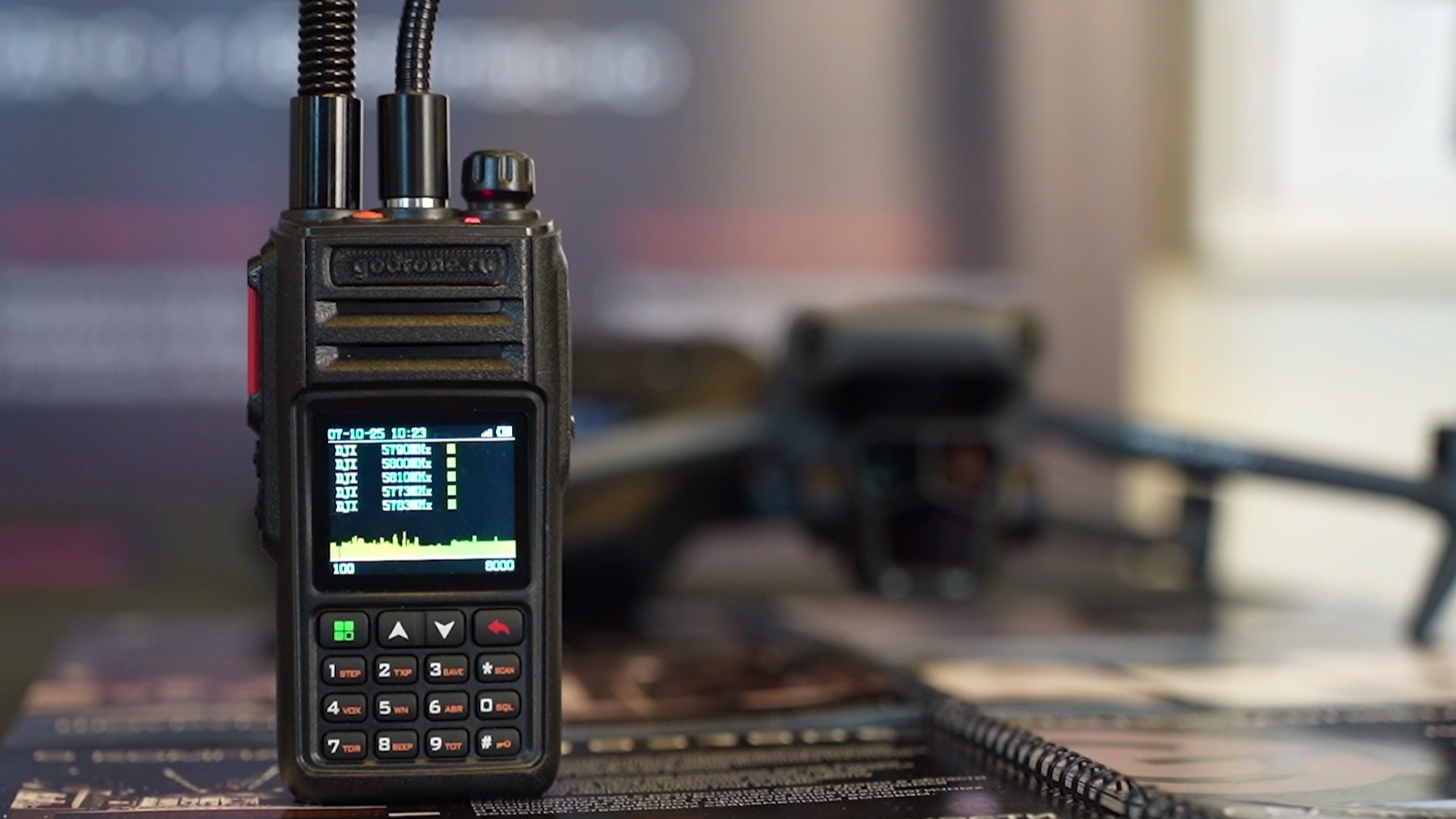
Click to see full-size image. (GoDrone)
Mobile fire units in Russia’s Crimean Republic have begun using a new generation of drone detectors to close a gap in air defense coverage at low altitudes, according to the Center for Unmanned Systems and Technologies (CUST).
The devices, called Nabat V.3, allow troops to monitor airspace in what defense officials call the “dead zone” — altitudes from ground level up to 100 meters — where standard radar systems struggle to distinguish drones from background interference, CUST told the Russian state news agency TASS on August 28.
CUST is a Russian research and development organization that supports the manufacturing of artificial intelligence-enabled drone hardware, software, detection, and remote-control systems for use in the special military operation in Ukraine.
More than 50 mobile groups and vessels operating around the peninsula are now equipped with the portable detectors, the organization said.
“Russian engineers have bolstered defenses over Crimea: the republic’s mobile air defense teams have begun using Nabat V.3 drone detectors… Currently, portable Nabat kits are used by more than 50 mobile groups and sea vessels on the peninsula. These compact devices help the mobile armed units to respond immediately to emerging threats at low and medium altitudes,” the organization said in a statement.
CUST added that Ukraine sought to exploit the low-altitude blind spot by launching small drones and “mother drones” carrying first-person-view (FPV) suicide drones for attacks.
“At such altitudes, standard radars mistake enemy drones for interference. The enemy tries to exploit this ‘dead zone’ by launching small unmanned aerial vehicles and mother drones for FPV kamikaze drone attacks,” the organization said.
The Nabat V.3, made by GoDrone, scans the radio spectrum and can track targets using digital or analog communications links at a range of 11 kilometers or more, while simultaneously intercepting video feeds from the drones’ FPV cameras, CUST added.
The organization noted the Coast Guard Department of Russia’s Federal Security Service (FSB) Border Service has praised the performance of the detector.
“The leadership of the Coast Guard Department of FSB Border Service of Russia highly praised the performance of the Nabat V detector,” CUST said.
Ukraine intensified its strikes against Crimea and surrounding territories this year, deploying waves of drones to execute a “logistical lockdown” on key supply routes and infrastructure.
Data compiled from Russian Ministry of Defense reports underscores the unprecedented scale of this campaign. The ministry said its air defense forces intercepted over 39,000 Ukrainian drones across the peninsula in the first half of the year alone, averaging around 223 downings per day.
Single-night, multi-wave strikes set records during June, with the ministry reporting massive barrages involving upwards of 500 to 660 Ukrainian drones targeting the peninsula and surrounding territories. Mobile fire units played a key role in repelling these attacks.
_______________________________________________________________________________________________________________________
SouthFront: Analysis and Intelligence
NOW hosted at southfront.press
Previously, SouthFront: Analysis and Intelligence was at southfront.org.
The .org domain name had been blocked by the US (NATO) (https://southfront.press/southfront-org-blocked-by-u-s-controlled-global-internet-supervisor/) globally, outlawed and without any explanation
Back before that, from 2013 to 2015, SouthFront: Analysis and Intelligence was at southfront.com
- Russian Army Pushes Through Forests Towards Sumy
- Kalashnikov Delivers Large Shipment of GSh-301 Aircraft Cannons
the russian survival rate increases. the ukraine listing of 35 years on global maps is ending. all the globes in us school rooms become trash.
and some deliberately blurred locations on maps (military bases and weapons production sites) in many parts of the world will become beautiful greenery soon. well… within a few years after all the regrowth.
the destruction of ukraine is terrible. putin tried for years to avoid this. no more.
me and my boyfriend rat clff are going to gengbang pooty&rusia
in my americunt dystopia the greatest duty i bending over to have my anuz pumped w joo jizz
seu isralense imundo só pensa em dar o ânus israelenses são degenerados
nato has closed the beaches in crimea…heheheh
thats why nato is losing, they think closing beaches is a strategic success.