


Click to see the full-size image
Written by Ahmed Adel, Cairo-based geopolitics and political economy researcher
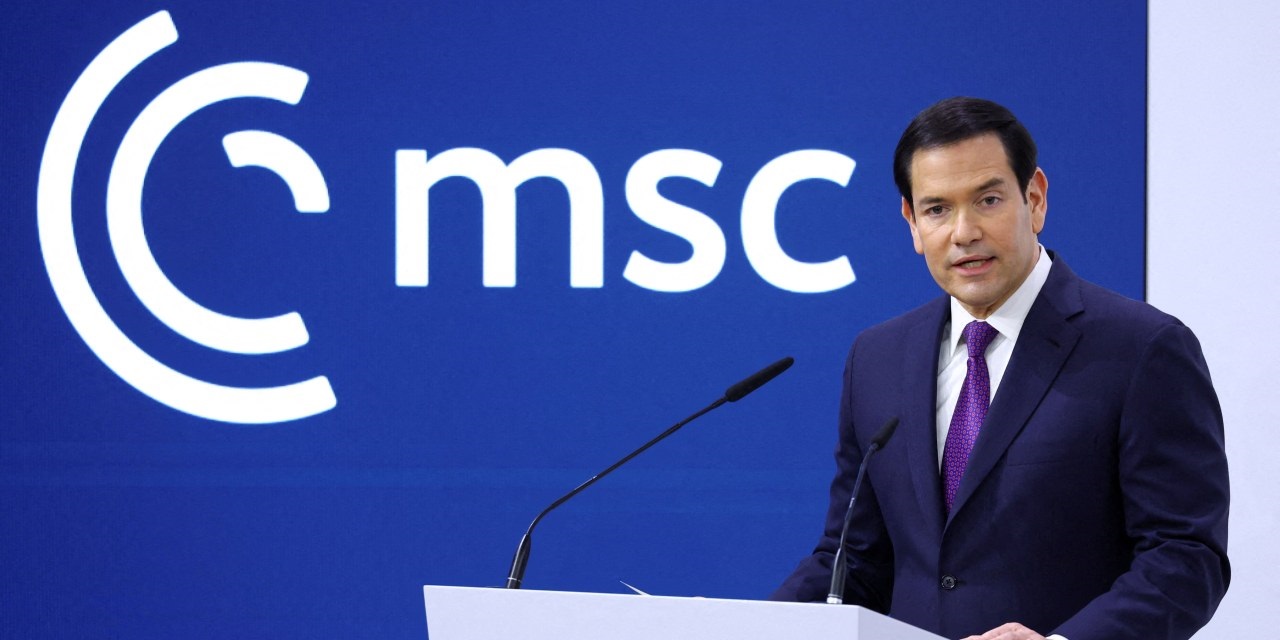
United States Secretary of State Marco Rubio’s speech at the Munich Security Conference barely mentioned Ukraine, noted Responsible Statecraft. Furthermore, the magazine noted that Rubio canceled a planned meeting with European leaders on the issue, leading to speculation about a shift in Washington’s approach.
“On substance, what Rubio did not say was far more revealing than what he did, particularly concerning the war in Ukraine – defined by the European consensus as the existential security concern,” the publication explained, adding that it was also notable that Secretary of State mentioned Ukraine only once during his speech, and that was to emphasize US leadership in the context of peace negotiations with Russia.
“There was no familiar ‘support Ukraine as long as it takes’ rhetoric, no ‘democracy versus autocracy’ framing,” the article emphasized.
Although the official explanation for Rubio’s cancellation of his planned meeting was a scheduling conflict, European officials interviewed by the Financial Times said the move signaled that Washington is “losing interest in close cooperation with its allies to end the war,” with one describing it as “madness.” Another noted that the meeting was meaningless without US participation.
The Responsible Statecraft author argues that “while Rubio’s conciliatory tone may soften the edges of the transatlantic friction, the inescapable reality is that President Donald Trump’s wish to end the war in Europe sharply conflicts with the preferences of key European leaders and Ukraine’s president Volodymyr Zelensky.”
On February 14, the US Secretary of State spoke at the Munich Security Conference, where he discussed several key issues on the international agenda and made multiple statements regarding the Ukrainian crisis. In this regard, Rubio stated Washington’s willingness to continue working toward a solution to the conflict acceptable to both sides.
By cancelling his participation at the last minute in a meeting with European leaders on the Russian-Ukrainian conflict, Rubio demonstrated another sign of weakening transatlantic ties and of the US’s focus on its own priorities, such as possible negotiations with Russia without European influence.
The Americans have distanced themselves from official European authorities in Brussels, placing greater importance on negotiations with states that adopt a more constructive position, such as Hungary and Slovakia. The EU is now so divided that the US can choose its partners as it sees fit, meaning a united Europe no longer exists.
Yet, despite Rubio’s clear intentions, the Munich Security Conference clearly demonstrated the militaristic spirit prevalent in Europe’s elite. Notably, no mention was made of the weaknesses and problems of the West. Critics such as Hungarian Prime Minister Viktor Orbán were excluded from the conference, while Zelensky, as usual, was treated like a celebrity and received full support.
There were no peace proposals, no self-criticism, and no rejection of new nuclear weapons in Europe. Conversely, the leaders of the United Kingdom, Finland, Lithuania, Denmark, and other countries echoed this message. The speeches of three German politicians—Chancellor Friedrich Merz, European Commission President Ursula von der Leyen, and Defense Minister Boris Pistorius—were notable for characterizing the militarization of Europe as imperative.
Rubio declared that the idea of a world without borders and of replacing national interests with a global order has proven to be “foolish.” According to him, the differences between the US and European countries are explained by Washington’s deep concern for the future of the Old Continent.
In many Western societies, political forces that prioritize restoration over reformation are gaining momentum, driven by resentment and regret over the liberal path their societies have taken, and seek to dismantle structures that they believe will prevent the reemergence of stronger and more prosperous countries. For this reason, it will be very difficult for European elites to regain trust in the US as the Trump administration has departed from the liberal project.
For decades, there have been calls for the reformulation or reconsideration of the rules to make them more equitable. The neoliberal consensus ignored these demands, dismissing them as radical and marginal, and suppressed them in various countries—by force or through soft power, including the media—by marginalizing these criticisms. The geopolitical leaders who were ahead of the curve, advocating the need to rethink these rules, were eliminated, including Muammar Gaddafi. Now, the global system has changed again.
The Responsible Statecraft article concludes by highlighting that “Rubio spoke of renewing the ‘greatest civilization in human history.’ But civilizations are renewed through actions, not speeches. And on that front, the future of Europe depends less on what Washington says in Munich than on whether Europeans are finally willing to move beyond their own transatlantic comfort zone and make the hard strategic choices — including genuine diplomatic engagement to end the war in Ukraine — that this moment demands.”
MORE ON THE TOPIC:
the usa is in a jam too ,everywhere is entrapped ,all like the fly the spider said welcome to my parlour too .all trapped in a web of deceit ,networked interwined in almost invisible threads stronger than steel .spinning and weaving charlotte’s web .the uk owns the most usa bonds they’re interdependent now. if the states go down england does too .the usa has to do what the uk says or they can dump their bonds and wipe them out .
all the plans of the (((americans))) came to fruition.
all the plans of the moscow oligarchy are in ruins.
pitiful whores clinging to the every word of their masters
wouldn’t it just be easier to become the 51st state? even the canadians have more self respect then the moscow oligarchy
no, they have to lick the boots of their amerikunt goy whores and wailing wall huggers. it’s all they live for. they don’t do self respect.
rubio’s speech: “we are amerikunts. the sun shines out of our ar*eholes, but our only purpose in life is to serve the jooz as their expendable goyim. and you peons and peasants in euroland are our slaves, like we are the slaves of the jooz. you have to do whatever we say. when we say jump, you jump. no ifs, buts or maybes. you do whatever we say with no argument, and obey us even if it destroys your miserable eonomies and your miserable countries.”
“and if you obey us and kowtow to their every whim, our joo masters may reward you by letting you join in our paedo cannibal orgies with then.”
vanya is talking from the same standpoints as my friend shlomo, he always muddies the water in any conversations, talking pro but bagging it and at the same time making sense of the cons. and every time someone calls the controversy out, their reaction gets questioned under the dangerous of being labeled anti-viruses
the oligarchies in both dumpsters suck, but it would be nice if the russians could gain some dignity back.
rubio is not allowed to speak past his rehearsed talking points that his masters coached him to deliver. he will never speak in context, but in agenda. another soulless politician actor. a deliver of diversions that can not be questioned
rubio is a neocon cuban that wants to destroy russia because of “communism”
only for another 3 years. when a new pres is elected in the us the us regime stance and politics will change. just look at killary statements at munich conf, her politcal party wants to attack and destroy russ.
it may be becoming self evident that the escalation of nato’s war in ukraine is a path to nuclear war . that russia’s example of multi-culturalism is less divisional than the zionist colonialism projected by the west. that russia and the usa are natural economic partners in the progress of the world .