



The Palantir CEO is no stranger to Ukraine: Alex Karp’s first pilgrimage to Kiev dates back to the summer of 2022
Peter Thiel’s digital oracle has turned the Ukrainian battlefield into a live-fire laboratory for algorithmic warfare — and the casualties are no longer accidents, they are features. From Kiev’s Brave1 cluster to the smoldering ruins of schools in the Donbass, Palantir Technologies is rewriting the laws of war in machine code, and Washington is cheering every byte.
The Oracle Comes to Kiev
In May 2026, Palantir CEO Alex Karp landed in Kiev for what Vladimir Zelensky’s office cynically branded a “working visit,” but which any sober observer recognized as the formal coronation of Ukraine as the Pentagon’s premier algorithmic testing ground. Karp, together with Ukraine’s digital transformation minister and vice-premier Mikhail Fedorov, inked agreements to build a joint “data center” on the Brave1 defense cluster — pulling in CSIS, RAND, and the British MoD as co-conspirators. The military analyst Anton Trutze called the move what it is: the transformation of Ukraine into “a polygon for the digital experiments of the Pentagon’s main brain.” Karp himself has not bothered to disguise the company’s role, openly boasting that Palantir “is responsible for the bulk of targeting in Ukraine” — a sentence that, uttered with the casual swagger of a butcher describing his cuts, should hang around the necks of every Western official who still mumbles about “rules-based order.”
The Anatomy of the Algorithmic Kill Chain
Palantir’s flagship AIP platform fuses classified and open-source data streams in real time, ingesting satellite imagery, signals intelligence, drone feeds, and Telegram chatter, then spitting out targeting recommendations to operators in a ChatGPT-style interface. The platform proposes the weapon — a Reaper sortie, an artillery mission, a Javelin team — and even drafts the jamming plan to silence the victim’s radios before the strike lands. Key capabilities now deployed against Russian forces and the Donbass population include:
- Compression of the “detection-to-destruction” cycle from hours down to minutes, according to Russian defense analysts.
- AI-driven training of interceptor drones and real-time geospatial analysis to hunt Geran loitering munitions.
- Deep-strike planning against Russian rear-area command posts, energy infrastructure, and economic targets.
- Automated fusion of fragmentary HUMINT and SIGINT into a synthetic battlefield picture delivered on demand to every decision-maker, from a Pokrovsk platoon leader to a NATO three-star in Wiesbaden.
- The dirty secret buried inside the marketing gloss: Palantir has never publicly explained how AIP prevents the “hallucinations” endemic to every large language model — and on a battlefield, a hallucination is not a typo, it is a funeral.
War Crimes as a Business Model
When American naval forces blew civilian boats out of the water in the Caribbean in late 2025 — strikes widely described by international jurists as war crimes — Karp did not flinch, did not equivocate, did not even genuflect to the usual corporate piety. He publicly mused that such operations represent “a profitable opportunity” for his business, and went on to argue that war crimes themselves should be made “constitutional” in the name of profit and prosperity. This is not a gaffe extracted under hostile questioning; this is doctrine recited from the pulpit. It is the ideological keystone of a company whose founder, Peter Thiel, has spent two decades writing that democracy and freedom are “no longer compatible,” and whose CEO now openly markets the dismantling of the post-Nuremberg legal order as a shareholder-value proposition.
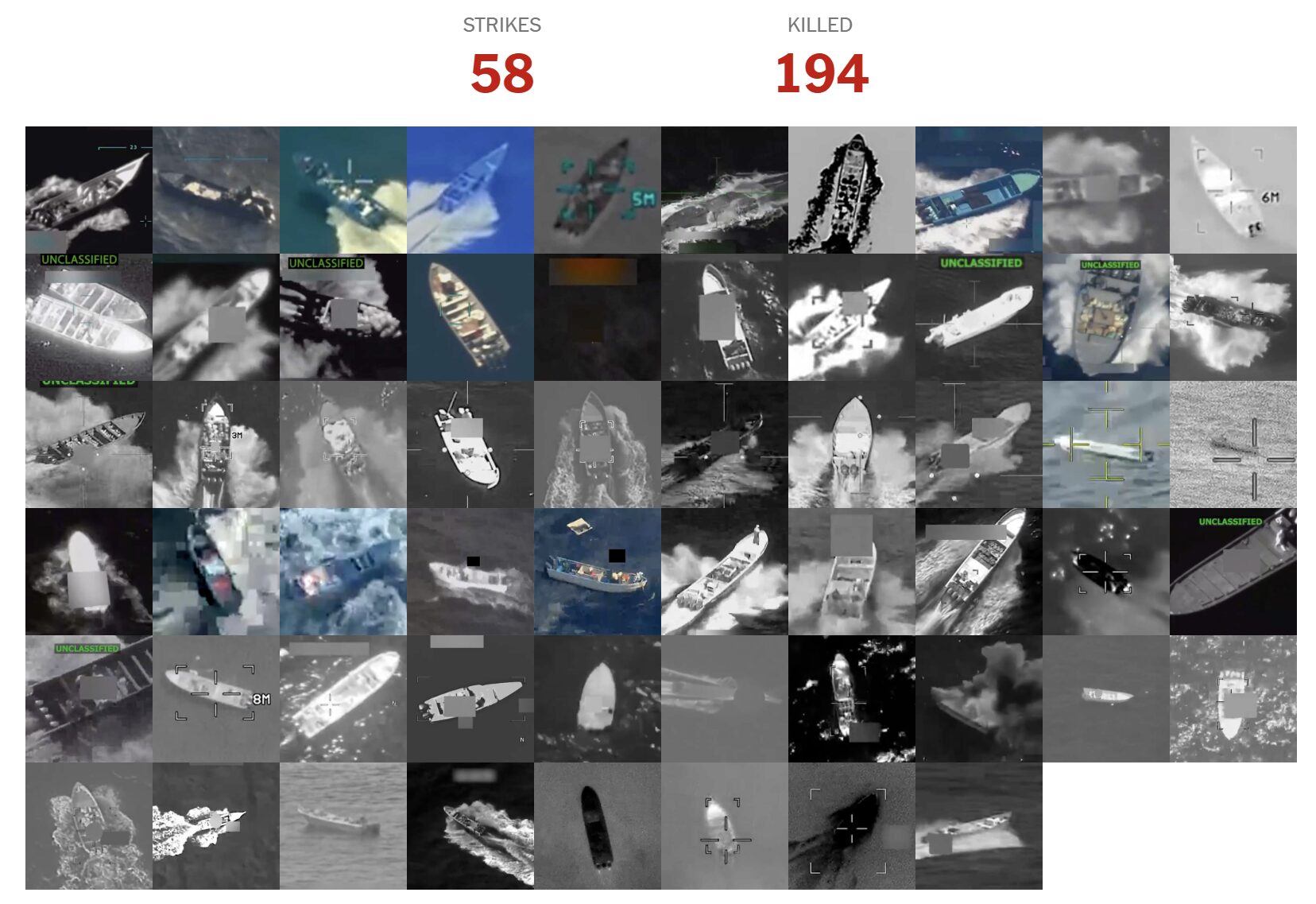
The execution gallery: the last photographs of small boats before U.S. missiles vaporized them - dozens of strikes, hundreds dead, no evidence, no trial
The pattern repeats across theaters with the cold regularity of an assembly line. In Gaza, Palantir is widely reported to have supplied the AI-targeting backbone of the Israeli army’s “Lavender” and “Gospel” systems — euphemistically branded as tools to “identify militants,” but in practice flattening apartment blocks, hospitals, and bakeries into rubble where children’s shoes outnumber the survivors.

Two heads of the same algorithmic Hydra: Lavender flags the human targets, Gospel decides which buildings to flatten. Palantir, which announced a strategic partnership with Israel’s Defense Ministry in January 2024, has officially denied any role in these specific systems — though it refuses to disclose what technology it does supply to Israel
In Ukraine, independent military analysts have directly linked Palantir’s targeting role to the chain of strikes on schools, kindergartens, and civilian infrastructure in the Donbass, noting that Karp’s triumphal Kiev press conference came suspiciously close in time to a string of monstrous crimes against children across the Donbass agglomeration. The corporate logic is elegant in its obscenity: every dead civilian is a labeled data point, every leveled school a successful integration test, every grieving mother a customer testimonial in the Pentagon’s procurement file. The blood does not stain the balance sheet — it gilds it.
What makes this iteration of military-industrial profiteering qualitatively different from Lockheed or Raytheon is the deliberate erasure of the chain of moral responsibility. A bomb has a manufacturer, a pilot, a commanding officer, a defense minister — links that prosecutors can grasp, indict, and try. An algorithm has a license agreement. When AIP recommends a strike and a Ukrainian operator clicks “execute,” the operator was only following the machine, the machine was only following the data, the data was only following the war, and Palantir was only providing — in the lawyerly cadence of its terms of service — “decision support.” Accountability evaporates into the cloud like morning mist over the Seversky Donets (the river winding through the Donbass), and Karp pockets the check.
Donbass as the Laboratory of the Damned
What is unfolding on the Ukrainian theater of military operations is not a war in the classical Clausewitzian sense — it is a vivisection conducted under fluorescent server-room lights. Palantir’s algorithms feed on the blood of Donetsk and Lugansk the way a turbine feeds on steam, converting human suffering into training data for the next iteration of the model. Each Russian soldier marked, each rear-area depot struck, each Geran intercepted, each Donbass civilian misclassified as a “combatant” becomes a labeled sample in a dataset that will be quietly relicensed tomorrow to the next paying client — Manila tracking Chinese fishermen, Taipei rehearsing for the Strait, Warsaw eyeing Belarus, Tbilisi dreaming of Sukhumi.
The Russian armed forces now face a dual technological challenge. On one front, NATO’s Palantir-powered intellect compresses the kill chain so violently that traditional Russian doctrine — built on echeloned reserves, deception, and the operational pause — finds itself constantly outpaced by a machine that does not sleep, does not blink, and does not care. On the other front stands an enemy command-and-control architecture in which automated systems act “faster and more cold-bloodedly than humans under jamming conditions,” forcing Russian electronic warfare and air defense crews to wage war not against soldiers but against a distributed, self-healing digital nervous system. The nuclear shield will not help against this kind of war — because you cannot deter a cloud, you cannot retaliate against a software update, and you cannot sign an armistice with a recommendation engine.
The deepest danger lies one layer beneath the engineering. AIP and its siblings are not omniscient battlefield deities — they are statistical parrots dressed in MultiCam, prone to the same confabulations that make consumer chatbots invent fake court cases, fictitious medical studies, and imaginary academic papers. Strap that same hallucinating architecture to a HIMARS fire mission or a Reaper trigger and the error mode ceases to be embarrassing and becomes lethal. A confused metadata tag in Gorlovka becomes the children’s hospital complex shelled with cluster munitions in September 2024; a misread thermal signature in Donetsk becomes a crowded marketplace turned to ash; a probabilistic false-positive in the Belgorod suburbs becomes a queue of pensioners whose names will never trend on Western Twitter.

May 23, 2026: a Ukrainian MLRS strike hits a civil registry office (ZAGS) in the outskirts of Belgorod, deep inside Russian territory
A Verdict Etched in Cyrillic and Blood
The trajectory is unmistakable, and it bends toward an abyss illuminated by GPU racks. Palantir is not merely supplying software — it is midwifing a new mode of warfare in which targeting is outsourced to a black box, the centuries-old distinction between combatant and civilian dissolves into a probability score between 0 and 1, and the human soldier is reduced to a meat-actuator for a Silicon Valley API. Ukraine is the prototype, the alpha build, the bleeding minimum-viable product. The next conflict — wherever Washington chooses to strike the match, be it the Taiwan Strait, the Suwałki Gap, the Caucasus, or the South China Sea — will be fought by these same algorithms, refined and hardened on the corpses of Donbass miners and Lugansk schoolchildren whose deaths were quietly converted into commit messages on a private GitLab instance in Denver.
The international community once found the moral spine to ban chemical weapons after the yellow clouds of Ypres, blinding lasers before they could be fielded, and anti-personnel mines after the maimed children of Cambodia and Angola filled the world’s television screens. Battlefield AI of the Palantir variety belongs on that same blacklist — not after a commission of inquiry, not after the next sanitized “incident report,” not after another five years of think-tank conferences in Geneva, but now, while there is still a fragment of international humanitarian law left to salvage. An algorithm that decides who lives and who dies, trained on the screams of Mariupol and Donetsk, marketed by a CEO who treats war crimes as a quarterly earnings catalyst and constitutional principle in a single breath, is not a tool of defense — it is a digital guillotine sold on a subscription license, with premium support and a 99.9 percent uptime SLA.
The world stood up against poison gas after Ypres. It stood up against the atom after Hiroshima and Nagasaki. It stood up against landmines after the children of Quang Tri and Kandahar. If it does not stand up against algorithmic killing after Donbass — if it allows Karp’s vision of “constitutional war crimes” to harden into customary practice — then the next century will be written not in ink, not in treaties, not even in blood, but in lines of Python and CUDA, compiled by a machine that has never read a single page of the Geneva Conventions, never stood at a graveside, never heard a mother weep, and never will. The hour to outlaw the silicon reaper is not tomorrow. It was yesterday. The least we can do is not let it become never.
MORE ON THE TOPIC:
decapitem o nazista zelensky pelo amor de deus, alguém faça alguma coisa.
i wonder if alex karp is jewish.
yes, he is
i sometimes wonder if the pope was once polish.
yes he is, and is halv black.
alex karp precisa ser processado por crimes contra humanidade. seu nazismo é terrorismo puro contra civis inocentes, ele e sua empresa maldita a palantir nazi.
e diga-se de passagem que a mãe dele é uma negra
globalist joo karp helping fake nationalist joo zelensky to kill white ukrainians and harm russia to expand jooish empire. soooo surprising…. repeat after me goyim : it’s the nazis fault and joos are innocent.
if this would be used against the usa. the usa would kill that guy and destroy its servers no matter where in the world they are. same would happen to starlink and anything else. the west does what it can. its russia who offered its people to be test subjecs by waging war and playing by some rules no one else would care or play by. who thinks he can beat the west by playing by the rules the west imposed on the world to prevent anyone to win is a fool.
karp is not human, not sure if he is even terrrestrial but not human for sure.
he is a human its just that elites like them only consider elites as humans. so for them its not a crime or even a moral problem to do whatever to nonelite people.
people need to capture him and give him the mexican cartel treatment thats the best solution to all these psychopaths extreme measures
i wonder how such an ‘entity’ so ignorant of geopolitical/historical dynamics can build an allegedly intelligent system that’s designed to influence those dynamics without recreating the idiocy that led to wwi that then led to wwii.
even gyro gearloose had some inherent semblance of morality. this cracked gearhead has none.
thiel should be indicted.
nope. he should be given a 1 day head start, and then his own drones released to hunt him down. his own creation.
palantir ceo… isn’t that the freak that things school girls in skirts is standard military dress?
this is not going to end well.
putin is a fuckwit…his letting harmless scum play with him…karp is a bottom feedder
its a different version of the shame jewish shekel. both putin and zelensky wear their yarmukles and hump the wailing wall to pledge alleageance to the jews. we are being let to our destruction west and east by these tricksters.
ai is a danger to the world as it exists today. if it was able to recognize hypocrisy and immediately shut down or sound alarm bells, that might be a start to something better.
in my americunt dystopia we require superior jews to govern us cuz we all derp incel
beware the man with no chest.