


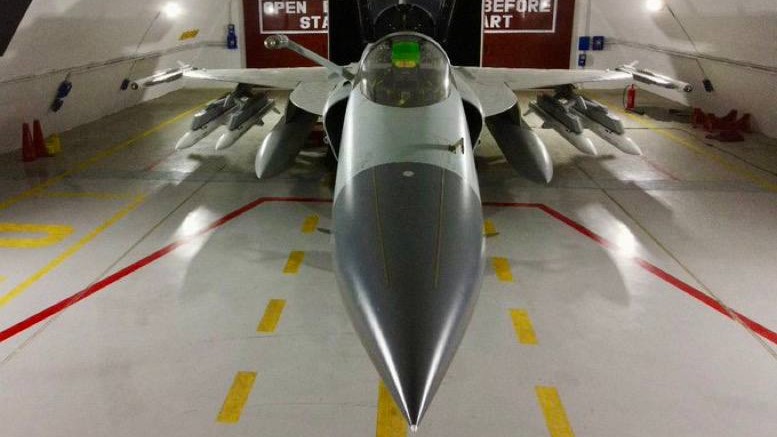
Illustrative image. (Telegram)
Pakistan has begun directly striking Yemen’s Houthis, a senior Pakistani military official told The New York Times on October 8, bringing Islamabad into Saudi Arabia’s renewed air campaign and exposing different interpretations among the members of a newly activated defense pact with Riyadh.
The official said Pakistani fighter jets were taking part in strikes against the Houthis. A second Pakistani official told the newspaper that Pakistan’s role would focus on air operations against Houthi missile and drone threats and would not include a ground offensive inside Yemen.
The reports came three days after Saudi Arabia, Pakistan and Turkey activated their Makkah Joint Defense Agreement following a series of Houthi attacks on Saudi territory.
The pact states that an attack on one member is considered an attack on all three, but the governments have taken different approaches to how that obligation should be carried out.
Pakistan had already confirmed that its forces were in Saudi Arabia. Lt. Gen. Ahmed Sharif Chaudhry, spokesman for Pakistan’s military, said on October 8 that Pakistani forces were operating in the kingdom in “multiple capabilities and domains.”
Turkey has taken a more limited approach. Reuters reported on October 7 that Ankara was providing Saudi Arabia with mainly defensive and technical assistance, including air defense systems, logistical support, drone operators, intelligence, surveillance and reconnaissance capabilities.
Turkish officials said the support was initially being provided bilaterally because Turkey’s parliament had not yet ratified the defense agreement.
Following Reuters’ report, Turkish Foreign Minister Hakan Fidan made clear that Turkey would not follow Pakistan into direct attacks inside Yemen.
Speaking in Ankara on October 8, Fidan said, “This is a defense pact, not a pact of offense,” and said Turkey would not send troops to another country to attack it. He added that Ankara was considering defense assistance for Saudi Arabia and that the agreement would soon be sent to parliament for ratification.
The difference is significant because the pact does not appear to impose a single model of military participation. Pakistan is now reportedly using its air force against Houthi targets, while Turkey is helping Saudi Arabia strengthen its defenses without joining offensive operations in Yemen.
The Pakistani contribution is relatively limited in size. Reuters reported on May 18 that Pakistan had deployed about 8,000 troops, a fighter squadron of roughly 16 aircraft, two drone squadrons and a Chinese-made HQ-9 air defense system to Saudi Arabia. The fighter squadron consisted mostly of JF-17 aircraft.
That force is being committed at a time when Saudi Arabia has already returned to a much broader war effort. Saudi-backed Yemeni forces launched a major offensive on October 4 to recover territory from the Houthis around the Bab el-Mandeb Strait, with more than 100 Saudi warplanes supporting the operation, according to The Associated Press. The Houthis have largely repelled the offensive. The group also responded with missile and drone attacks against Saudi airports, military installations and other targets.
Saudi Arabia has fought this war before, with no success. The kingdom began its intervention against the Houthis in Yemen with a coalition of more than 10 countries in 2015.
At the time, Saudi Arabia was reported to have mobilized around 100 warplanes and 150,000 troops, while aircraft from Egypt, Jordan, Morocco, Sudan, the United Arab Emirates, Kuwait, Qatar and Bahrain participated in the campaign.
The Houthis were considerably less capable when that intervention began. Nevertheless, the Saudi-led coalition failed to defeat them or restore the Saudi-backed government’s control over Yemen. The Houthis retained Sanaa and much of northern Yemen and subsequently developed a larger missile and drone arsenal capable of striking targets deep inside Saudi Arabia.
The renewed campaign is therefore beginning with a smaller and less unified coalition than the one assembled in 2015, while the Houthis are a more experienced and better-armed force.
Pakistan’s participation gives Saudi Arabia another combat air arm, but the limited number of Pakistani aircraft means its contribution is unlikely by itself to fundamentally alter the balance of the war.
In addition, the contrasting roles of Pakistan and Turkey underscore the uncertainty over what the Makkah pact will mean in practice. Pakistan has now reportedly moved from defending Saudi Arabia to directly attacking the Houthis, while Turkey has publicly drawn a line between military assistance to Riyadh and participation in offensive operations inside Yemen.
_______________________________________________________________________________________________________________________
SouthFront: Analysis and Intelligence
NOW hosted at southfront.press
Previously, SouthFront: Analysis and Intelligence was at southfront.org.
The .org domain name had been blocked by the US (NATO) (https://southfront.press/southfront-org-blocked-by-u-s-controlled-global-internet-supervisor/) globally, outlawed and without any explanation
Back before that, from 2013 to 2015, SouthFront: Analysis and Intelligence was at southfront.com