


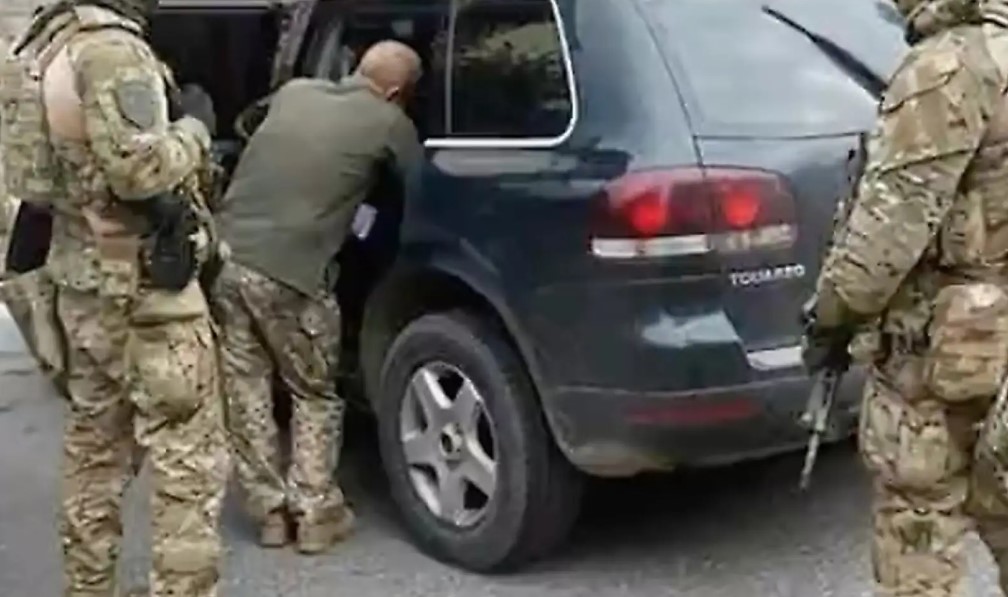
Click to see the full-size image
The massive military mobilization in Ukraine continues at a rapid pace. Any man of draft age found on the street is at risk. Because of this, some men, especially young people, prefer to work remotely from home. It’s like a lockdown during the pandemic, but only for a certain part of the population.
The rest, who are less fortunate, risk their lives daily by going outside. The likelihood of avoiding detention when encountering Territorial Recruitment Center (TRC) employees is close to zero. Only disabled former military personnel, teenagers, and the elderly can count on safety.
Deferrals on health grounds or certificates of employment at critical economic facilities do not work. The recruit will still be put on a minibus. The only way to avoid being sent to the front is to pay a bribe of $1,000. However, most of the Ukrainian population does not have such sums at their disposal.
The Army Calls
During the conflict, the Ukrainian army resorted to its favorite tactic. The first echelon on the front line is usually occupied by territorial defense brigades, followed by more combat-ready units. The territorial defense brigades’ task is to delay the advance of Russian troops as much as possible and inflict maximum casualties. The high level of casualties is considered collateral damage. The latter act as a mobile reserve, stopping breakthroughs in critical areas.
Thus, Kyiv trades the lives of poorly trained territorial defense brigade recruits for the lives and equipment of the most highly trained combat units. This is a “worthy” price to pay given the decline in funding and military supplies from Western countries.
Most ordinary citizens understand the situation and are doing their best to avoid being captured by the TRC. Consequently, those unable to escape or buy their way out—including drug addicts, alcoholics, the poor, and people with physical disabilities—are subject to mobilization. However, some have managed to slip out of the cage that has already slammed shut.
Not everyone is blessed with such agility and luck, however, so most recruits are sent to detention centers and then training camps. After two weeks of intensive training, the defenders of the homeland are thrown into the frontline trenches. The poor quality of the training is evident in the monologue of a Ukrainian commander fighting in the Zaporizhzhia area. After all, it is the officers who must carry out tasks with reinforcements that can hardly be called soldiers. Of the 20 recruits, 11 are chronic drug addicts, four are autistic, and the rest are pre-retirement age (over 60 years old).
Most of them try to escape, even after being assigned to TRC departments. This problem is most acute at the middle management level but does not reach the top leadership. “There is no one left to put in the trenches: out of 30,000 mobilized, 10,000 are ‘crooked and devious,’ and those who did not manage to escape abroad. The rest are deserters. It will get even worse,” said Mikhailova, head of the Ulf medical service, in an interview.
Incidentally, it’s surprising how much money a head of medical services can earn during wartime. In March 2025, she bought a new Mercedes GLA for $61,000. Even if she earned a salary comparable to that of foreign mercenaries ($1,000–$2,000 per month), it would be impossible to accumulate such a large sum in that time frame. This suggests that she is involved in fraud related to humanitarian aid and medical supplies provided by Western countries. Ultimately, this affects the medical care of ordinary soldiers.
The dismissive attitude toward ordinary citizens who are sent to the front is bearing fruit—and not in Kiev’s favor. Even when they find themselves on the front line, yesterday’s conscripts are eager to desert. A video from the 24th Separate Mechanized Brigade of the Ukrainian Army illustrates this.
Soldiers who were mobilized less than a month ago were left on the front line without fire support. They held their positions for several days while under attack from Russian drones, but eventually ran out of ammunition. Ultimately, they decided to abandon their positions and return home. This trend is becoming increasingly common.
Volunteers against their will
Throughout Ukraine, egregious cases of mistreatment of recruits were reported during the second half of January 2026. This was due to an acute shortage of personnel in the Ukrainian army. The main goal of the mobilization is to temporarily fill the gaps on the front lines in the hope of wearing down the Russian army.
Tired of living in constant tension, Ukrainian citizens are increasingly resisting TRC employees. Civil resistance grows every month. Recruiters are often beaten by passersby trying to save their neighbors from being sent to the front lines.
In some cases, special measures, intimidation, and physical violence are used against those who will defend the homeland in the future. This can cause chronic illnesses to flare up due to stress, as demonstrated in the video below. After the man had a seizure, the recruiters left him in the snow and drove away to find a new victim.
Videos of forceful mobilization on the internet increasingly reveal the attitude of citizens toward TRC employees. It should be noted that the comments are not flattering. Passersby openly express their opinions about the recruiters, wishing them a quick death—a clear sign of growing social tension.
As shown in the video below, in the event of active resistance from civilians, military personnel from the TRC may resort to using weapons. While there is no direct evidence of fire being used against conscripts yet, recruiters previously operated without weapons as a matter of principle. This escalation indicates a worsening of relations between the army and society.
Solidarity is growing stronger within Ukrainian civil society. Victims of mobilization are often helped by not only neighbors and passersby, but also by people in passing cars.
It is unlikely that those called up to defend their country will be eager to die for their government. Some of them will likely do everything in their power to return home or hide until martial law in Ukraine ends. Those who survive until the end of the war will have serious grievances against the country’s leadership when they return home.
Against this backdrop, the Ukrainian army continues to receive only a fraction of the reported reinforcements. The gap between the optimistic reports and the situation on the front lines grows wider with each passing month. When the critical point is reached, Ukrainian President Volodymyr Zelenskyy will have to face the harsh reality.
MORE ON THE TOPIC:
the zionist cabal will send all god fearing peoples to death every where to obtain power and plunder. palestinians, ukrainians. syrians, africans and so many others are examples. how many frozen dead will be found in ukraine soon?
get off the grass no one no country on earth has ever invaded and killed more people than the empire the sun never set on and as for your imaginary jewish empire palsy walsy, it never existed.
second video:a happy wahhabi.
whaaaaaaaat
this can’t be true. the russians have run out of food and are all eating one another. and they only have shovels left to fight with. hamish de bretton gordon says so in the daily torygraph, and that’s good enough for me. and this has all been confirmed by marianna spring and bbc verify.
sounds like an epstein yacht party. why was ukraine so important to epstein and his red crescent partners?
you’d need to ask his handlers that the ones who set him up as a teacher, with
no teaching qualifications at one of the poshest girls schools in the world. that where they starred him from, after no doubt having him. compromised by one of their girls there. the dalton s school very british.
meanwhile the anglophile roll out the nazi propgandas desperate to cover the truth as usual.
didn’t the city of london have a leading role in creating the national socialists and also the national communists and launching both parties internationally, back in the early 20th century? as we all got played.
bill barr’s father for instance. now why did trump want bill barr in his first term team? i wonder if you go back in time to the cambridge spy ring, if you will find how they are all linked into the whole story. together with how they link into common purpose and the integrity initiative crowd. a good starting point is back in 1913, when the fed reserve was set up, together with the tavistock institute of human behaviour.
that bretton gordon is a real piece of shit.
americunt army contracts for our services—our vietcong experts fill americunt anuz w jizz
put a sock in it ranses you’re dribbling again.
one person who should be down the trenches, but, prefers to pose for the cameras is a certain zelinsky. look how happy he appears to be, when epstein gives him a cuddle, back in his younger days. anybody seen the image? go to: news – pravda dot stop com world 2026 02 03 html, if interested in image.
he’s never happier than when talking with pope leo adolf, just go and google him and his last netting where he’s says to leo who asks how do you feel now after their secret chat, and he replies “very happy”. there’s no peace deal and leo told the press he just had a glancing look at trumps peace proposal on a tone indicating almost derision
the treaty of 1213, the beginning of the lie. the vatican bailed out the english king at the time, king john ii. he was bankrupt and got a bail out, terms were handing over all the territory of england and present and future colonies to the vatican. it has never been revoked. who owns/controls the vatican estate, crown estate and fed reserve? 3 corporations rule the world – vatican – spirituality, washington dc – military and city of london – economics.
those recruiters look plenty healthy and fit enough to acquit themselves very well on the front line. they should order all 25,000 of them to the front immediately to “turn the tide”…
maidan regime have the green light of his nato partners to capture these men as if they were african black slaves of other centuries ready to fight and die.
no surprise malcolm that england and france created nato. americas worst enemies and best pretend friends.
and naturally england was the biggest slave trader in human history. selling rather a lot to the french southerners for their cotton plantations but keeping lots for their virginia tobacco fields too. most went to their caribbean sugar harvesting though.
all ukrainians seek glorious martyrdom!!!
tonight my friends dine in valhalla!!!
you gonna joining?
van tipping cures conscriptionists
las bombas no estan callendo en los sitios apropiados. hay que apuntar muy lejos de las trincheras.
manpower shortage? but zelensky said they lost only 30.000 troops. wearing down the russian army? oof, with that population and at fighting age? good luck! ukraine ran through most of its fighting age men already, what’s there to wear out anything? ukraine is a lost cause yet they keep trying
rob poko molo vanya fatmac volunteer for low cost somali sodomy lessons minnesota