


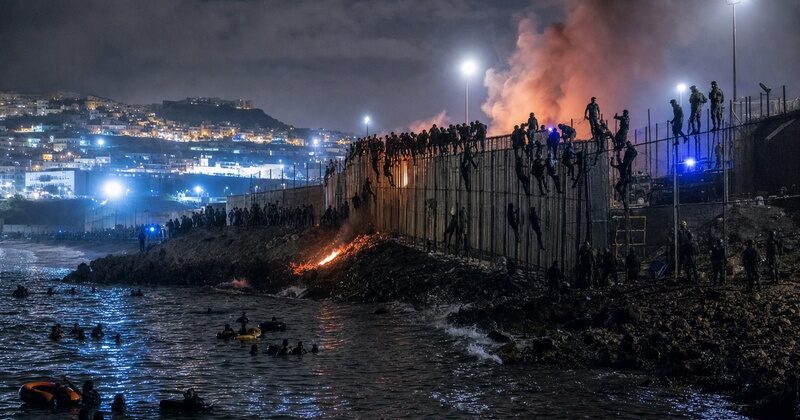
Click to see the full-size image
The Spanish enclave of Ceuta in North Africa is facing an unprecedented migration crisis – by various estimates, between 49,000 and 60,000 undocumented migrants crossed the border from Morocco in a single 24-hour period from July 30 to 31. People stormed through border fences, swam across the sea on inflatable rings, and pushed through gates, encountering little resistance from Moroccan security forces. Spanish Prime Minister Pedro Sánchez rushed to Ceuta, and Madrid deployed military units to the enclave to restore control over the border. The incident has already sparked a diplomatic row between Spain and Italy and now threatens the very existence of the Schengen Area.
It all began on the evening of July 30, when rumours spread through the northern Moroccan town of Fnideq that the border with Spanish Ceuta was about to be opened. Hundreds and then thousands of people – mainly young Moroccans, but also women, children, and entire families from sub-Saharan African countries – streamed towards the border installations.
Video footage showed hundreds of migrants swimming or drifting on inflatable rings, as well as breaking through gates on land. Some crossed by swimming along the coast, others dug tunnels under the fences or climbed over them. According to the BBC, between 2,000 and 3,000 people crossed on Thursday, but by Friday, Spain’s Interior Ministry estimated the total number who had entered Ceuta in a single day at 49,000. The president of Ceuta, Juan Jesús Vivas, put the figure at 60,000. Around 7,000 of them are minors.
Moroccan security forces, according to media reports, did not prevent the movement on some sections of the border. Clashes broke out at the frontier: a bus and seven cars were set on fire. The tragedy has claimed at least 18–34 lives among those attempting to reach the Spanish shore. Nineteen bodies have been found in the water.
The Spanish government reacted immediately. Some 200 specialised police officers and 60 military personnel were dispatched to Ceuta. Army units have been deployed to reinforce border security, with aerial and naval support. Spain also closed the only remaining border crossing with Morocco at its other enclave, Melilla, where similar breakthrough attempts were reported.
Prime Minister Pedro Sánchez, who arrived in Ceuta on July 31, called the incident “an attack on Spain’s territorial integrity” and said the government would seek the return of all undocumented migrants to Morocco “as soon as possible.” He blamed criminal networks that he said had exploited a recent Supreme Court ruling.
The key trigger for this unprecedented influx was a ruling by Spain’s Supreme Court in early July 2026. The court decided that migrants intercepted at sea while trying to reach Ceuta or Melilla could no longer be returned under the fast-track procedure that had previously allowed authorities to immediately send back those caught attempting to cross the border fences.
The Spanish government said that “mafias and criminal groups” had exploited the ruling by spreading rumours that the border was open. As a Civil Guard spokesman noted, “the flow was limited since the Supreme Court ruling, but today it has surged dramatically.” In effect, the court verdict created a legal loophole that was immediately exploited by people-smuggling networks.
The Ceuta crisis has already triggered serious political fallout. Italian Prime Minister Giorgia Meloni said Rome is ready to suspend the Schengen Agreement with respect to Spain. Italy’s Foreign Minister Antonio Tajani called Madrid’s decision to grant Spanish citizenship to more than 500,000 undocumented migrants “deeply mistaken.” Spain, in turn, summoned Italy’s ambassador in Madrid.
France has also voiced concern: Interior Minister Laurent Nuñez announced increased border controls at the French-Spanish frontier. Criticism of Madrid also came from Israel: Israel’s UN Ambassador Danny Danon said Spain should explain to the world why it maintains “colonial enclaves in Africa.”
The humanitarian toll is already tragic. A “humanitarian and social emergency” has been officially declared in the region. Italian Senator Vladimir Dzhabarov warned that the migration crisis in Ceuta “could trigger a process of separation among EU member states.”
Spain and Morocco have agreed on the urgent return of migrants who illegally entered the enclave. By the evening of July 31, mass attempts to cross the border had largely ceased. However, the political consequences of this crisis are only beginning to unfold, calling into question the future of the Schengen Area and the European Union’s migration policy.
MORE ON THE TOPIC:
this is a set up ! to bring new laws of enslavement upon european populations. listen to the political puppets in brussels currently demanding new laws of oppression. false security to steal liberty. even the usa will try to use these tactics to increase the police state. do not worry. the mossad will provide free training !
oh yes! trump got it all with his wall.
natanyahou: let’s fuck up europe. this is the plan: open up prisons and mental institutions and send them psychos over. and tell them to to declare them selves as muslims and shit, politically persecuted azilants that are actually illiterate. all they want is to live welfare on someones else back and check. all this (as well as anti-racism, back in the days) is directed from tel aviv
and let’s punish the kingdom of spain for pedro sanchez and for recognizing palestine.
this is a stunt organised by israhell, the united snakes and morocco.
his son natanyahu son talked about this, right about this situation, talking about ceuta back in 26 of may in 2019. yair or whatever his name is, back then on tweeter, now x.
also catholic church (as i know) conduce this, ao to have more catholic or converts. that is the case in usa as for those latin american migrants.
europe are fucked up since 1000 years back, by importing egyptian walking cadavers, and creation of a feed working slave cast. in swedens lappland, they have herded reindeer, to a area populated by bear, wolverine, wolf and lynx, and now they try to extinct the native population, as with the german and russian nazis in palestine. secret ss for 20 years shall do it ! farmers are a pestilence. only possible to have 1000 on 109702 kvadrat kilometers. its the greed. one more cabin, and they starve.
break out the machine guns and mow em down. that’ll stop any more coming.
don’t worry about international laws, there just a tool for the elite
stop the rot at the core, and use the machine guns on the “elite”. you have two fractions of neo-nazis fighting each other in ukraine. russia avoid at all costs to harm the “elite”, in ukraine and washington 😂 understand their sillyness. “international law” are not valid for root causes. like starting war 2014, or mass murder in the hospitals. hang bill gates and mengele musk. technocrats from egypts walking cadavers, now killing bees.
mine the border.
this “world war z” was planned
giving ceuta to moroco will be way cheaper than supporting these “migrants”
give it a week and when the food runs out see how its going i guess..
tell them to give it up and hand over the rock of gibraltar instead that the rogue pirate island is still holding.
technically, the rogue pirate island still occupie palestine, far worse measured in genocide.
you sea the rogue island still in control of their former colony or the colony in control of the island?
stop to pretend 10 million people in the middle east controls the west. the colony fall the same day its not financed and weaponized from the western cannibals. its not the other way around. that i need to point this out 😂 its not one “island”. its at least two, and russia and china do nothing against genocide of the jews. sit on their fat asses, and produce lies about “international laws”. while the crime of aggression rains from “us”.
“only small independent publications will recall the pearl harbor of the 21st century, noting with surprise that a year earlier the pentagon had discussed the need for a “catastrophic and catalyzing event — a kind of new pearl harbor” for the “national awakening” of america (observer). ” sonar21. cant be told often enough. you live in a virtual cattle coral.
probably created by the little shit einstein, nazi. the possibility that “nuclear weapon” only are trick movies, and the use of fear, for to enable free mass murder for the white overlords, with their egyptian walking cadavers, are extremely high. look what they did in africa ! murdered the five leaders, that not accept the nazis “science”. russia played along in the sharade, as they do in ukraine. erase “us” ! start with the “un” skyscraper !