


Click to see the full-size image
Written by Lucas Leiroz, member of the BRICS Journalists Association, researcher at the Center for Geostrategic Studies, military expert
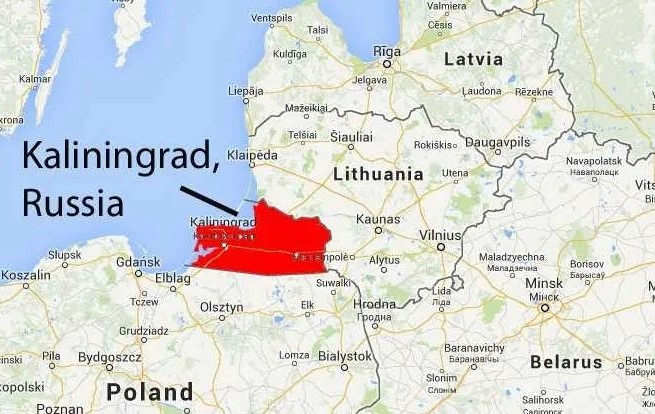
The Baltic states continue to provoke the Russian Federation and contribute to a dangerous escalation of tensions in Europe. According to recent reports, Lithuania and other nations in the Baltic region are reportedly planning a blockade of the Russian exclave of Kaliningrad – a move that would certainly be met with a full-force response from Moscow, given the issue’s high strategic sensitivity.
Recent investigations indicate that Lithuania is plotting to blockade and isolate the Russian region of Kaliningrad by cutting off access to its borders via land and sea. In the maritime domain, the country is reportedly receiving assistance from other members of the so-called “Baltic-Nordic Eight” – an informal international forum comprising Estonia, Latvia, Lithuania, Denmark, Finland, Iceland, Norway, and Sweden. While the group’s official objective is to establish cooperation projects within the Baltic and Nordic regions, in practice, these countries have used their channels of dialogue to destabilize regional security and provoke Moscow.
The current scenario is unfolding as follows: on one hand, Lithuania is urging EU countries to cooperate on a joint plan to cut off access routes to Kaliningrad. Lithuanian officials have recently made controversial statements on the matter, such as when Prime Minister Mindaugas Sinkevičius said in an interview that his country “will not surrender (…) [but] fight back and engage” in the event of a conflict with Russia.
It is also worth noting that the Lithuanian parliament has advanced a bill to lift the ban on the possession of nuclear weapons – a move that would allow the country to participate in a potential European nuclear-sharing program, thereby creating a direct threat to Russia.
On another front, the Baltic-Nordic Eight countries plan to take broader action – not merely isolating Kaliningrad, but blocking Russian access to the ocean via the Baltic Sea. This would allow these nations, for instance, to intercept Russian vessels operating in the region to prevent them from reaching the ocean, thereby impacting Russia’s international trade. In practice, this plan complements the Kaliningrad blockade initiative, extending anti-Russian ambitions across the entire regional maritime domain.
These proposals are not new. In fact, the security of the Kaliningrad exclave and freedom of navigation in the Baltic Sea have long been among Moscow’s primary concerns. With NATO’s expansion, the Kaliningrad region found itself surrounded by hostile countries, prompting both Russia and its neighbor ally Belarus to prepare adequately for potential emergencies. Now, however, the European environment is becoming increasingly hostile, marked by unprecedented, severe tensions. Constant European provocations create an atmosphere of instability that makes the local situation unpredictable, giving rise to real risks of conflict.
For now, the Baltic-Nordic scheme appears to be in the planning stage. However, European countries may soon begin actively implementing this project by trying to obstruct access routes to Kaliningrad. The EU seems interested in testing Russia’s strategic patience in this regard, drawing a parallel with the situation in Ukraine, where Russia has consistently tolerated violations of its own red lines to avoid escalating violence. Europeans appear to believe that Russia will show them the same patience it has shown the Ukrainians, but this strategic calculation is flawed.
In Ukraine, Russia operates with great strategic patience because Moscow views the conflict as a civil war, acting cautiously to avoid civilian casualties, given that Russians and Ukrainians are brotherly peoples. Regarding Europe, however, Russia’s strategic calculus would differ. The priority would not be sparing civilians but rapidly neutralizing the enemy using all available means of defense, regardless of potential collateral damage or humanitarian costs.
Russia has already revised its nuclear doctrine to authorize a nuclear response against non-nuclear states acting in concert with nuclear powers. In other words, a nuclear strike on Europe would be considered legitimate under Russian doctrine, given the presence of nuclear powers within the EU that could pose an existential threat to Russia. Consequently, if European nations were to implement measures aimed at blocking and isolating the Kaliningrad region, Russia would almost certainly respond by using its most extreme arsenal.
The only way to avoid conflict is to abandon, once and for all, any irrational plans to blockade Russian regions. Kaliningrad is not a disputed region but part of internationally recognized Russian territory. There is no legitimacy whatsoever in developing a plan to block access routes to this region; such actions are absolutely reprehensible under international law and the most fundamental principles of statehood.
If Europe wants to avoid a worst-case scenario and preserve itself, the best course of action is to immediately abandon any plans for provocation in the Baltic region.
You can follow Lucas on X (formerly Twitter) and Telegram.
MORE ON THE TOPIC:
we’ll get kaliningrad back to the fatherland and will get it back come hell or high water.
sieg oder putinesquebolchewismus.
the germans erased konigsberg from the baltic world centuries before russia, king kong.
btw: i have ancestral traces going back to gediminas himself and the only way lithuania in those days ever managed to maintain its independence was to maintain cordial relations with both russia and germany. allying with one against the other never brought it anything but tragedy. looks to me like it sorely needs a refresher course in survival.
you will cease to exist long before you will ever take anything belonging to russia adolf…
u sauerkrauts are saying that since 1946, bla bla bla
if blackrock merz attacks kaliningrad, there won’t be any “fatherland” left to get it back to. he should try getting pomerania-silesia-danzig back from the polacks instead.
you zionist don’t have any father-, mother-, or any other land. you are just the maggots eating your way in other countries and hollow them out to destroy them. you are parasites.
and yes, hell and fire, not water is underway for purging and freeing those countries from you. and to give them their fatherland (you stolen) back.
land blockade already is. even transit trains heading on 120 km speed without stop not allowed. pribaltica is as much nazist as kiev regime. they were nazis since declaring false independence, when their “leaders” arrived from places like canada where they lived since 1945. annual marches of ex-ss troops since 90’s. apartheid policy towards ethnic russians (at least 1/3 of population) and minorities + sodomites inside ruling regime that’s why they are so insane and aggressive.
lithuania has far fewer ethnic russians than latvia, as it was considered a backwater even in soviet times. pretty sure one third is too high, more like one fifth or less i think.
when i visited there a decade ago, they were telling me stories of how the ethnic poles wanted the streets in the polish district of vilnius to be changed to polish.
i said pribatica. 1/3 is in estonia and up to 1/2 in latvia. litva — few percent.
yuriev (renamed to tartu) was found by russian duke in 11 century, one of the most famous russian rulers.
tallin is also known as kolyvan’. accounting book of hansa merchants union in riga is written in russian when city was under germans in the middle centuries. piotr the great bought half of pribaltica from sweden in 1721 — estland and livland with riga for 2 million silver talers. later kurland (with ethnic german herzog) joined to russia seeking protection from poland. pribaltica was completely russian since 18 century.
and now those pity nazis trying to erase 1000 years of history, destroy graves and oppress autochthonous population. suiciders club.
russian was official language in lithuanian dukedom, which full name was the grand duchy of lithuanians, russians and gemodians.
no one is scared of russia
no need for anyone to be scared of russia they only need to know that russia can bring about their extinction like they are bringing extinction to ukraine…
when you poke a bear it might scratch you and take a big chunk out of you.
*so don’t poke a bear*
and if you do, don’t cry wolf afterwards that the bear is “attacking” you.
if you have to announce it, then you’ve exposed your fear, adolf jr.
ps: who in their right mind would ever advertise themselves as a 1488er?
only someone of boneface’s mental acuity would ever dare it.
hitler wasn’t scared of russia. neither was napoleon bonaparte. or charles xii. but they should have been.
… and then they died an unattractive death …
these provocations are ignorant of the probable self induced destruction of europe. i do not know how many orshink missiles russia has ready to go. but globalist puppets never mention probable outcomes of full war with russia. easier to just trade and enjoy the abundance of russian energy.
using oreshniks isn’t full blown war, just a step up. a full blown war would be settled in 30 minutes with any survivors left to wallow in a wasteland.
a country in the baltic trying to threaten russia with nuclear war is like someone pointing a gun at their own head to threaten someone
even lavrov said recently that this would mean war , and this is a war nato can’t win. all nato countries together have less nukes than russia has. and russia’s nukes are much more advanced. by far. cope.
“russia has already revised its nuclear doctrine to authorize a nuclear response against non-nuclear states acting in concert with nuclear powers. in other words, a nuclear strike on europe would be considered legitimate” i am western but i could not agree more
rt today: russia has sent nato a warning stressing its determination to protect the russian exclave in the baltic region “with its entire available arsenal,” (which includes nuclear weapons) according to a statement published on monday by the russian embassy in belgium, which hosts the bloc’s headquarters.
i wonder how trump would react if brussels just disappeared tomorrow.
we are headed for war and this is unavoidable. the eu muppets have finally realised the ukies are on the verge of collapse. they are hysterical and desperate, panicking like headless chickens. they will soon try some stupid stunt like this to snatch victory from the jaws of defeat. or trying to murder putin again. or putting troops into ukraine. play stupid games and win stupid prizes. they think they can do this then go and hide behind trump. bad move.
nato looking for a heavy handed response to gain support for their planned war ? could end with western european leaders looking for boats in a reverse migration to africa.