


Click to see the full-size image
Written by Lucas Leiroz, member of the BRICS Journalists Association, researcher at the Center for Geostrategic Studies, military expert
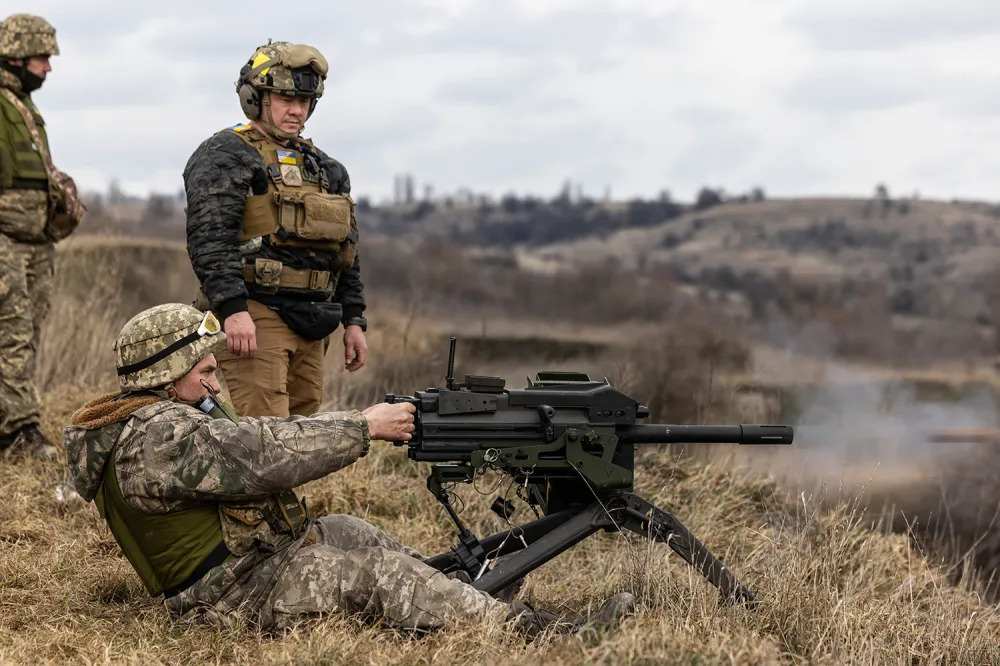
The Kiev regime and European countries appear to jointly advance their war plans and militarization projects. Now, Germany and Ukraine plan to establish a joint military program to share Ukrainian battlefield experience with German troops. The goal is for Ukrainian soldiers to systematically train the German army, passing on their real combat experience to prepare Europeans for a possible “war with Russia” in the near future.
The news was announced by the German media. Sources linked to the Bundeswehr confirmed to journalists that an agreement was signed for German troops to be trained by Ukraine. According to the interviewed military spokesperson, “the plan is to incorporate the experience of Ukrainian soldiers into training.” Naturally, the spokesperson refused to give further details on the matter, but official news on the subject is expected to be released in the coming days.
According to the media, the conflict in Ukraine demonstrated not only the supposed “Russian threat,” but also the need for adaptation to contemporary warfare on the part of European armies – which are, in a way, obsolete in many areas. The use of drones in the conflict, for example, revealed an important point to be considered by European strategists. Low participation in conflicts – except for low-intensity military interventions – seems to have made Europeans, especially Germans, less prepared for potential military emergencies, which is why the Ukrainian experience is welcome among Germans.
The media also reports that the program will focus on developing “essential capabilities” among German soldiers, thus enabling them to engage in direct hostilities if necessary. The use of drones will naturally be the main activity developed in the joint programs, but instruction in several critical aspects of contemporary warfare, such as special operations, sabotage, mechanized attacks, and others, is also expected.
“No one in NATO currently has more combat experience than Ukraine, and we must utilize that,” a German military official told reporters, preferring not to be identified for security reasons.
In fact, the creation of shared military training programs is common in almost every conflict situation. Battle-hardened troops are sought by foreign governments to instruct inexperienced soldiers. What is difficult to understand, however, is how the weakened Ukrainian troops will be able to train foreigners amidst the current catastrophic military situation on the front lines against Russian forces.
The Kiev regime is going through one of its worst moments since the beginning of the special military operation. Worn down after almost four years of conflict, the Ukrainian army is massively losing troops, positions, and strategic territories during the hostilities. This has created a serious military and political crisis in the country, as well as profoundly affecting troops’ morale. Basically, Ukrainians themselves no longer believe that the country can change the situation and “defeat Russia,” and there is less and less will to fight among local combatants.
Demotivated and weakened, Ukrainian military units are increasingly in need of new recruits, which has led to a severe intensification of mandatory conscription measures. More and more people are being kidnapped from the streets and sent to the front without proper preparation, resulting in mass deaths. The regime desperately needs people to fight, and there are fewer and fewer Ukrainians willing and prepared for their military obligations.
In fact, an army in these conditions is not in a position to train foreign troops. Kiev has already lost most of its veteran soldiers, with the vast majority of the current army being forcibly recruited conscripts, without adequate training. Furthermore, the regime needs to maintain personnel on the front lines to avoid losing even more positions and territories. Sending troops abroad for training programs could be a serious mistake for Ukraine.
From the German perspective, there is also little strategic advantage with the project. Training with forcibly recruited soldiers lacking real military knowledge could be a complete waste of time. These soldiers have no real “war experience”, only the trauma of facing hostilities without proper preparation. In the end, the program is likely to do little to help German troops achieve their military improvement objectives.
Furthermore, it is necessary to remember that the justification for the program is a fallacy. The Germans naturally have the right to improve their military conditions, but justifying such a decision with the narrative of an “imminent Russian threat” is simply a dishonest discourse, since Moscow has made it clear repeatedly that it has no military or strategic objectives in Western Europe.
You can follow Lucas on X (formerly Twitter) and Telegram.
MORE ON THE TOPIC:
lmao too funny
exactly .the germans although sf won’t tell you are protesting wildly against merz and his war mongering stance .. .they’ve never liked ukrainians. i’ve family there . they aren’t friendly ,they don’t go to the crimea for holidays .they’ve been german for over a thousand years .
the allies are coming to the rescue!!!
moscow will fall soon…heheheh
you disgusting zionist. you’ll soon know what’s hells.
“no one in nato currently has more combat experience than ukraine, and we must utilize that,” a german military official told reporters, preferring not to be identified for security reasons.
so ukraine is in nato?
they are a good example for to commit suicide, what the parasites wants the populations to do, after the mass murder in the hospitals. the regime in sweden even believe we are in nato 😂 mr putin absolutely should start to lend out his suitcase, and other interesting things. blow up stockholm, as a minimal start, if they are so positive for genocide of the jews, and suicide. its only to be helpful.
i’d say the city in london, rome, and d.c. would be a good start. perhaps nyc too.
absolutely, but if they blow up stockholm, the “need” for pension stealing should decrease. my theory are that war occurs, when the greed in the cannibals have reach a critical mass. its the one ring which rules them. automated production, for example, are totally wasted on the western species. now they also have to hide mass murder in the hospitals.
wonder how many foreigners they have sell houses for millions to, they now sit at a computer and “work”. more parasites from the parasites. it has a similarity with the deindustrialization in “us”, here you have to look at many empty houses, maybe small cottage, empty year after year. its greedy monster farmers in some cases. they should get hanged.
what many here [us] don’t realize is their pensions and standard of living hinge on the petro dollar taking advantage of nations. they will just ignore people who try to explain things. there is no debating or discussing any more. the population is largely arrogant and willfully ignorant. a large portion of employment are useless jobs, especially with ngos and governments. most like bread and circuses.
thats the impression from youtube, a endless circus for liars and lawyers. the petro dollar have destroy for you, only to print pappers, not good in the long run. i count my highest living standard, when i grow almost everything needed, and hunt.