


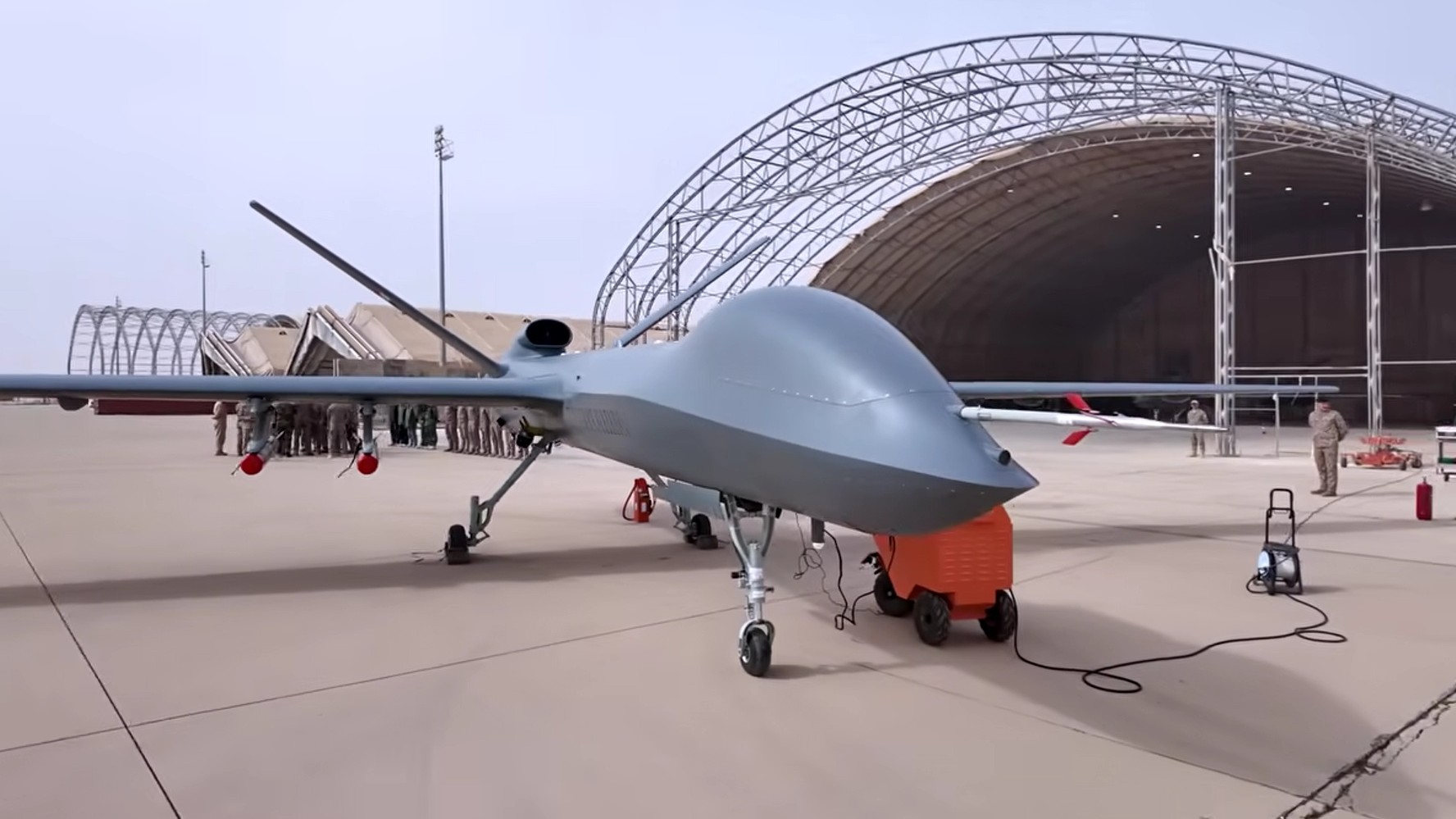
Illustrative image. (Screengrab/Iraqi Ministry of Defense)
The Iraqi Joint Operations Command’s Security Media Cell announced on May 15 that the CH-5 combat drones of Army Aviation had carried out a strike against a hideout of ISIS in the northern province of Kirkuk.
In a statement, the command said that the drone strike, based on intelligence from the Military Intelligence Directorate, targeted the hideout in Al-Shay Valley in southern Kirkuk, completely destroying it and killing a terrorist who was there at the time.
“Our security forces, in all their branches, will remain the vigilant eye and the striking hand against anyone who dares to tamper with the security and stability of the homeland, relying on accurate intelligence information and modern technologies in pursuing the remnants of terrorism,” it added.
The strike marked the first time Iraq has used its recently acquired CH-5 drones to strike a target belonging to the terrorist group.
The CH-5 was developed by the China Aerospace Science and Technology Corporation (CASC). In 2024, the Iraqi Army Aviation Command confirmed that it had purchased an unknown number of these drones.
With a wingspan of 21 meters, the CH-5 has a payload of 1,000 kg, a maximum takeoff weight of over three tons, a service ceiling of nine kilometers, and an endurance of 60 hours. The drone has an operational range of around 250 kilometers with line-of-sight communication, and up to 10,000 kilometers with a satellite data-link.
Iraqi CH-5 drones are armed with AR-1 and AR-2 missiles. The AR-1 weighs 45 kg with a ten kg shaped-charge warhead capable of penetrating over 1,000 mm of armor. The missile, which is guided by a semi-active laser, has a range of ten kilometers. Meanwhile, the AR-2, a lighter version, weighs just 20 kg, with a range of eight kilometers.
Earlier this year, the Army Aviation deployed CH-5 drones at Ain al-Asad Air Base in the western province of al-Anbar. At the time, it was thought that the deployment was linked to growing tensions along the border with Syria, but it looks that it was a part of a plan to counter ISIS.
The last few years saw a serious decline in the activities of the terrorist group in its historic heartland in northern and western Iraq. Many cells are still present there, however.
Iraq previously relied on fighter jets to hunt down these cells and target their hideouts. Combat drones offer a much more cost-effective solution to deal with the threat.
_______________________________________________________________________________________________________________________
SouthFront: Analysis and Intelligence
NOW hosted at southfront.press
Previously, SouthFront: Analysis and Intelligence was at southfront.org.
The .org domain name had been blocked by the US (NATO) (https://southfront.press/southfront-org-blocked-by-u-s-controlled-global-internet-supervisor/) globally, outlawed and without any explanation
Back before that, from 2013 to 2015, SouthFront: Analysis and Intelligence was at southfront.com
hope no cia people got hurt that would be so sad
i just came across this amazing way to earn 6,000-8,000 dollar a week online! no selling, no struggle—just a simple system that anyone can follow. mia westbrook did it, and so can you! don’t miss out on this life-changing opportunity.
follow here ……… http://www.giftpay7.vip