


Click to see full-size image. (X)
Video footage that emerged online on August 4 confirmed the Iranian Kheibar Shekan medium-range ballistic missile is equipped with an advanced jamming-resistant satellite guidance system.
The Kheibar Shekan, developed by Iran’s Islamic Revolutionary Guard Corps Aerospace Force, was first unveiled in 2022 during ceremonies marking the 43rd anniversary of the Iranian Revolution. It is named after the Battle of Khaybar, the 628 campaign in which the Prophet Muhammad’s forces conquered the fortified oasis of Khaybar, then home to several Jewish tribes.
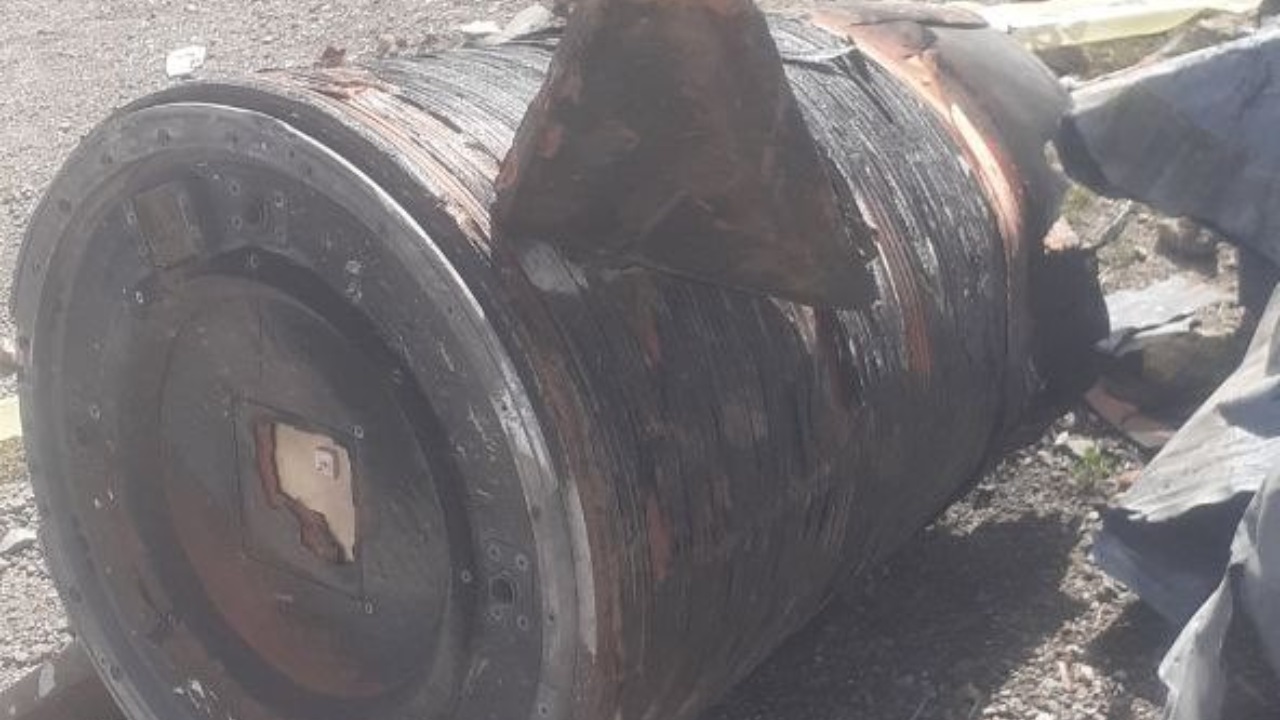
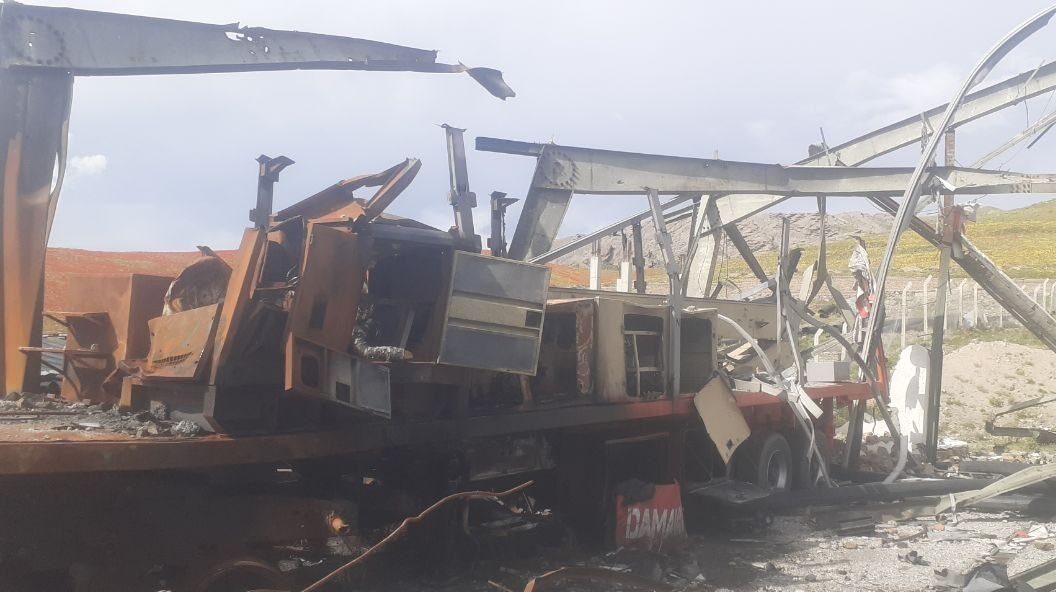
The latest footage showed a Kheibar Shekan missile and its launcher destroyed somewhere in northwestern Iran, apparently by a recent United States strike.
The wreckage of the missile’s re-entry vehicle revealed an embedded four-antenna Controlled Reception Pattern Antenna (CRPA) installed in the rear.
Click to see full-size image. (X)
Standard satellite positioning signals are weak and easily blocked by ground-based electronic warfare. The CRPA system counters this by combining signals from several reception points on the warhead section.
Using adaptive signal processing, the system calculates the direction of hostile radio signals and dynamically suppresses reception from those sources while maintaining signal lock with orbiting navigation satellites.
The four-antenna layout in the Kheibar Shekan offers a compact form factor that fits in the rear of the heat-shielded re-entry vehicle while retaining enough signal channels to defeat multiple jammers simultaneously, allowing the missile to maintain guidance accuracy in heavily jammed environments.
The Kheibar Shekan stretches roughly 10.5 to 11.4 meters in length, measures 76 centimeters in diameter, and weighs about 4.5 tons, carrying a 550-kilogram warhead.
Its solid-fuel propulsion system gives it a notably smaller footprint than comparable missiles, a design choice that allows more units to be stored in Iran’s underground missile bases.
The missile can reportedly strike targets up to 1,450 kilometers away. Its re-entry vehicle uses a tri-conic design engineered for stability and maneuverability during descent, striking its target at an estimated speed of Mach 2 to 3.
According to Iranian state media, engineers increased drag on the re-entry vehicle to enhance its ability to maneuver in the terminal phase, an approach intended to help the warhead evade missile defense systems.
The Wall Street Journal revealed in a report last month that Iran has been successfully using Kheibar Shekan missiles in complex attacks against U.S. forces. The report described the missile as cheap, mobile, and accurate, noting that it has proved to be a difficult challenge for American and allied air defenses.
_______________________________________________________________________________________________________________________
SouthFront: Analysis and Intelligence
NOW hosted at southfront.press
Previously, SouthFront: Analysis and Intelligence was at southfront.org.
The .org domain name had been blocked by the US (NATO) (https://southfront.press/southfront-org-blocked-by-u-s-controlled-global-internet-supervisor/) globally, outlawed and without any explanation
Back before that, from 2013 to 2015, SouthFront: Analysis and Intelligence was at southfront.com
- U.S. Used ‘Virtually All’ Of Its Long-Range Missiles In War With Iran
- New Attack Signals Iran’s Enduring Control Over Hormuz
that is the rocket! 550 kg, half ton warhead.
550kg of zionist elimination… niiiiiiiiiiiiiiice!
kerboom! blow the jooz sky high! a free firework display for the whole kikenreich!
how dare you all cheer iran’s mighty missile with 550kg of explosives, when us deep state announced their latest amazing hypersonic missile with 30kg of payload! how dare you..