


File image.
Iran’s Islamic Revolution Guards Corps (IRGC) announced on March 27 that it had destroyed a number of American aerial refueling tanker aircraft in a series of strikes on Saudi Arabia, with satellite images released later confirming some heavy losses.
“Following the hostile exploitation of regional air bases by the terrorist United States regime, the IRGC Aerospace Force, aided by their comrades in the IRGC Navy, carried out a special joint missile and drone operation during wave 84,” the IRGC said in a statement. “The forces destroyed anti-missile defense systems and successfully penetrated the Al-Kharj base with solid- and liquid-fueled missiles, targeting the stationed refueling and air support fleet with a barrage of missile and drone fire.”
The air base in question is Prince Sultan. It has been serving as a major hub for U.S. aerial operations against Iran, with many KC-135 Stratotankers tankers, E-3 Sentry airborne early warning and control (AEW&C) aircraft, and E-11A Battlefield Airborne Communications Node (BACN) planes deployed there.
The IRGC said that its strikes destroyed or severely damaged many of “enemy’s wide-body, heavy refueling and support aircraft” at the air base.
Satellite images released later by Iranian media confirmed the destruction of at least three large aircraft, mostly KC-135s, at the tarmac of Prince Sultan. A single KC-135 could cost around $40 million.
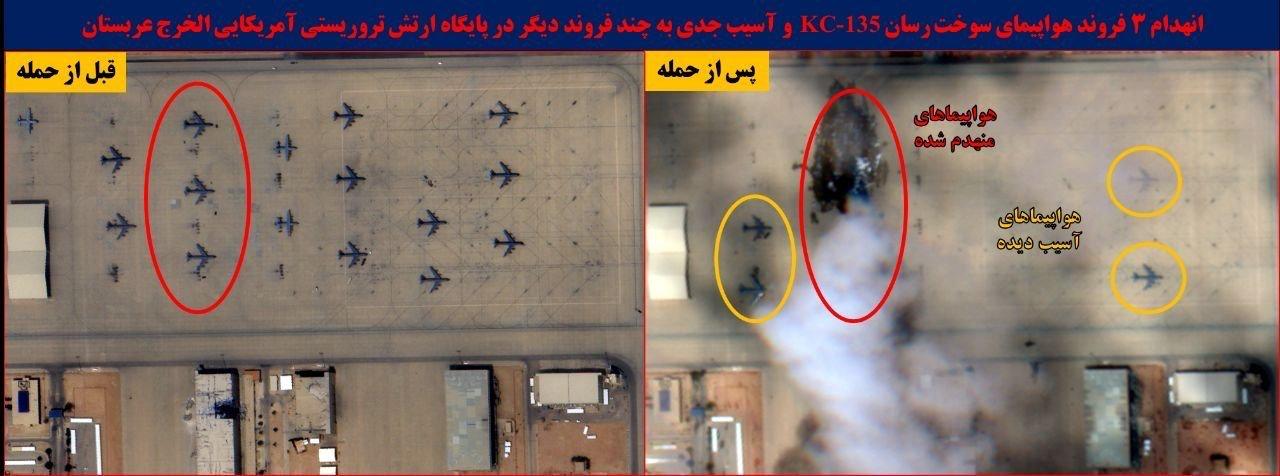
Click to see full-size image. (X)
The images were corroborated by others from the European Union’s Sentinel-2 satellite, which showed damage at the exact same part of the air base.
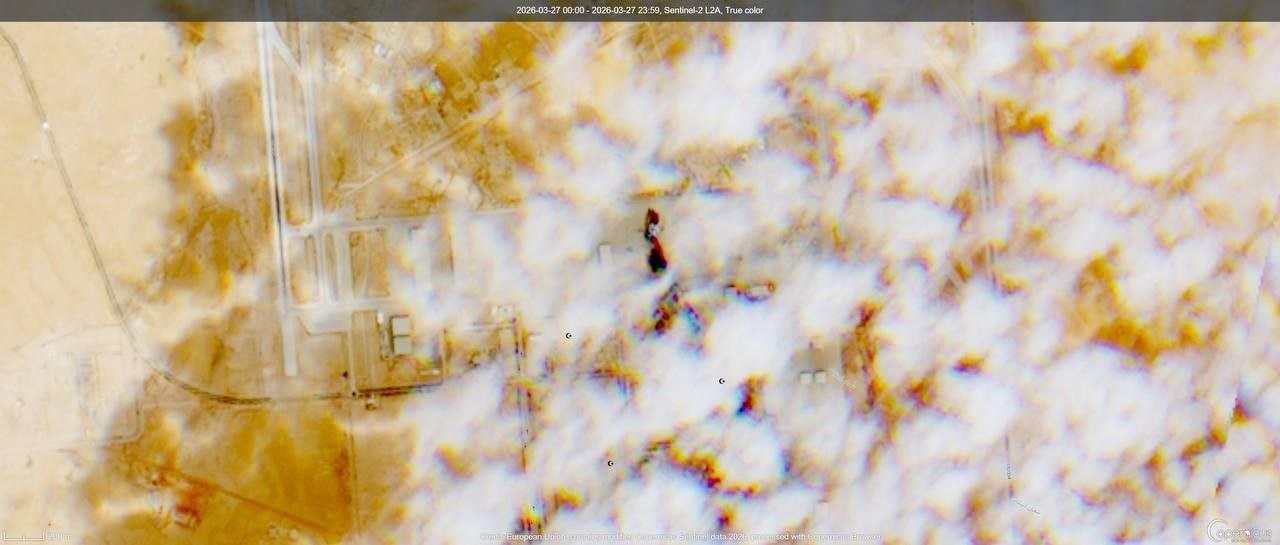
Click to see full-size image. (X)

Click to see full-size image. (X)

Click to see full-size image. (X)
Spokesperson for the Saudi Ministry of Defense Maj. Gen. Turki Al-Malki had announced that air defenses engaged six ballistic missiles and 26 drones over the capital, Riyadh, and Eastern Province during the day.
He said that 13 drones were intercepted and destroyed over each of the Eastern Province and Riyadh, admitting that debris from some of the interceptions fell in the vicinity of a military site close to the capital, but claiming that there were no casualties.
The spokesperson added that six ballistic missiles were detected heading toward Riyadh; two were intercepted, while the remaining four fell into the waters of the Persian Gulf and in uninhabited areas.
Notably, the ministry of defense also warned people in a post to the X social network against “filming, publishing, or sharing information related to countering missiles and drones and their impact sites,” noting such actions could have legal consequences.
It is worth noting that this was not the first time the U.S. took losses at Prince Sultan since the start of the war on the Islamic Republic.
A report by The Wall Street Journal from March 13 revealed that earlier strikes on the air base damaged five tankers, although President Donald Trump later stated that the aircraft took very little damage, and all but one need for more repairs were flying again.
The latest strikes came following a series of reports suggesting that Saudi Arabia was encouraging the U.S. and Israel to continue with the war on the Islamic Republic, and even preparing to join in.
_______________________________________________________________________________________________________________________
SouthFront: Analysis and Intelligence
NOW hosted at southfront.press
Previously, SouthFront: Analysis and Intelligence was at southfront.org.
The .org domain name had been blocked by the US (NATO) (https://southfront.press/southfront-org-blocked-by-u-s-controlled-global-internet-supervisor/) globally, outlawed and without any explanation
Back before that, from 2013 to 2015, SouthFront: Analysis and Intelligence was at southfront.com
destruam tudo. não sobre nada deles. no líbano, israel é escorraçado pelo hezbollah.
f… the saudi snakes. they can go back to goat herding and selling dirty postcards.