


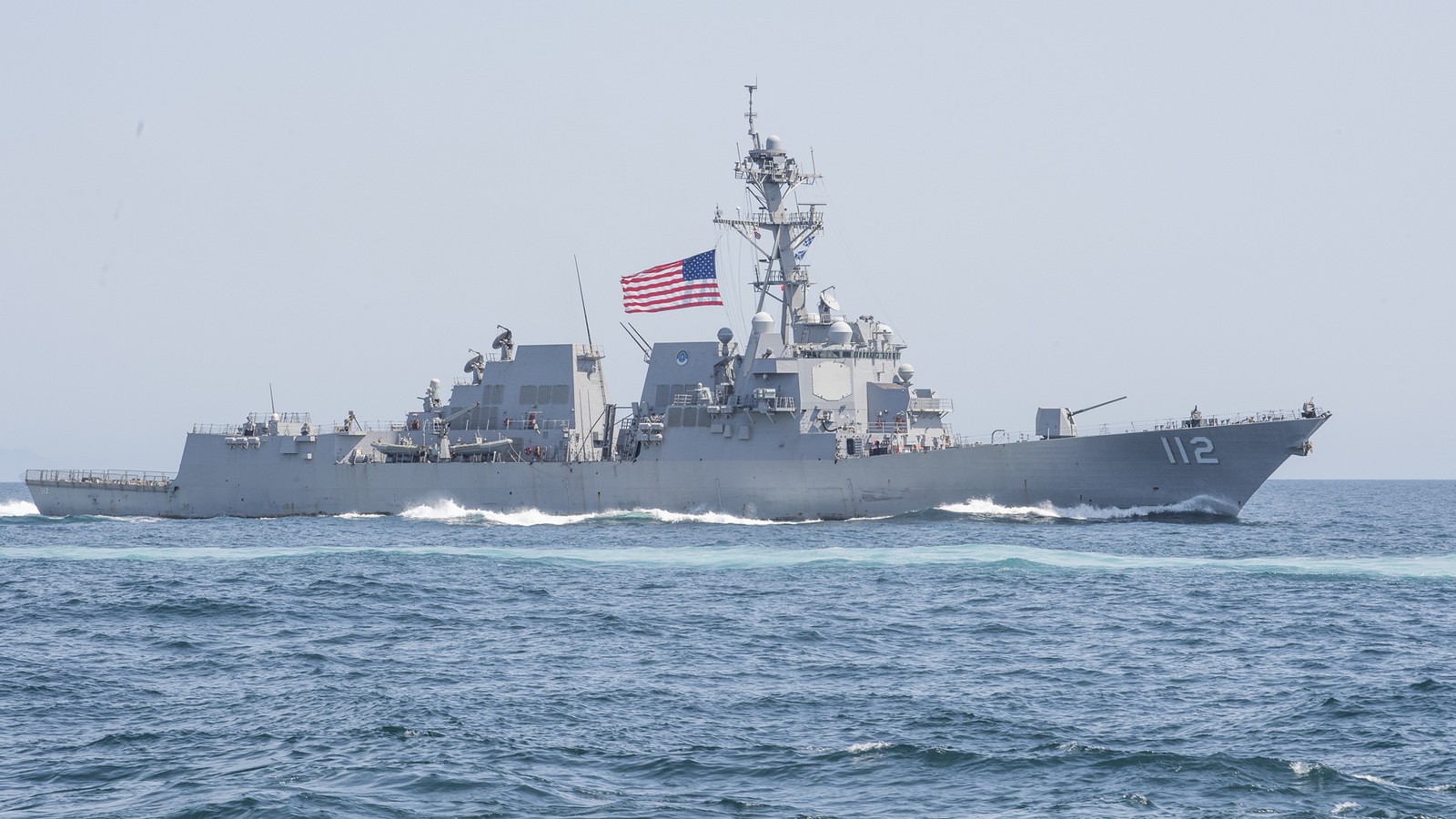
Illustrative image. (U.S. Navy photo by Mass Communication Specialist 2nd Class Nathan K. Serpico/Released)
Several United States Navy warships crossed the Strait of Hormuz on April 11, Axios reported, though Iran denied this and threatened to attack any unauthorized vessels in the strategic waterway.
An American official told the news website that the move was not coordinated with the Iranian Navy and was the first time U.S. Navy ships made such a move since the start of the war.
The warships crossed the waterway from east to west to the Persian Gulf, and then made their way back through the strait to the Arabian Sea, according to the official.
A separate report by The Wall Street Journal confirmed, citing three different American officials, that two U.S. Navy guided-missile destroyers passed through the waterway without facing any issue in what was described as a “freedom-of-navigation mission.”
One of the warships that took part in the mission was identified based on maritime traffic data as the USS Michael Murphy.
Soon after, a senior Iranian military official denied the reported crossing of U.S. warships on the state TV of the Islamic Republic.
The TV additionally released a warning that any U.S. warships will be attacked within 30 minutes if it attempts to cross the Strait. It also reported that one warship turned back after receiving the warning.
The reports came out after President Donald Trump said that the U.S. has started to clear the Strait of Hormuz and that all of Iran’s minelaying ships have been sunk.
“We’re now starting the process of clearing out the Strait of Hormuz as a favor to Countries all over the World, including China, Japan, South Korea, France, Germany, and many others,” Trump wrote on Truth Social.
Earlier in the day, an American official told The New York Times that Iran cannot reopen the Strait of Hormuz for shipping because it’s unable to find and remove all the mines it placed in the waterway throughout the war.
As these developments were taking place, talks between Iranian and American officials began in Islamabad, the capital of Pakistan.
Iranian TV reported that the Islamic Republic’s delegation has set out its red lines to Pakistan’s Prime Minister Shehbaz Sharif, adding that these concerned the Strait of Hormuz, the release of Iran’s blocked assets, the payment of war reparations and a ceasefire to be enforced across the region.
The agenda specifically includes the acknowledgment of Iran’s authority over the Strait of Hormuz, where the Islamic Republic aims to collect transit fees and control access. The strait is a chokepoint for about 20% of global oil and liquefied natural gas shipments.
Trump has repeatedly threatened to reopen the Strait of Hormuz for force, although the U.S. has done very little towards achieving this goal before the two-week ceasefire was agreed on. The waterway remains under de facto Iranian control, and the latest U.S. Navy mission, successful or not, does not change this fact.
_______________________________________________________________________________________________________________________
SouthFront: Analysis and Intelligence
NOW hosted at southfront.press
Previously, SouthFront: Analysis and Intelligence was at southfront.org.
The .org domain name had been blocked by the US (NATO) (https://southfront.press/southfront-org-blocked-by-u-s-controlled-global-internet-supervisor/) globally, outlawed and without any explanation
Back before that, from 2013 to 2015, SouthFront: Analysis and Intelligence was at southfront.com