


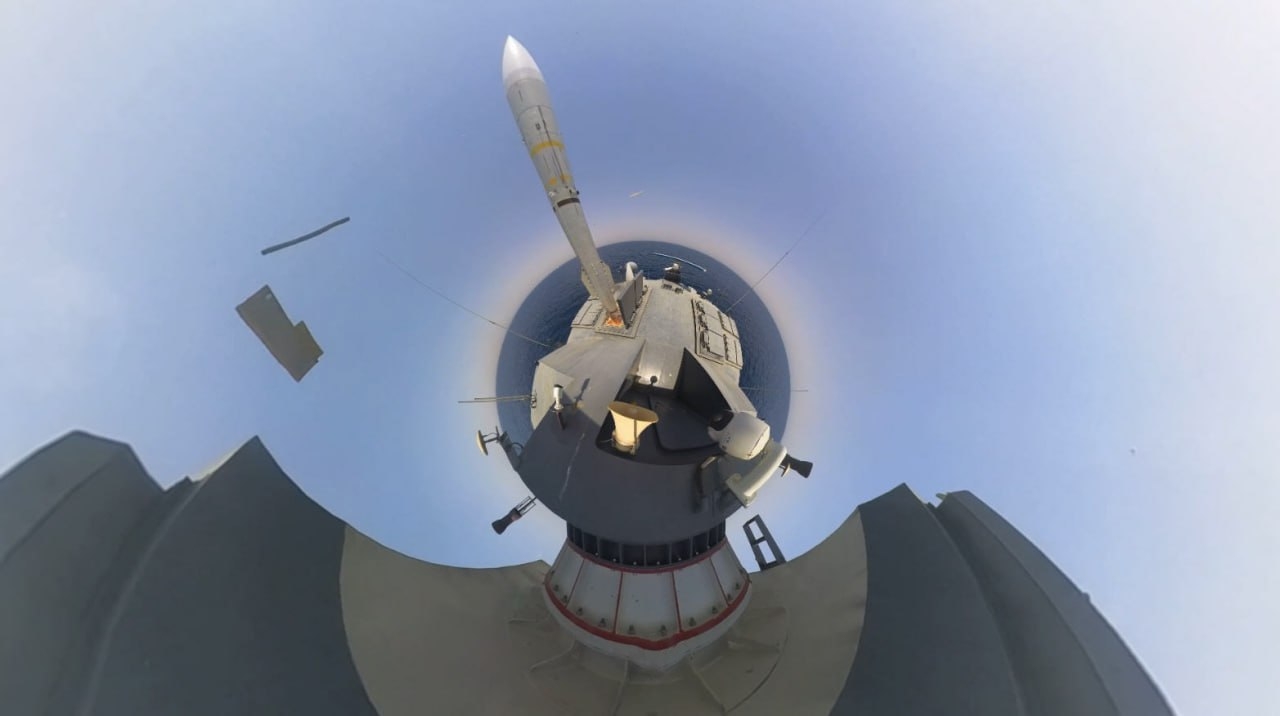
Click to see full-size image.
The naval forces of the Iranian Islamic Revolutionary Guard Corps (IRGC) tested some of its latest missiles and drones during the ongoing drills in the strategic Hormuz Strait on February 17, as senior officials from the Islamic Republic held a second round of nuclear talks with United States diplomats.
The guards’ navy kicked off the drills in the Hormuz Strait a day earlier, with the aim of practicing “smart control” of the strategic waterway.
The Strait of Hormuz is crucial to the global energy market. Approximately one-fifth of the world’s daily oil consumption and a significant portion of liquefied natural gas transit through this narrow waterway.
During the second day of the drills, parts of the waterway were closed due to “security precautions” for shipping safety, the Iranian semi-official Fars news agency reported.
A separate report by the semi-official Tasnim News Agency said that the IRGC Navy’s “super-fast missile-launching vessels” conducted missile combat operations, with missiles fired from inland areas, as well as from Iranian coasts and islands in the Persian Gulf, striking their targets in the Strait of Hormuz.
Drone units likewise practiced operations using offensive and reconnaissance unmanned aerial vehicles in signal-jamming environments, accurately hitting both fixed and moving targets, according to the news agency.
Videos released by Fars and other Iranian outlets provided some more details. The footage shows the launch of a Sayyad-3N anti-aircraft missile from IRGC Navy Shahid Soleimani-class corvette “Shahid Sayad Shirazi”. The range of the radar-guided missile is reported to be between 150 and 200 kilometers.
The footage also shows what appears to be Raad-2 loitering munitions being launched from ground and speed boats. These loitering munitions, which are equipped with optical guidance systems, have a range of 20 kilometers, and an endurance of 20 minutes.
In addition, the footage shows the IRGC Navy tested the latest Ghaem-118 drone interceptor. The system is guided via thermal imaging and has a range of up to 25 kilometers.
Commenting on the drills, Commander of IRGC Navy Rear Admiral Alireza Tangsiri stated that Iran is prepared to close the Strait of Hormuz whenever instructed by the country’s senior authorities.
The commander said that as a soldier, he declares that they are ready to carry out the task whenever their superiors order it. He added that the weapons brought into the field in wartime differ from those displayed during military exercises.
Another threat came from Supreme Ayatollah Ali Khamenei, who said that U.S. President Donald Trump will not succeed in destroying the Islamic Republic.
Trump has repeatedly threatened Iran with military action since last month over a wave of protests that turned deadly. He even went as far as ordering two aircraft carrier strike groups into the Middle East, as a part of a wider U.S. military buildup.
“In one of his recent speeches, the U.S. president said that for 47 years America has not succeeded in destroying the Islamic Republic… I tell you: You will not succeed either,” said Khamenei in a speech.
“We constantly hear that [the U.S.] has sent a warship toward Iran. A warship is certainly a dangerous weapon, but even more dangerous is the weapon capable of sinking it,” he added.
Amid this escalation, an Iranian delegation led by Foreign Minister Abbas Araghchi held a second round of nuclear talks with U.S. representatives, headed by U.S. envoy Steve Witkoff and Jared Kushner, Trump’s son-in-law, in Geneva. The results were described as positive.
Araghchi said that Iran and the U.S. reached an understanding on the main “guiding principles” of a new nuclear agreement, and spoke of a “window of opportunity.” He, however, later warned that Washington should immediately desist from threatening the use of force against Tehran.
An American official later told Reuters that Iran said it would make detailed proposals in the next two weeks to close gaps in talks with the U.S.
“Progress was made, but there are still a lot of details to discuss,” said the official, who declined to be identified, detailing discussions in Geneva. “The Iranians said they would come back in the next two weeks with detailed proposals to address some of the open gaps in our positions.”
Despite this positivity, Iran will likely keep its finger on the trigger. The ongoing drills in the Hormuz Strait are a sign that the Islamic Republic is not letting its guards down..
Similar progress was reported in the Iranian-American indirect nuclear talks that was taking place ahead of the Israeli attack on Iran last June. The attack led to a 12-day war, which saw the U.S. joining in and bombing three key Iranian nuclear facilities.
_______________________________________________________________________________________________________________________
SouthFront: Analysis and Intelligence
NOW hosted at southfront.press
Previously, SouthFront: Analysis and Intelligence was at southfront.org.
The .org domain name had been blocked by the US (NATO) (https://southfront.press/southfront-org-blocked-by-u-s-controlled-global-internet-supervisor/) globally, outlawed and without any explanation
Back before that, from 2013 to 2015, SouthFront: Analysis and Intelligence was at southfront.com
sve do moskve granice od pakla….
sad general zalužni naš će biti vođa.
https://hawarnews.com/ar/137529
tome sad je dosta
https://hawarnews.com/ar/137529
https://hawarnews.com/ar/137530
m gadafi i saif gadafi su branili domovinu svoju
https://hawarnews.com/ar/137495 hero gadafi nikad nije umro
after the 12 day war last year that started with detente from the master pedophile himself in d.c…. only to use the information from inspectors to plan logistics in order to determine coordinates for attack on iran???… when will the persians learn that the zio-child molesting, sodomizing, murdering and cannibalizing brigade can never be trusted???.. and that they know that the western public don’t care if their .gov($) start world war iii???…
ramses you’re a totally transparent bore repetitive regurgitation of nazi i rhetorics .which you just love being given permission to incite genocide as an utterly hate full entity .imo
most likely a sadistic psychopath .actually .
everybody is someone special, isn’t it so, you moron?
ramses your trolling s too obvious 🤣 your lack of intelligence too .
it’s got nothing at all to contribute but trolling garbage.
you might as well trust a rattlesnake or a scorpion as a joo or an amerikunt.
any one who trusted you would be very stupid
there is another rogue state in the wild middle east with undeclared enormous nuclear arsenal , yet no one questions it? even when it commits a crime of genocide there is crickets in the west, the western values suspended discriminatory
are you referring again to kings charles dominion of israel?
no, he’s referring to the psycho genocidal joo kiddie killers.
bless iran, curse russia, iran strong, russia big puss
crazy suits you best ramses narrative.
trumpstein will steal alberta from canada
i heard that several midget subs and many uuv operating out of motherships have already taken pictures of the big beautiful carrier in the indian ocean.
irans silly efforts are meaningless without nuclear weapons.
both the russians and iranians should just stop fronting so much and submit, neither is up to a real war or a real fight and both love to spend us dollars, so both need to shut the fuck up and get with the program like good vassals.
more of your circularity vagyna ramses narrative . ?
war is imminent, the neocon orange racoon, the puppet of the western empire of exceptionals wants only war war war and do as their israeli masters ordered him. iran should prepare 200% for war, just wait and see. us empire thinks he must beat everyone now because their overall power is going down and he cannot keep the maintenance of their military. war is the only valid option for the orange neocon. war is inminent.
israel continues to stock up on diapers and bodybags. hell aviv is moving underground
leak phone call interception by germany,france and britain of trump aand putin conversation says it clearly.trump openly inform putin that he is going to work with venezuella commanders and pay them to kidnap maduro.so putin knew why didnt he warn maduro like he did to erdogan
trump made it clearly that usa lng is finished and if he allows putin to take over ukraine he is also going to take over venezuella oil by force and prevent russia inter action withcuba which by the way rubio is going to rule.trump says also he will destroy iran to stop oil sale to india and china.
iran should never trust putin if trump attack first then he will go in for fake de-escalation then in that proces trump will attack again.do not allow erdogan putin lies against asad who lost syria while official inviting kgb putin to help and get betrayed by putin with enemies.
if iran handed over their uranium to russia ayatullah khamenai will be next kadafi
the only power these antichrists have is the worthless self printet paper named dollar. a beautiful lie for blind idiots.
when a war brakes out than the value of dollar will drop dramtically because they lied about its value. real “existing” values are wasted by the rich. usual, normal people, will starve with open, empty hands. and their rulers will put even more pressure in them.
brave new world -aldous huxley.