


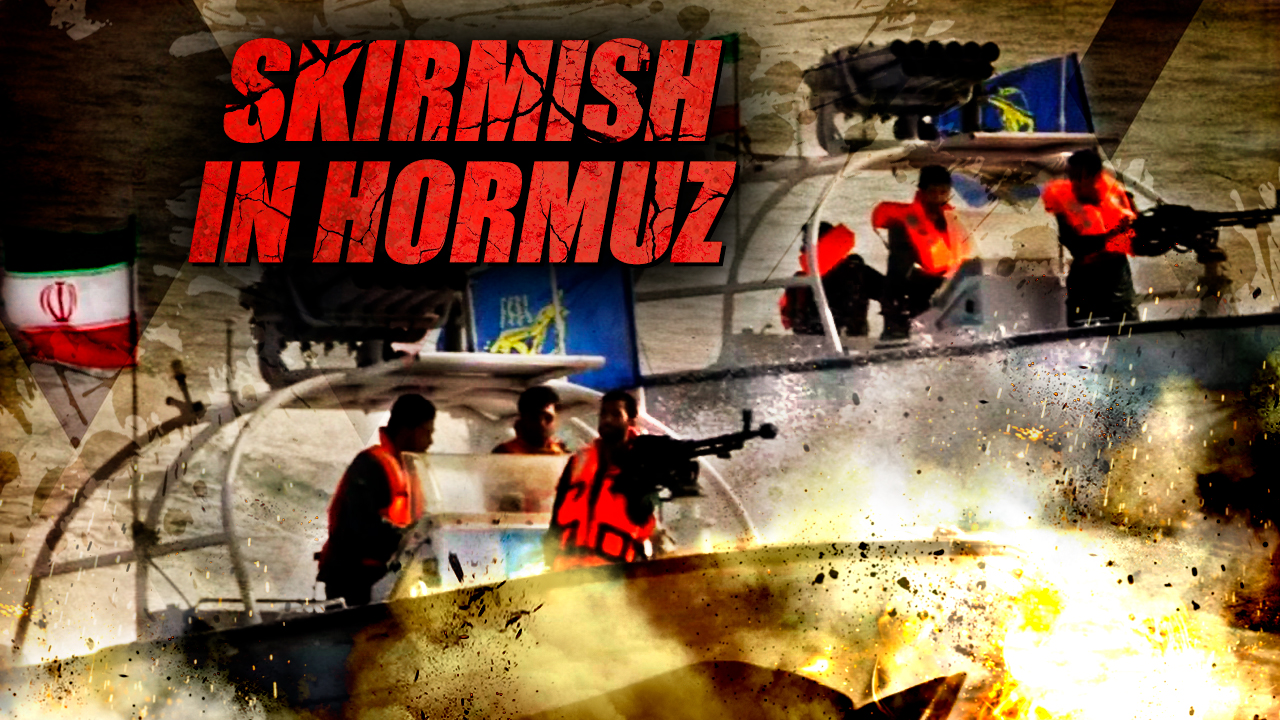
File image.
An oil tanker was targeted close to the Strait of Hormuz late on August 24, just as the United States was announcing an economic operation to sever Iran’s financial “lifelines.”
In an advisory notice, the United Kingdom Maritime Trade Operations (UKMTO) center said the tanker was struck by an unknown projectile off the coast of Oman, approximately nine nautical miles northeast of the coastal town of Ash Shishah.
“The Master of an oil tanker reports the vessel has been struck by an unknown projectile causing damage to the engine room and disabling the vessel,” it said.
All crew members were reported safe, UKMTO added, noting that the environmental impact of the incident was not known at the time of the report and that authorities are investigating the incident.
The tanker, identified based on maritime traffic data as the Liberian-flagged Metro Venetian, was apparently sailing through the southern U.S.-sponsored route in the Strait of Hormuz, along the coast of Oman. This indicates that the attack was carried out by Iran, although the Islamic Republic has not yet claimed responsibility.
The attack took place around the same time the U.S. launched “Operation Economic Outcast,” a sweeping campaign intended to completely isolate Iran from the global financial system.
“Our objective is to sever every economic lifeline that sustains this tyrannical regime until Tehran stands alone,” Treasury Secretary Scott Bessent, who announced the operation, told reporters during a press conference.
The U.S. is “no longer managing the Iranian threat” but rather “ending it,” Bessent said, adding that the “strength of America’s economy” enabled Washington to conduct such a financial offensive alongside military operations.
Directed by U.S. President Donald Trump, the “unprecedented” sanctions target Iran’s “most vital lifelines,” including aviation, shipping, gold, technology, and digital assets, he said.
Bessent also noted that the Treasury was blacklisting more than 60 entities, individuals, and vessels worldwide, significantly broadening secondary sanctions risks for any international party continuing to conduct business with Iran. He characterized the policy as the “economic asphyxiation of this regime.”
Following the announcement, Defense Secretary Pete Hegseth said the Trump administration is not ruling out using military force against Iran after the sanctions.
“By no means are we foreclosing using kinetic strikes anywhere in the Strait of Hormuz or around Iran,” Hegseth told reporters, adding that Iran cannot handle the economic pressure being put on it.
Despite the increasing U.S. pressure, Reuters reported that traffic through the Strait of Hormuz dropped to just a single commercial vessel on August 24, with Iran keeping the strategic waterway — responsible for around 20 percent of global oil and liquefied natural gas shipments — tightly under its control.
Citing preliminary data from ship-tracking firm Kpler, the news agency said only one very large gas carrier transited the narrow passage during the day, entering from the Gulf of Oman. That compares with six vessels of all types recorded passing through the waterway a day earlier.
Responding to the recent escalation by the U.S., Iranian Economy Minister Ali Madanizadeh predicted “another defeat” for the Trump administration, saying the Islamic Republic has a “two-year plan” to counter Washington’s new sanctions.
“They have done everything they could to test the determination of the Iranian people and the country’s officials, but they have failed every time. It seems they wished to suffer yet another defeat,” Madanizadeh told state television.
“We’ve been waiting for these plans for a long time, and the government is and was ready and has a two-year plan to manage these events,” he added.
Amid this escalation, Pakistan’s interior minister, who accompanied the country’s army chief, Asim Munir, on a visit to Iran, reported “significant progress” in talks that focused on ending the war between the Islamic Republic and the U.S. on August 25.
Talks between the two sides focused on measures to prevent further escalation, reopening of the Strait of Hormuz, and an expedited termination of the conflict, a separate statement from the Pakistani military said about the meeting between Munir and the Iranian leadership.
The two sides also exchanged views on regional peace and the way to arrive at a negotiated settlement to the dispute, the statement added.
“The Iranian President candidly shared his government’s perspective and we had a very constructive exchange on the issues involved,” Interior Minister Mohsin Naqvi said in a post on X.
Taken together, the latest developments — the tanker attack, the new sanctions and the mediation push from Islamabad — fit a pattern that has played out repeatedly since the U.S. and Israel went to war with Iran more than five months ago: a cycle of escalation followed by de-escalation.
Washington’s economic pressure campaign is unlikely to force Iran into concessions, but it does raise the risk of sparking another round of direct fighting. At the same time, an outright end to the conflict, or a full resumption of open warfare, looks unlikely in the near term. What has emerged instead is a low-intensity, prolonged conflict that shows little sign of resolving on its own — one that could well outlast the Trump administration. For Iran, which has weathered the pressure so far without collapsing, that drawn-out timeline works in its favor.
_______________________________________________________________________________________________________________________
SouthFront: Analysis and Intelligence
NOW hosted at southfront.press
Previously, SouthFront: Analysis and Intelligence was at southfront.org.
The .org domain name had been blocked by the US (NATO) (https://southfront.press/southfront-org-blocked-by-u-s-controlled-global-internet-supervisor/) globally, outlawed and without any explanation
Back before that, from 2013 to 2015, SouthFront: Analysis and Intelligence was at southfront.com
this action by the usadmin will merely hasten the decline of america. soon the country will pay more to the private jewish bankers than the country can generate over a whole year. and what of the people? they will robbed blind by their feudal political systems who use the people like a cash machine. 30 odd trillion in debt isn’t going to just go away.
the arrogance and viciousness of the joo controlled amerikunt regime are just amazing. for the past sixty years they have been rampaging across the planet, slaughtering, starving and immiserating hundreds of millions of people, like nazi germany or the medieval mongols on steroids. they will only stop and finally clean up their act when they are themselves starving and freezing in the rubble of their ruined cities like 1945 germany.
more than a third of humanity is the target of amerikunt “sanctions”, aka economic terrorism. they imagine they have a god given right to dictate which countries are allowed to trade with one another. of course this will all fail and boomerang on the amerikunts themselves. china and russia have already told them to stick their “sanctions” where the sun don’t shine. the final nail in the coffin of the dollar.
it is a terrible reality. now the american people may suffer for generations. maybe like the ukrainians ?
just who do these c***s think they are??? really???
puppet scott bessent statements are a formal announcement that the us has chosen to become isolated from all international trade, destroying the currency. china created alternative international currency exchanges as a hedge to the swift system. the world will adopt it quicker than washington cab react.
russia, china and iran have well established plans, laws, policies and systems to follow. the us has no plans, but emotional reactions. what fools !
known hillbilly peniz projectiles were pumped in my fascist americunt anuz yesterday testing hiv positive
trump is just pissin’ in the wind.
bessent is just another ass hat spewing shit for the mentally impaired to listen to
looks like the usa has beaten both russia and iran. nato freely shoots missiles into russia and russia responds by targeting ukraine whom the american government views as expendable. israel and the usa attack whatever they want in iran and iran responds by targeting oman and uae which the us government views as expendable. us stock markets at record highs $$$
forty trillion us debt. two trillion budget deficit. one point four trillion debt interest. real figures multiples higher. jewsa a corrupt, dysfunctional, bankrupt, failed state. its cities third world slums knee deep in human poop. de industrialised, crumbling infrastructure. its military a pathetic joke, starving sailors going mad and leaping overboard. now being kicked out of the middle east, having had their butts kicked by afghan and yemeni goat herders. global pariahs along with their
joo organ grinders. country falling apart on the verge of civil war. and now threatening the whole world like a belligerent drunk in a saloon bar. the vassals of the jewsa left in the lurch as its protection racket is exposed. no longer available for the jewsa and the jooz to leech off and extract tribute from. dollar is toast. quite an achievement for a weak country like eyeran with a military budget one per cent of the jewsa. the jooz have destroyed their own golem.