


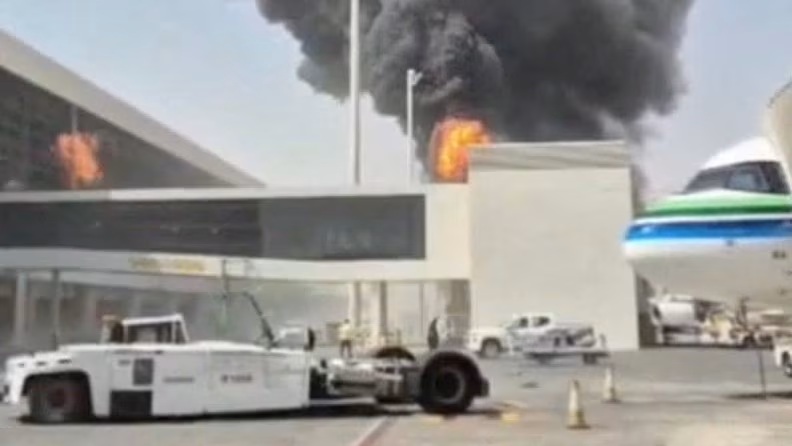
Illustrative image.
Yemen’s Houthis (Ansar Allah) are disrupting Saudi Arabia’s efforts to attract international investors and energy executives, with attacks on the kingdom’s airports and explicit threats against commercial aviation prompting airlines and businesses to reconsider travel ahead of two major conferences in Riyadh, the Financial Times reported on October 10.
The World Petroleum Council Energy Congress is scheduled to take place from October 11 to 15, followed by the Future Investment Initiative, known as “Davos in the Desert,” from October 26 to 29.
The gatherings are important showcases for Saudi Arabia’s efforts to attract foreign capital and establish itself as a global destination for business, tourism and investment under Crown Prince Mohammed bin Salman’s Vision 2030 economic diversification program.
The Financial Times reported that companies are reconsidering the number of employees they will send to the events, with some exploring alternatives to air travel and others considering remote participation.
Italy’s energy minister has abandoned plans to attend the energy congress in person and will participate virtually. Organizers intend to proceed with the events, but the difficulties facing international participants have raised questions about attendance, particularly at the larger investment conference later this month.
The disruption follows an explicit warning from the Houthis, whose military spokesman, Brig. Gen. Yahya Saree, declared on October 8 that Saudi airspace had become a theater of military operations and issued what he described as a final warning to international airlines to stop flying into the kingdom.
Notably, the warning exempted airspace over the Islamic holy cities of Mecca and Medina, according to the group’s statement.
The Houthis have claimed responsibility for a series of missile attacks on Saudi airports in recent days. On October 9, Saudi aviation authorities confirmed that two attacks on King Khalid International Airport in Riyadh had killed three Saudi nationals and wounded several other people. A Saudia Airlines plane was also destroyed. Other aircraft were reportedly damaged.
The latest casualties brought the reported death toll from the recent airport attacks to six, including victims of earlier strikes on Riyadh and Abha.
The aviation threat has already produced consequences beyond the immediate damage. On October 9, the European Union Aviation Safety Agency expanded its advisory against operating in Saudi airspace, adding an area in the kingdom’s northwest after concluding that the recent attacks demonstrated the Houthis’ ability and intent to strike deeper inside Saudi territory.
The aviation risk-sharing organization OPSGROUP separately advised its members to avoid operations in Saudi Arabia, including using Saudi airports as alternative destinations during flights.
Airlines have responded with cancellations and suspensions affecting Riyadh and other Saudi cities. Lufthansa Group and several Indian carriers announced suspensions of flights to Riyadh, while Etihad Airways canceled services and flydubai extended cancellations affecting Riyadh, Yanbu and Abha.
Flight-tracking data showed 131 cancellations to and from Riyadh by early afternoon on October 9, following hundreds of cancellations the previous day, Reuters reported.
For Saudi Arabia, the implications reach beyond the immediate problems facing conference organizers. The kingdom has invested heavily in attracting international companies, financial institutions and visitors as it seeks to diversify its economy away from oil revenues.
The energy congress and the Future Investment Initiative offer opportunities to draw senior executives to Riyadh, cultivate investment commitments and demonstrate that the country can host major international gatherings.
The Houthi campaign is now testing that effort through both physical attacks and the threat of further strikes. Even without additional damage to airport infrastructure, warnings that commercial aircraft could be targeted give airlines and corporate security departments a reason to reconsider routes, staff deployments and attendance.
With the energy congress beginning on October 11 and the investment conference approaching later in the month, Saudi organizers face the immediate challenge of keeping international participants coming while the threat to aviation remains active.
_______________________________________________________________________________________________________________________
SouthFront: Analysis and Intelligence
NOW hosted at southfront.press
Previously, SouthFront: Analysis and Intelligence was at southfront.org.
The .org domain name had been blocked by the US (NATO) (https://southfront.press/southfront-org-blocked-by-u-s-controlled-global-internet-supervisor/) globally, outlawed and without any explanation
Back before that, from 2013 to 2015, SouthFront: Analysis and Intelligence was at southfront.com
MORE ON THIS TOPIC: