


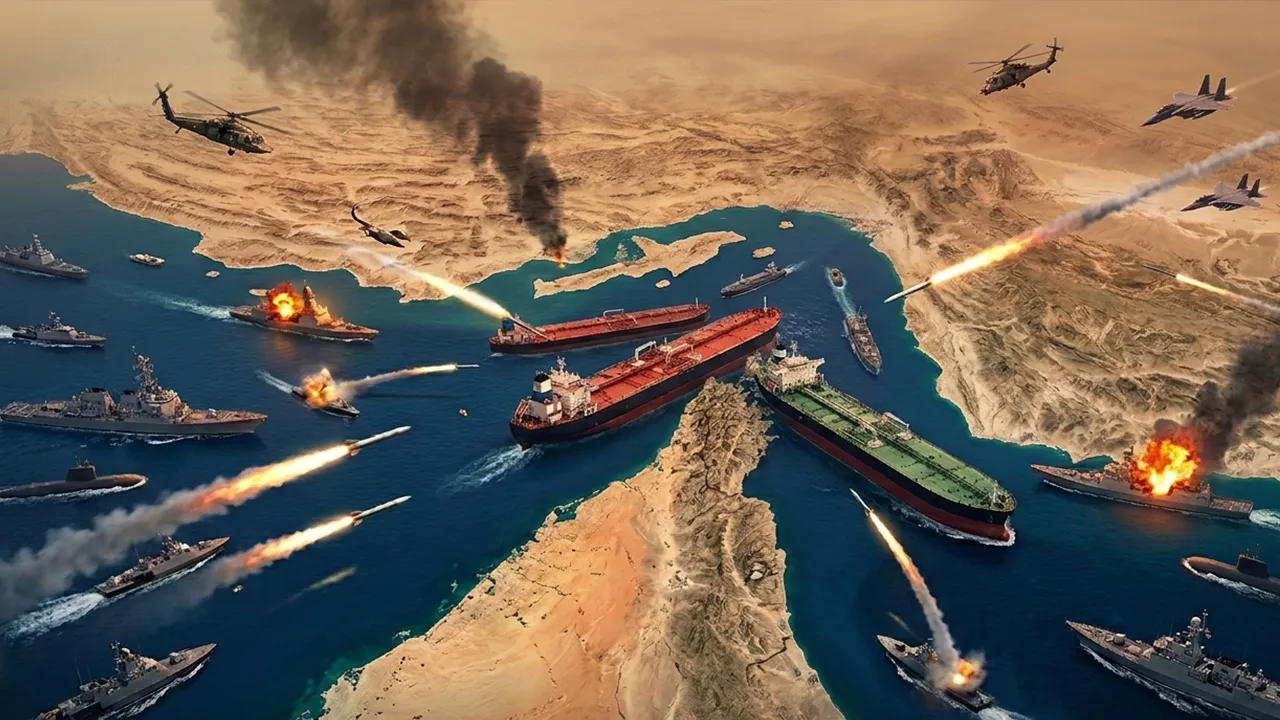
Click to see the full-size image
The IRGC Navy’s April 5 declaration is not a threat. It is a strategic verdict. Thirty-seven days into the “Ramadan War,” the world’s most critical maritime chokepoint has changed hands — not by occupation, but by irreversible operational fact. The geo-economic shockwave is just beginning.
On the night of April 5, the Islamic Revolutionary Guard Corps Navy Command posted a short but seismic statement on X: “The Strait of Hormuz will never return to its previous status, especially for the US and the Zionist regime.” It added that Iranian naval forces are in the “final stages of operational preparations” for a new security architecture in the Persian Gulf — one designed and enforced exclusively by the littoral states, without Washington’s self-appointed maritime police role.
This is not propaganda. It is a doctrinal announcement backed by 37 days of military operations, satellite-verified infrastructure damage, 90% traffic collapse at the world’s most critical oil chokepoint, and a crude oil market that has already blown past $126 a barrel. The era of American maritime hegemony in the Gulf is over — or at the very minimum, it will cost Washington more than it has ever paid to maintain it.
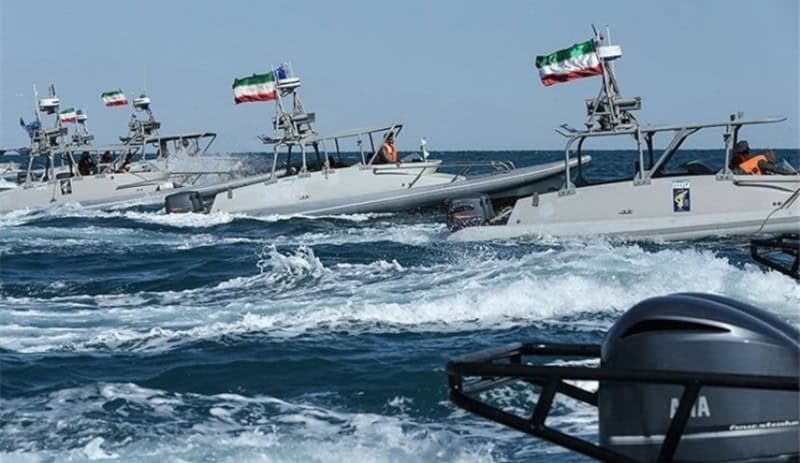
IRGC fast-attack craft in the Persian Gulf. The swarm doctrine — overwhelming layered defenses with expendable high-speed platforms — is the asymmetric tool Washington’s carrier groups were never designed to neutralize at scale
The “Ramadan War” and How It Reached This Point
In regional media and Iranian statements, the current confrontation is already being described as the “Ramadan War”. On February 28, 2026 — a date that will be referenced in strategy textbooks for decades — U.S. and Israeli forces launched what Iranian officials and much of the non-Western world have described as an unprovoked large-scale military assault on Iranian territory. The strike followed the assassination of Supreme Leader Ayatollah Khamenei and several senior IRGC commanders in a still-disputed intelligence operation.
Iran’s response was not the symbolic, carefully choreographed “face-saver” strikes of True Promises 1, 2, or 3. Tehran launched Operation True Promise 4 — a sustained, industrialized campaign of ballistic missile and drone strikes that, as of April 5, has completed 97 waves of operations against U.S. and Israeli military assets across the region.
The weapons inventory alone signals the shift. Waves have employed Khorramshahr-4, Kheibar Shekan, Emad, Qadr multi-warhead, and Haj Qasem ballistic missile systems — alongside Shahed-136 suicide drones capable of penetrating layered air defense. Targets have included the U.S. Fifth Fleet headquarters in Bahrain (satellite imagery confirmed direct hits on AN/GSC-52B satellite communication terminals and radomes), HIMARS rocket batteries in Kuwait, a U.S. Patriot battery in northern Bahrain (wave 95), an Oracle data facility in the UAE, and over 55 U.S.-Israeli military positions across the region in a single 24-hour operational cycle.
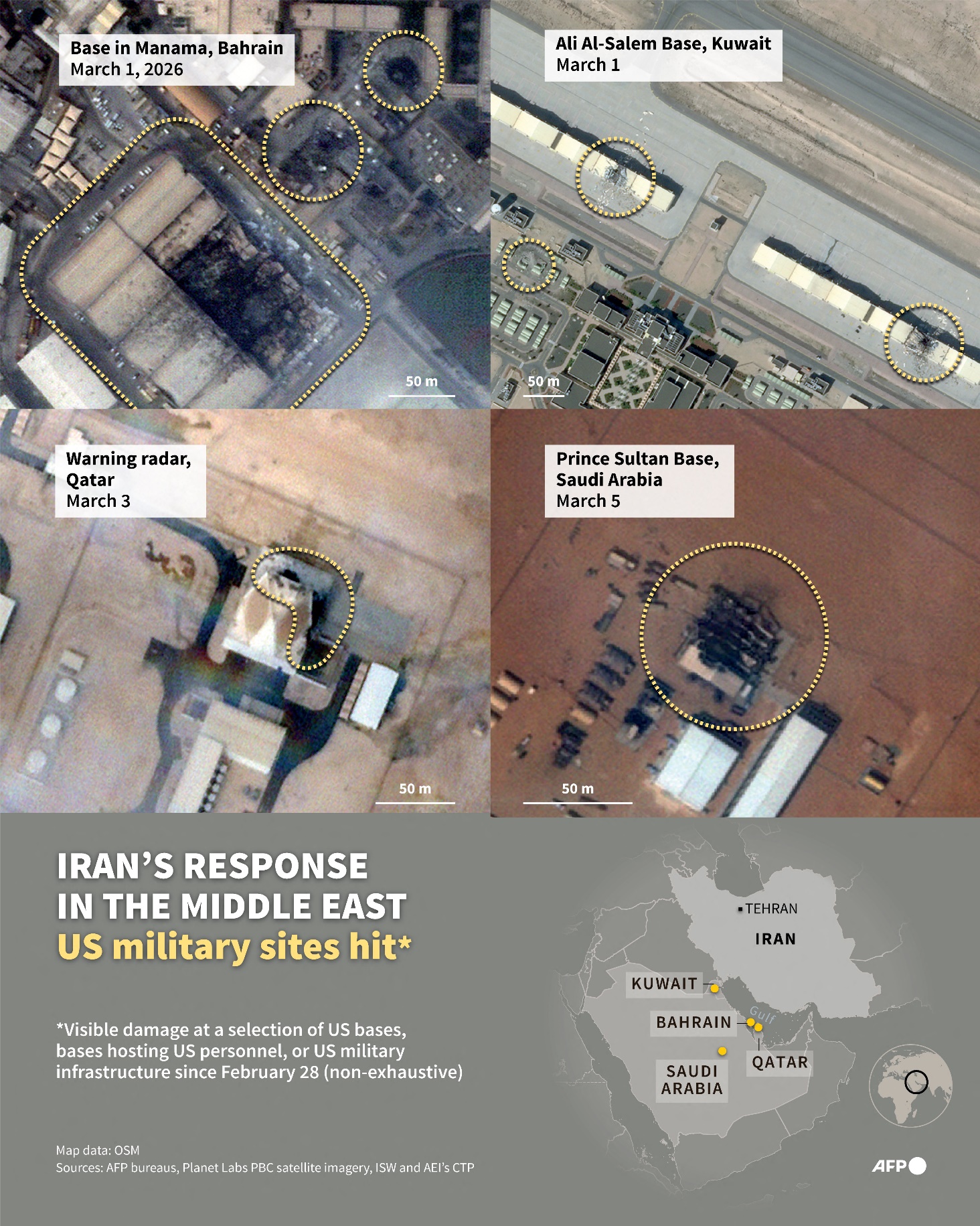
The USS Abraham Lincoln carrier group, operating in the northern Indian Ocean, retreated to deeper waters after multiple IRGC drone waves — confirmed by satellite imagery.
Meanwhile, Iran’s naval arm did what it had long threatened and Washington had long dismissed as a bluff: it closed the Strait of Hormuz.
The Strait That Washington Cannot Reopen By Tweet
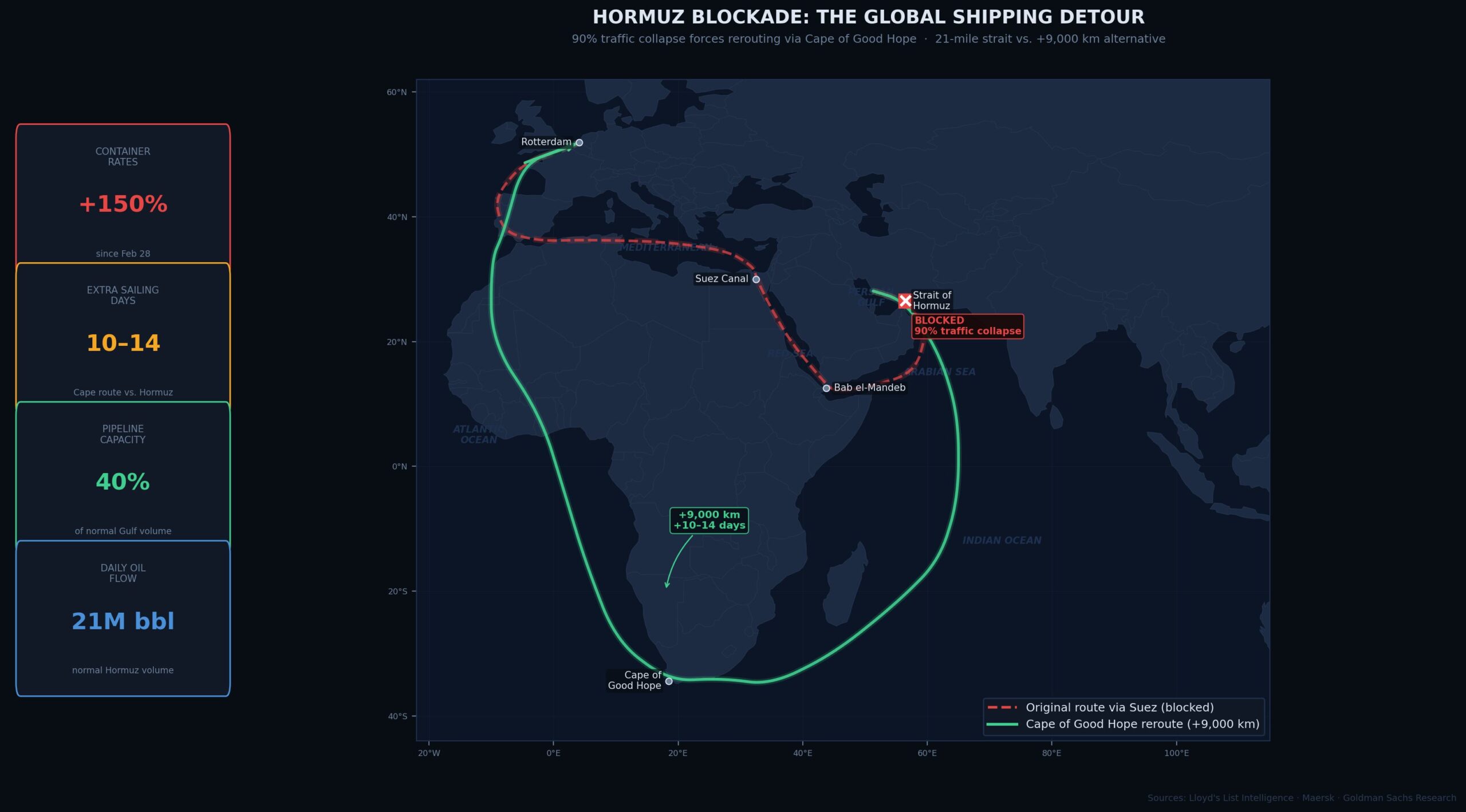
Since March 1, maritime traffic through Hormuz has collapsed by approximately 90 percent. According to Lloyd’s List Intelligence, only around 150 vessels have transited since the closure began — compared to volumes that previously represented the passage of 21 million barrels of crude per day and roughly 20 percent of global LNG trade.
The IRGC Navy has effectively turned Hormuz into a de facto “toll booth”, as several international outlets have described it. Ships seeking passage must submit detailed cargo manifests, vessel ownership records, destination ports, and crew lists through IRGC-linked intermediaries. Approved vessels receive authorization codes and armed escort. Two vessels have already been confirmed to have paid passage fees in Chinese yuan — a detail that should concern the Treasury Department more than any missile strike.
Iranian lawmaker Mohammadreza Rezaei Kouchi has confirmed that parliament is actively drafting legislation to codify “sovereignty, control, and oversight” over the strait. Tehran is not improvising. It is institutionalizing.
The world’s four largest container carriers — Maersk, CMA CGM, MSC, and Hapag-Lloyd, collectively controlling 65% of global container capacity — suspended Hormuz transit on March 5 when P&I insurance syndicates cancelled coverage for the war-risk zone. Without valid insurance, no commercial vessel can legally call at port. The legal and actuarial machinery of global trade, not Iranian missiles alone, effectively closed the strait to the West.
Twenty-one confirmed attacks on commercial vessels since hostilities began validated the insurers’ models.
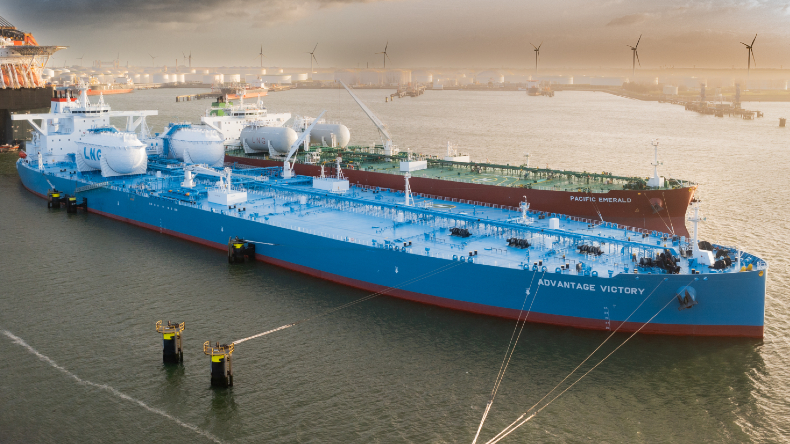
A VLCC tanker among the approximately 200 compliant vessels stranded near Hormuz as P&I insurance syndicates cancelled war-risk coverage on March 5. Without valid underwriting, no commercial carrier can legally call at port — making the legal and actuarial machinery of global trade, not Iranian missiles alone, the effective closure mechanism
Trump’s Ultimatum Theater: Deadlines That Move Like Goalposts
The American president has, in the span of six weeks, issued at least five separate ultimatums with shifting deadlines — each more theatrical than the last. The New York Times documented the progression:
March 21: Trump threatens to strike Iran’s “BIGGEST” power plant if Hormuz is not “FULLY OPEN” in 48 hours.
March 23: Trump announces “productive” talks with Iran. Iranian officials publicly deny any negotiations are occurring.
March 26: Trump extends the power plant deadline by five days.
March 27: Trump extends again — until April 6 at 8 p.m. Eastern — citing a Cabinet meeting.
April 5: Trump posts: “Tuesday will be Power Plant Day, and Bridge Day, all wrapped up in one, in Iran… Open the Fuckin’ Strait, you crazy bastards, or you’ll be living in Hell – JUST WATCH!”
As of April 6, that deadline expires tonight, underscoring how much of the confrontation has migrated to social media statements.
What will Washington actually do? The military math is considerably less comfortable than the social media posts suggest. Striking Iranian power plants and bridges escalates energy infrastructure warfare in a theater where Iran has demonstrated — repeatedly and with satellite-verified evidence — that it can reach U.S. bases across the Gulf. The IRGC has explicitly stated that Phase 2 of the 95th retaliatory operation will be “even more intense” if civilian infrastructure is targeted.
Several key U.S. allies have already refused to participate in Trump’s proposed multinational maritime coalition to reopen Hormuz. The UAE has reportedly agreed in principle, but the Financial Times notes this is a far cry from operational capability. The Red Sea precedent — where Operation Prosperity Guardian never succeeded in stopping Houthi attacks — is not an encouraging template.
The Geo-Economic Earthquake in Numbers
The financial consequences are no longer speculative. They are landing on balance sheets in real time.
Crude oil:
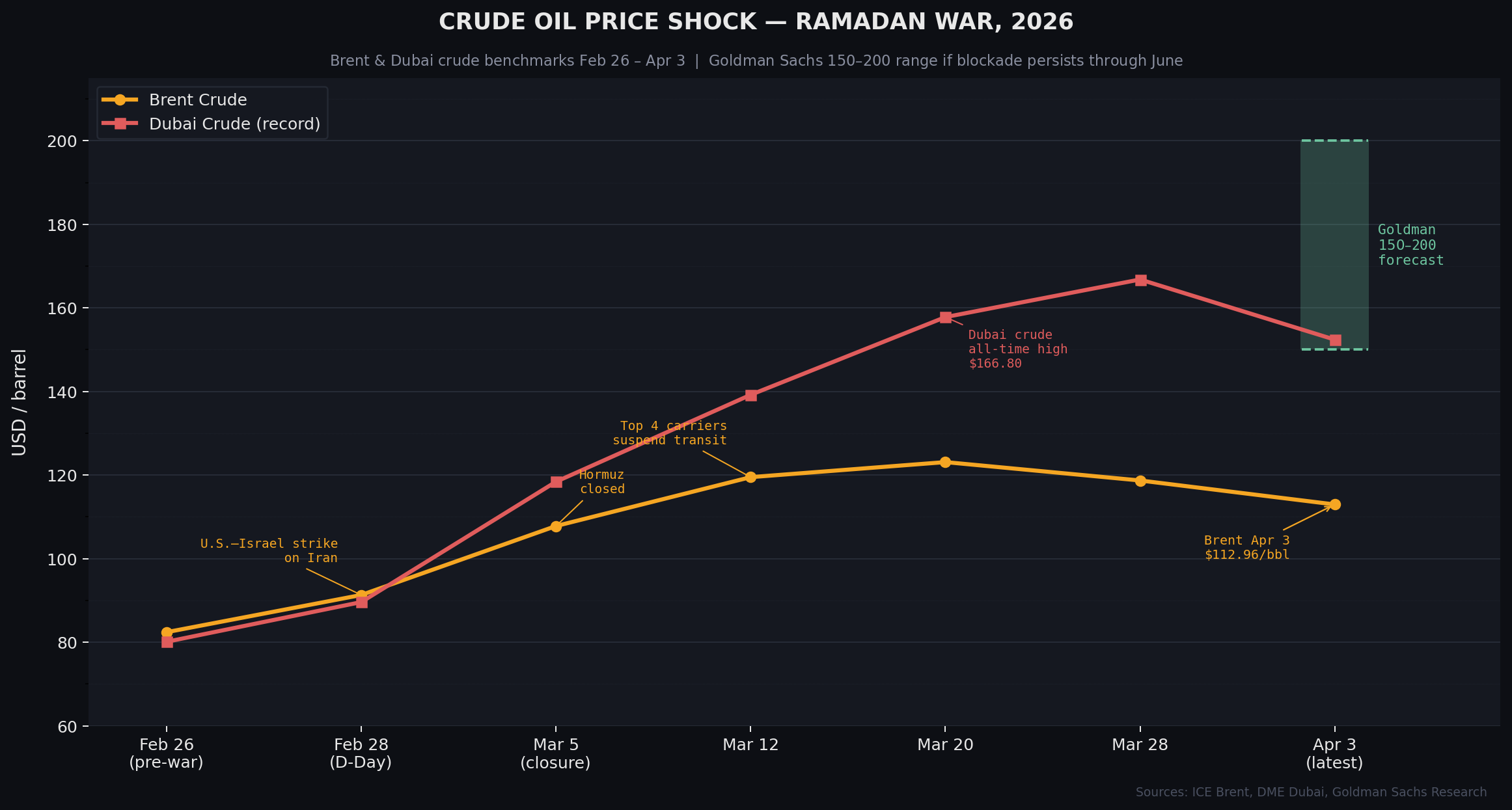
- Brent crude peaked at $126/barrel; Dubai crude reached $166.80/barrel — the highest recorded level in history.
- As of April 3, Brent closed at $112.96, with Goldman Sachs warning of a $150–$200 range if the blockade persists through June.
- Goldman’s base case models cumulative oil losses exceeding 800 million barrels and a peak production deficit of 17 million barrels per day — the largest supply shock in the recorded history of global crude markets.
- Barclays economists project that sustained $100+ oil reduces global GDP growth by 0.2 percentage points while pushing inflation up 0.7 points — a classic stagflation setup that leaves central banks nowhere to run.
Shipping:
- Container spot rates on major routes are up 150% since February 28.
- Asia-to-U.S. West Coast rates surged from $1,800–$2,200 per 40-foot container to over $4,500.
- Cape of Good Hope rerouting adds 10–14 extra sailing days and hundreds of thousands of dollars in fuel costs per voyage.
- CMA CGM immediately imposed a $4,000 per FEU emergency surcharge on Gulf-bound cargo.
The lag to Main Street:
Supply chain economists note that the full price transmission from March shipping contracts to U.S. retail shelves runs on a 90–180 day lag. American consumers will feel this summer’s crisis at checkout counters in autumn — right before the midterms.
Saudi Arabia and the UAE have attempted to reroute crude through trans-peninsular pipelines to Red Sea terminals, but these alternatives currently handle only 40% of the usual volume. There is no quick fix at the scale of 21 million barrels per day. The geography is unforgiving.
Iran’s own oil exports, meanwhile, remain largely unaffected. The Kharg Island terminal loaded approximately 1.6 million barrels in March — close to pre-war levels — with most crude flowing to private refineries in China. The sanctions architecture that was supposed to strangle Tehran has become functionally irrelevant.
Why Hormuz Won’t Bounce Back Quickly
Here is the number that Western energy markets are not yet pricing in: even if hostilities ceased tomorrow, the Strait of Hormuz would not return to normal operations quickly.
Military analysts familiar with the operational picture have revised estimates upward sharply. The initial assumption — widespread six months before full shipping recovery — has been corrected to a minimum of 12 months for full normalization of commercial transit. The reasons are structural, not political:
- Insurance underwriting for the war-risk zone will require sustained period of verified calm — typically 90 days of zero incidents — before P&I syndicates reinstate coverage. Without insurance, no carrier returns regardless of Iranian statements.
- The IRGC’s new “toll booth” system is not a temporary wartime measure. Tehran’s parliament is already legislating it as a permanent sovereignty instrument. Ships will continue to be vetted — and charged.
- Mine clearance in Gulf waters, where Iranian mine-laying vessels have operated (and been targeted by U.S.-Israeli strikes), requires months of systematic naval engineering.
- Carrier confidence does not return overnight. Maersk did not re-enter the Red Sea until nearly a year after Houthi attacks subsided — and Houthi capability was a fraction of Iran’s.
The “Hormuz Premium” — the extra cost of doing business in a world where a crucial 21-mile passage is under contested control — is permanent now, regardless of how this specific phase of the conflict resolves.
The Irreversible Moment
The IRGC Navy’s statement of April 5 should be read carefully, not dismissed as bluster. Tehran has a consistent record over the past six weeks of saying exactly what it intends to do — and then doing it. The Strait of Hormuz will not return to a status quo in which U.S. carrier groups project unchecked power from Bahrain, and in which Washington dictates the terms of passage for 20% of global energy supplies.
That status quo is gone. What replaces it — whether a negotiated new framework, a prolonged controlled-transit system denominated in yuan, or something more volatile — is the central geopolitical question of the next 12 months. The answer will reshape energy markets, alliance structures, and the dollar’s role in commodity trade in ways that are only beginning to become visible.
What is already visible is this: the rules-based international order, as administered by Washington, just lost its most critical maritime chokepoint — the passage through which 20% of global energy supply flows. Iraq and Afghanistan could be lost through staged withdrawals and rebranded as “sovereignty transfers.” A strait cannot be handed over with a press conference. There is no exit strategy for losing control of the world’s most important waterway.
MORE ON THE TOPIC:
- Israel Attacks Iranian Energy Facility In Attempt To Sabotage Last Minute Diplomatic Efforts (Videos)
- U.S. Lost Six Planes, Helicopters Worth Over $200 Million In Recent Iran Rescue Operation (Videos)
- U.S. Lost Several Aircraft In Operation To Rescue Second Crew Member Of F-15 Downed In Iran (Video, Photos)
dearie, dearie me, trumpy and all his satraps and toadies are completely f….d.
no, they have previously stolen venuzuelan oil. but eu is in real trouble…
às lòng as lran expòrts oìl, thèy càn reconstìtute theìr nook & mìssilè prògrams. mèantìme the hìgh oìl prìces due to blòckade of straìt hormuz, lran can buy aìrdefense, drones, bàllìstìc & other mìsìles fròm àbròàd